
California Civil Code section 682 lists the four ways two or more people can own property together: as joint tenants, as partners, as tenants in common, or as spouses holding community property. Which of the four applies decides whether a co-owner can file a partition action to force a sale. For joint tenants and tenants in common, which covers most co-owned houses from Orange County to San Jose, the answer is yes, as a matter of right.
Full Text of Civil Code 682
The ownership of property by several persons is either:
(a) Of joint interest.
(b) Of partnership interests.
(c) Of interests in common.
(d) Of community interest of spouses.
California Civil Code section 682 (amended by Statutes 2016, chapter 50, section 7, effective January 1, 2017)
The Four Forms of Co-Ownership Under Civil Code 682
Section 682 names the four categories. The sections that follow it in the Civil Code define each one:
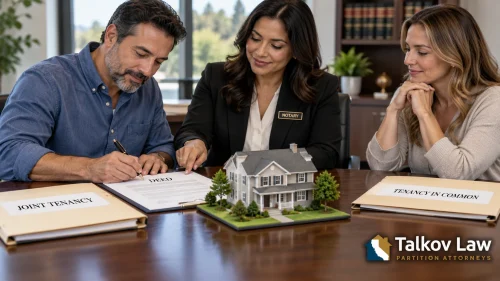
- Joint interest (joint tenancy). Two or more owners hold equal shares with a right of survivorship. Under Civil Code 683 on how a joint tenancy is created, the deed or will must expressly declare a joint tenancy.
- Partnership interests. Civil Code section 684 defines a partnership interest as “one owned by several persons, in partnership, for partnership purposes.” The partnership, not the individual partners, owns the property.
- Interests in common (tenancy in common). Civil Code section 685 defines an interest in common as “one owned by several persons, not in joint ownership or partnership.” Tenants in common can hold unequal shares, and there is no right of survivorship. See what tenancy in common means.
- Community interest of spouses. Property a married couple acquires during the marriage is generally community property, which belongs to both spouses equally.
When the document that creates the ownership does not pick one of the four, Civil Code 686 makes tenancy in common the default. That is why most siblings who inherit a house, friends who buy together, and unmarried partners are tenants in common.
How Courts Apply Civil Code 682
In Wilson v. S.L. Rey, Inc. (1993) 17 Cal.App.4th 234, three people bought 156 acres in Bonsall, in San Diego County, as tenants in common. When a lender later took one owner’s 28 percent share through foreclosure, the trial court concluded the lender took the share not as a tenant in common but as a joint venturer.
The Court of Appeal called that legal conclusion “erroneous.” It began with section 682, explaining that ownership of property by several persons is one of the four listed forms. It then held that an interest not expressly declared a joint tenancy or a partnership interest is held in common, because “California favors tenancy in common, contrary to the common law favor of joint tenancies.” (Wilson v. S.L. Rey, Inc. (1993) 17 Cal.App.4th 234, 242.) The court added that “[t]enancy in common merely requires, for creation, equal right of possession or unity of possession.” (Ibid.) A buyer who steps into a co-owner’s share becomes a tenant in common with the remaining owners.
What Each Form of Co-Ownership Means for Partition
The category in section 682 decides which partition rules apply:
- Joint tenants and tenants in common can partition as of right. Under Code of Civil Procedure section 872.710, “partition as to concurrent interests in the property shall be as of right unless barred by a valid waiver.” Neither form requires the other owners’ agreement, and either owner can force the sale of jointly owned property.
- Partnership property follows a different path. Under Code of Civil Procedure section 872.730, the court may apply the partition statutes to partnership property when it finds them a suitable remedy and the partnership’s unsecured creditors will not be prejudiced.
- Spouses cannot partition their community property. Code of Civil Procedure section 872.210 bars a partition action “between spouses or putative spouses for partition of their community or quasi-community property.” The family court divides it instead. Former spouses who still share title after the divorce, and anyone who co-owns with a married couple, can still partition, as our post on divorce and the co-owned house explains.
How to Tell Which Form Applies to Your Property
Start with the vesting language on the recorded deed, the words after the owners’ names:
- “As joint tenants” means a joint tenancy.
- “As tenants in common,” often with each owner’s percentage, means a tenancy in common.
- “As community property” or “husband and wife” points to community property.
- Title in a partnership’s name means partnership property.
- Nothing after the names, for unmarried owners, means a tenancy in common under Civil Code 686.
Most buyers choose this wording on the escrow vesting worksheet. The deed is strong evidence of how title is held, but it is not always the final word on each owner’s share. In a partition, “all parties’ interests in the property may be put in issue regardless of the record title.” (Milian v. De Leon (1986) 181 Cal.App.3d 1185, 1195–1196.)
Common Questions About Civil Code 682
Is a “Joint Interest” the Same as a Joint Tenancy?
Yes. Section 682 uses the older term “joint interest,” and Civil Code 683 defines a joint interest as one declared to be a joint tenancy. Our comparison of joint tenants vs. tenants in common covers the practical differences.
Can a Joint Tenant Force a Sale Like a Tenant in Common?
Yes. Both are concurrent interests, so both carry the right to partition under CCP 872.710. See our guide to joint tenancy in California.
My Ex and I Were Never Married. Is Our House Community Property?
No. Community property exists only between spouses and registered domestic partners. Unmarried partners are joint tenants or tenants in common, and either one can file for partition. See our page on ex-boyfriend and ex-girlfriend property disputes.
Every Form of Co-Ownership Has a Way Out
Civil Code section 682 tells you what kind of co-owner you are. For joint tenants and tenants in common, that answer comes with a right to end the co-ownership, whether or not the other owners agree.
Talkov Law can help. With 12 full-time partition attorneys and experience in over 650 partition actions throughout California, our team handles every step of the process, from proving how title is held through the partition sale and the final distribution of proceeds. No fees until you win. Call (877) PARTITION (727-8484) today or contact us online for a free 30-minute consultation.