

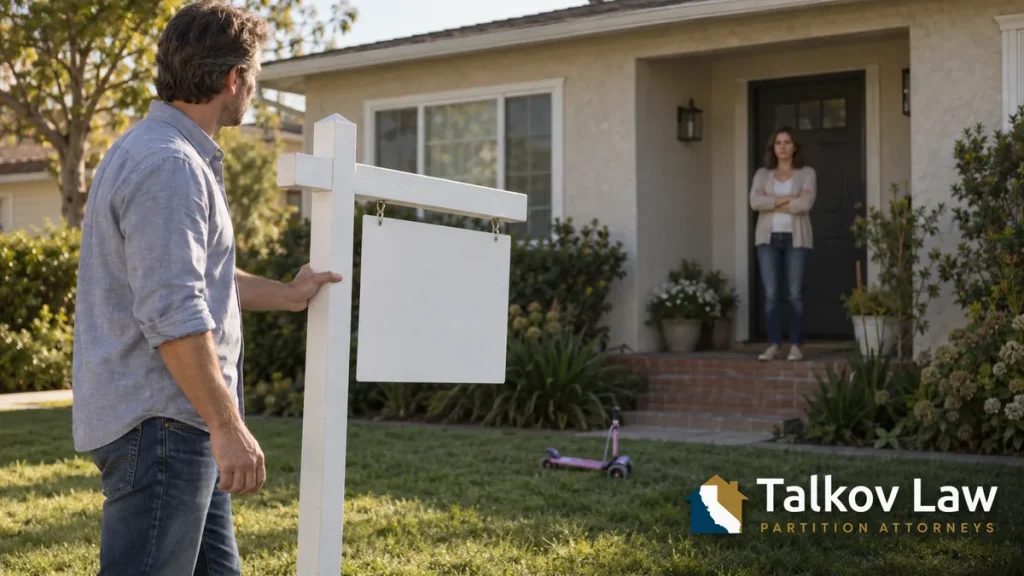
An ex-spouse who stays in the former family home cannot block a sale by recording a homestead. In Squibb v. Squibb (1961) 190 Cal.App.2d 766, a divorced wife who lived in the house with the children filed a declaration of homestead almost two years after the divorce. The Court of Appeal held that the homestead was no defense, and the Los Angeles County home was ordered sold in a partition action.
Why Squibb v. Squibb Matters
- A homestead does not stop a partition. Between co-owners, a homestead gives the person living there no more rights than they already had.
- After the divorce, your ex is just a co-owner. Once the marriage ended, the court treated the ex-wife like any other co-owner of the house, with the same co-owner rights and no more.
- Living there with the children did not change the result. The court ordered the home sold even though the ex-wife and children lived in it.
- A divorce that leaves out the house leaves partition open. When the divorce decree said nothing about the home, the ex-husband could still use partition to sell it.
The Facts: A Divorce That Never Dealt With the House
Daniel and Alma Squibb took title to their home as joint tenants while they were married. Alma sued for divorce, and the final decree was entered on October 28, 1957. Neither the interlocutory nor the final divorce decree said anything about who would use or own the house. Alma and the children kept living there. The house had a loan against it and, as a practical matter, could not be physically divided.
On October 23, 1959, almost two years after the divorce, Alma filed a declaration of homestead on the house. On December 4, 1959, Daniel sued her for partition and sale. Alma answered that her homestead was a defense. The trial court struck that defense and entered an interlocutory judgment ordering the house partitioned and sold. Alma appealed.
How the Court of Appeal Decided the Case
Alma asked the court to read the homestead law broadly to prevent Daniel “from breaking up her home by forcing a sale of the premises.” (Squibb, at p. 768.) The court declined.
The Divorce Made Her a Co-Owner, Not a Spouse
The court started with the facts that made the case simple. The house was held in joint tenancy, it could not be partitioned without great prejudice, and Daniel and Alma were no longer married. When Alma recorded her homestead, “her relation to respondent was solely that of co-tenant and a third party.” (Squibb, at p. 768.) The court noted that cases letting a married woman place a homestead on property she held with her husband did not apply, because Alma was no longer married when she recorded hers.
A Homestead Does Not Affect the Other Co-Owner
Each joint tenant owns an undivided one-half interest in his or her own right, and either may record a homestead on that interest. But a homestead mainly protects the owner from creditors. It does not take anything from the other co-owner:
“But as between co-tenants, a homestead interest does not affect the rights, interests or estates of persons holding adversely or collaterally.”
Squibb v. Squibb (1961) 190 Cal.App.2d 766, 769
The person claiming the homestead keeps only the right of possession they already had, and the other co-owner “may sell or assign his undivided share.” (Squibb, at p. 769.) If he objects to his co-owner, his remedy is partition, and when the property cannot be divided without great prejudice, it may be sold.
The Law Was “Now Clear”
Relying on an earlier Court of Appeal case in which a creditor who bought a husband’s share at an execution sale won the right to partition a home the wife had homesteaded, the court concluded: “The law is now clear that a statutory homestead interest does not deprive the co-tenant of the right to have the common property partitioned and sold.” (Squibb, at p. 770.) The judgment ordering the sale was affirmed. The same rule appears in Priddel v. Shankie, where a co-owner’s homestead on his own half could not stop the sale of a Los Angeles lot.
The Law Today
Squibb was decided under the partition and homestead statutes in effect in 1961. Today, Code of Civil Procedure section 872.710 provides that partition between co-owners “shall be as of right unless barred by a valid waiver,” and CCP 872.820’s rule on ordering a sale lets the court sell a home that cannot be fairly divided. The declared homestead now appears in the Code of Civil Procedure’s rules on enforcing money judgments, beginning at CCP 704.910.
A homestead is not a waiver of partition, and under CCP 872.710 only a valid waiver can bar the right to partition. For other arguments an ex may raise, see partition action defenses in California and why fairness is not a defense to partition.
What Squibb v. Squibb Means for Divorced Co-Owners
- You can force the sale of the former family home. If your divorce left you and your ex both on title, you can force the sale of the house through partition.
- A homestead declaration is not a reason to wait. Your ex’s homestead does not stop the case, and filing first puts you in control of the timeline.
- Your ex living there does not end your rights. If your ex refuses to sell while living in the property, you may also be able to claim rental value in the partition. A partition sale can also get a co-owner out of the house.
- A buyout is still possible. Many cases end with one co-owner buying the other out; see buying out a co-owner in California.
- Paying the mortgage alone? See what you can do when a co-owner is not paying the mortgage, whether you can get back what you paid, and how offsets, credits and reimbursements work.
Still on Title With Your Ex?
Squibb v. Squibb shows that a former spouse who stays in the house cannot hold it forever. A partition action lets the court order the home sold by a partition referee and the proceeds divided.
Talkov Law can help. With 12 full-time partition attorneys and experience in over 650 partition actions throughout California, our team handles every step, from filing the partition action through the referee’s sale and the final distribution of proceeds. Call (877) PARTITION (727-8484) today or contact us online to get started.







