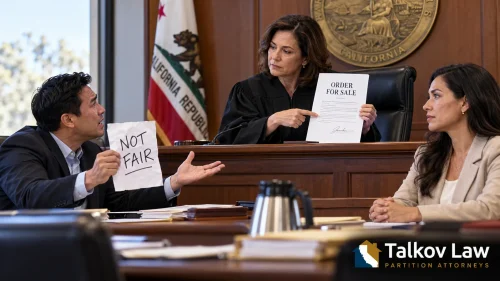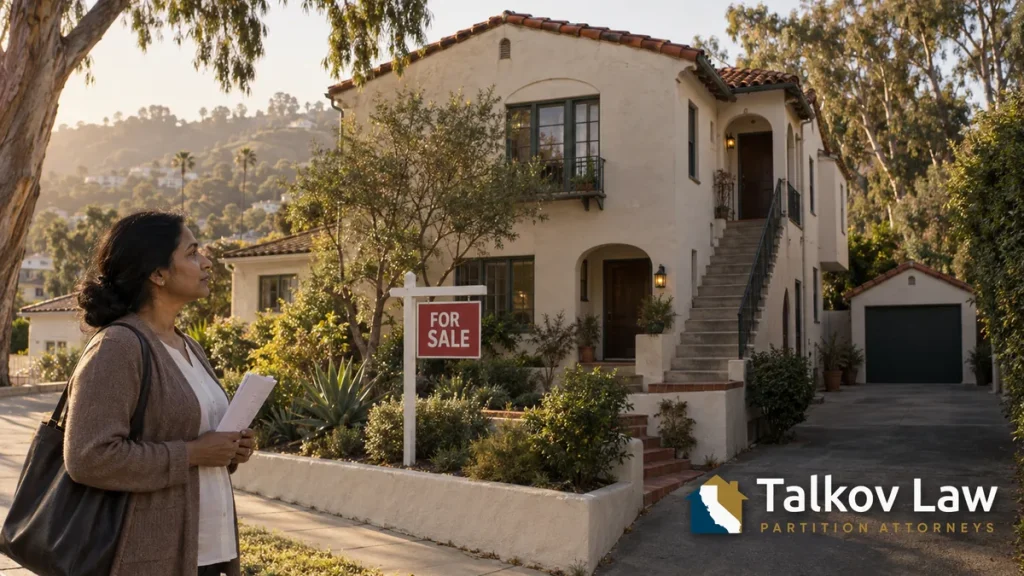
A co-owner cannot avoid a partition sale by proposing to turn a duplex into condos or to keep both owners locked into a tenancy-in-common agreement. In Caiozzo v. 2672 to 2674 North Beachwood Drive, LLC, an unpublished 2023 opinion, the Court of Appeal affirmed that a family trust had the right to partition a Los Angeles duplex it co-owned with an LLC (limited liability company).[1] Back in the trial court, the judge then ruled in 2024 that a sale was more equitable than dividing the building.
Why Caiozzo Matters
- The right to partition held up on appeal. The LLC argued the trust had not proven its case. The Court of Appeal affirmed the interlocutory judgment of partition.
- “Fairness” is not a defense. The court refused to follow a 1976 case defendants cite for a fairness defense, because it was decided under the old partition statute.
- A duplex is rarely divisible. On remand, the court found a condo conversion would leave the owners sharing walls, land, the garage and utilities, which defeats the purpose of partition.
- A rent-free relative did not change the result. The LLC blamed the trust for letting a relative live in a unit rent-free. The court treated that as a money issue for the accounting, not a reason to deny a sale.
The Facts: A Family Duplex Since 1962, Half Owned by an LLC
The property was a two-story duplex on North Beachwood Drive in Los Angeles, with a downstairs unit, an upstairs unit, and a detached garage with parking for each. It had been in the extended Williams family since 1962. In 1965, two branches of the family took title to equal one-half interests.
One half passed into the Harry A. Williams Family Trust. After Harry Williams died in 2020, his daughter, Cally Williams Caiozzo, became sole trustee. The other half went to Dino Williams’s family trust. After he died in 2014, his children moved that half through a series of transfers that ended with the defendant LLC.
Caiozzo filed a partition action in May 2021 seeking a sale. The LLC answered with defenses of waiver, unclean hands, estoppel, laches and failure to do equity.
How the Court of Appeal Decided the Case
The Right to Partition Comes First
Code of Civil Procedure section 872.710 makes partition of concurrent interests a matter of right unless a valid waiver bars it. Under CCP 872.710’s right to partition, the trial court found Caiozzo entitled to partition, without yet deciding whether the duplex would be sold or divided. CCP 872.720 on the interlocutory judgment allows exactly that sequence: right first, manner later, as Summers v. Superior Court explains.
The parties then stipulated to an interlocutory judgment of partition so the LLC could appeal immediately. The Court of Appeal affirmed. Caiozzo had established her standing as trustee and the trust’s ownership through the 1984 deed, and the LLC had not raised a triable issue on the only defense that can bar the right itself: waiver.
The “Fairness” Defense Rests on a Repealed Statute
The LLC relied on American Medical International, Inc. v. Feller (1976) 59 Cal.App.3d 1008. The court rejected that reliance:
“Because AMI does not address section 872.710, it does not guide our analysis.”
Caiozzo, 2023 WL 7485496, at *6
In plain terms, AMI was decided under the pre-1976 partition statute, which did not make partition a matter of right. Our post on why fairness is not a defense to partition covers this line of cases.
The court sent the case back for the trial court to weigh the LLC’s other equitable arguments when choosing between a sale and a physical division.
On Remand: Sale Was the Only Real Option
In September 2024, the trial court granted Caiozzo’s motion for summary adjudication of the LLC’s remaining defenses.[2]
Condos would not end the co-ownership. Caiozzo’s expert explained that a condo conversion would still leave the owners sharing the exterior walls, garage, land and utilities, and would require major structural work and 12 to 14 months of permitting at a likely cost above the property’s value. The court agreed:
“In other words, the parties would remain co-owners which defeats entirely the purpose of a partition.”
Caiozzo, tentative ruling of Sept. 16, 2024
That tracks Butte Creek Island Ranch v. Crim, which recognized that physical division is often impractical for urban property.
A tenancy-in-common agreement can’t be forced on a co-owner. The LLC proposed keeping both owners on title under a TIC (tenancy-in-common) agreement governing the common areas. Caiozzo refused, and that ended it. “Unfortunately for Defendant, there is no TIC agreement,” the court wrote. As in Cummings v. Dessel, a court cannot invent a partition method the statutes don’t provide.
The rent-free relative was an accounting issue. Caiozzo’s stepbrother lived upstairs without paying rent under an oral arrangement. The court held he was a tenant at will whose tenancy any owner could end at any time, and that lost rent could be handled through offsets after the sale. Our post on rental value claims against a co-owner in possession explains how those offsets work. The court concluded:
“Plaintiff has demonstrated as a matter of law that partition by sale is more equitable than a division in kind.”
Caiozzo, tentative ruling of Sept. 16, 2024
The Result
The trust won the right to partition on appeal. On remand, it showed that a sale under CCP 872.820 on sale instead of division was more equitable than splitting the duplex.
What Caiozzo Means for California Co-Owners
- Duplexes and small multi-unit buildings usually can’t be split. Shared walls, roofs and utilities make partition by sale the realistic outcome.
- An LLC co-owner is still a co-owner. When an LLC holds title as a tenant in common, it gets no extra protection against partition.
- You don’t have to keep sharing. Saying no to a TIC agreement is enough.
- Rent disputes are settled after the sale. Unpaid rent and similar claims go through offsets in the final accounting.
- The right to partition is absolute. See why the right to partition is absolute unless a valid waiver bars it.
Co-Own a Duplex You Want to Sell? Start With the Right to Partition
If you co-own a duplex or other multi-unit building and the other owner won’t sell, a partition action is how you end the co-ownership.
Talkov Law can help. With 12 full-time partition attorneys and experience in over 650 partition actions throughout California, our team handles every step of the process, from proving your right to partition through the referee’s sale and the final distribution of proceeds. Call (877) PARTITION (727-8484) today or contact us online for a free 30-minute consultation.
References