

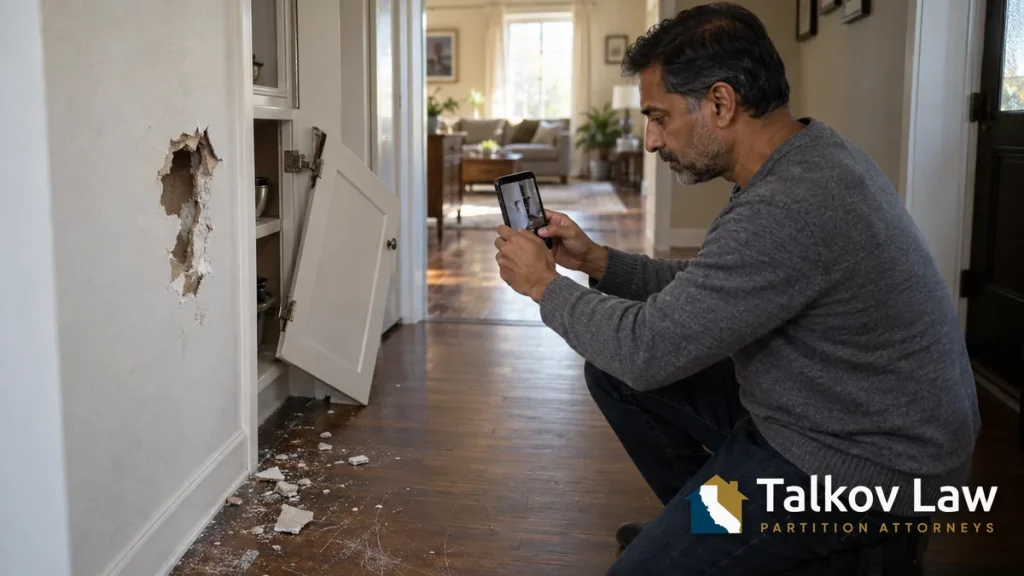
If your co-owner damages the property, California law may provide remedies. But this is not something a partition action itself is expected to cause. In over 650 partition cases, Talkov Law has never seen a co-owner deliberately damage a property because a partition action was filed. If damage does occur, Code of Civil Procedure section 732 (CCP 732) may allow a person aggrieved by waste to bring an action, with treble damages possible. A partition court may also issue orders to prevent waste and may make an equitable accounting. These are distinct remedies, and none is automatic.
What is “waste” in California?
“Waste” is a legal term for conduct that harms real property and another person’s interest in it. It can involve an affirmative act, such as destroying or removing part of a building, or an omission, such as allowing serious deterioration to continue. California courts explain that the doctrine protects owners of interests in the same land from harmful conduct affecting the property. Cornelison v. Kornbluth (1975) 15 Cal.3d 590, 597–598.
Not every disagreement about repairs, remodeling, or maintenance is waste. The court looks at what happened and its effect on the property and the other owner’s interest. In Smith v. Cap Concrete, Inc. (1982) 133 Cal.App.3d 769, 775–778, the court discussed the importance of harm to the property’s value; the case involved concrete debris that substantially and permanently impaired the land. Ordinary wear, a disputed but beneficial repair, or a difference of opinion about upkeep does not by itself establish a waste claim.
Can I sue my co-owner for waste?
Potentially. CCP 732 specifically names a joint tenant or tenant in common who commits waste. A person aggrieved by the waste may bring an action, and the statute says the court may enter a judgment for treble damages. That is a possible statutory remedy—not a guaranteed award. You must prove that the conduct qualifies as waste and establish the resulting harm. A claim for treble damages should be evaluated and pleaded carefully based on the facts.
Read the text of CCP 732 on waste by a co-owner.
Can a court stop more damage before it happens?
If a partition action is pending, Code of Civil Procedure section 872.130 (CCP 872.130) authorizes the court to issue a temporary restraining order or injunction to prevent waste, protect the property or its title, or stop unlawful interference with a court-ordered partition. The statute gives the court authority to act; it does not mean an injunction issues automatically whenever one co-owner alleges damage. The party asking for an order needs evidence of the conduct or threatened harm and must follow the applicable court procedures.
Learn more about CCP 872.130’s rule on restraining orders and injunctions in a partition action. When the property is in danger of being lost or materially injured, the court can also appoint a receiver in the partition action to take charge of it while the case is pending. If damage is happening now or appears imminent, speak with a California partition attorney promptly about the available relief.
How does property damage affect a partition accounting?
In a partition action, Code of Civil Procedure section 872.140 (CCP 872.140) allows the court to order an allowance, accounting, contribution, or other compensatory adjustment between the parties according to equitable principles. Depending on the evidence and claims properly before the court, the alleged damage may be relevant to that accounting.
An accounting under CCP 872.140 is different from a waste action under CCP 732. CCP 872.140 does not itself promise reimbursement for every repair estimate or treble damages. The court considers the parties’ competing charges and credits and the proof supporting them. Read CCP 872.140’s rule on compensatory adjustment and learn more about accounting and offsets in partition actions.
What evidence should I preserve?
- Photographs and video: Record the property’s condition as soon as it is safe. Capture wide views and close-ups, keep the original files, and note the date and location.
- A timeline: Write down when you first noticed the damage, what changed, who had access, and any communications about the work or condition.
- Independent inspection and repair records: For significant damage, ask a qualified contractor or inspector to describe the condition and the work needed. Keep estimates, invoices, receipts, and reports.
- Evidence of value: If the harm may have affected the property’s value, consider whether an appraiser or other qualified professional should evaluate that issue.
- Ownership and agreement documents: Preserve the deed, co-ownership agreements, and any written approvals or restrictions about repairs, alterations, or use.
- Insurance records: If a loss may be covered, report it promptly and keep the policy, claim number, adjuster communications, inspection records, and any written coverage decision. Follow the policy’s notice and inspection requirements.
Take reasonable steps to prevent immediate additional loss, but preserve evidence before cleaning up or making non-emergency repairs when it is safe to do so. Avoid retaliation, changing locks, removing fixtures, or taking other self-help measures that could create a separate dispute.
Does damage change my right to partition?
Damage to the property does not, by itself, resolve who owns what or end co-ownership. A partition action is the court process for dividing jointly owned property or ordering its sale. The court may address related accounting issues, and a separate waste claim may also be available when the statutory requirements are met. Which claims and requests belong in a particular case depends on its facts and procedural posture.
For related issues, see Wallace v. Daley and partition accounting, what happens when a co-owner refuses to sell, what to do about a hoarding co-owner, crime at a co-owned house, and selling after a fire, flood, or earthquake when a co-owner wants to rebuild.
Is this likely to happen during a partition?
Our experience should be reassuring: deliberate property damage by a co-owner is not an expected consequence of a partition case. A lawsuit does not make a home more susceptible to a fire, storm, earthquake, plumbing failure, or another natural or accidental hazard. Those risks exist whenever property is owned, whether or not the co-owners are in a dispute or a partition action is pending.
Insurance may cover some losses, but there is no blanket answer for every peril or every policy. Coverage depends on the cause of the loss, the policy language and endorsements, exclusions, limits, and deductible. Earthquake and flood damage may require separate coverage. A policy may also treat an intentional act by someone who qualifies as an insured differently from an accidental or natural hazard. Do not assume a loss is covered or excluded without checking the policy and getting a coverage decision from the insurer. The California Department of Insurance explains that the actual policy determines coverage and offers a homeowners coverage comparison tool. See also its guidance on earthquake insurance and flood insurance.
Whether insurance responds to a loss and whether a co-owner is legally responsible are separate questions. If property is damaged, promptly document it and contact the insurer or agent to ask how to report the claim.
Talk to a California partition attorney
If a co-owner has damaged or is threatening to damage jointly owned real estate, the evidence and timing can matter. Talkov Law handles partition actions involving California real property. Call 877-PARTITION (877-727-8484) to discuss whether a partition action, an injunction, or a waste claim may apply.
This article provides general information, not legal advice. It does not create an attorney-client relationship. The proper claim and available remedies depend on the specific facts and applicable law.







