

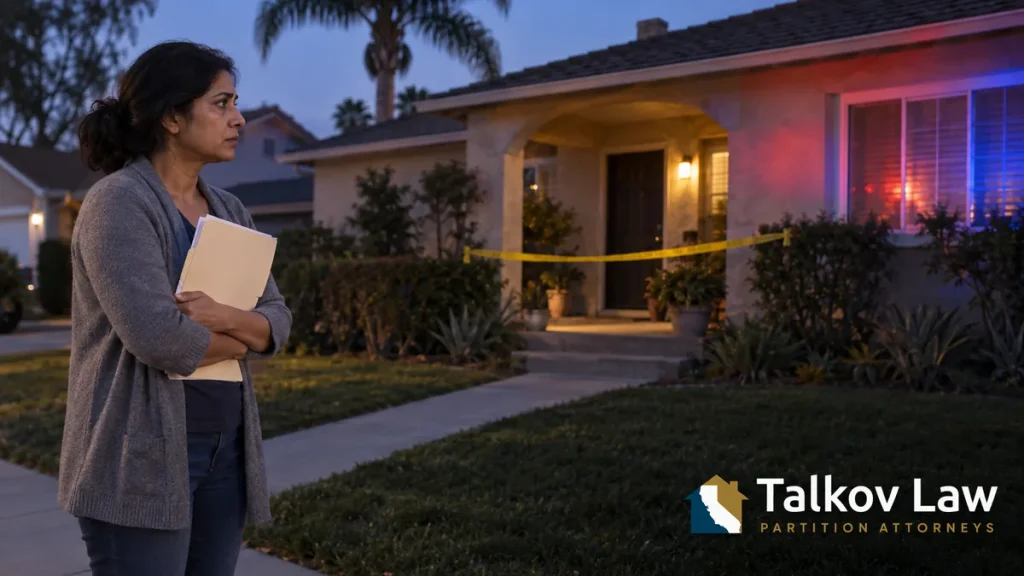
When crime is happening at a house you co-own, such as drugs being sold out of it, you don’t have to wait for it to stop, whether it comes from your co-owner, their friends, or a tenant your co-owner rented the house to. In California, any co-owner can ask a court to order the property sold, even if the other owner refuses. That lawsuit is called a partition action. You don’t need a criminal conviction, you don’t have to prove who committed the crime, and what is happening at the house gives your co-owner no way to stop the sale.
Acting quickly matters here more than in most co-ownership disputes, because crime at a house puts the house itself at risk, along with everyone whose name is on the deed.
Why Crime at the House Is Your Problem Too
Criminal charges are personal, but the property is shared. When crime happens at a co-owned house, the innocent owner can be pulled in:
- The house can be declared a nuisance property. Under Health and Safety Code section 11570, a building used to sell, store, or manufacture illegal drugs is a nuisance that can be shut down, and damages can be recovered. The law targets the building, so it doesn’t matter whether the dealing is done by your co-owner, a guest, or a tenant. If the nuisance is proven, Health and Safety Code section 11581 allows the court to order the building closed for a year. A closure falls on every owner, not just the one causing the problem.
- Forfeiture can come up. California’s drug forfeiture law, Health and Safety Code section 11470(g), generally protects a family residence, and property owned by two or more people where one of them had no knowledge of the unlawful use. Once you know what is going on, you should not count on that protection standing in for action.
- The value drops. Police activity, damage, and a reputation in the neighborhood make the house harder to sell and lower what buyers will pay. Every month it continues comes out of your share.
What Doesn’t Work
Calling the police may end a single incident, but officers usually won’t remove someone whose name is on the deed. You generally can’t evict a co-owner, and changing the locks can be treated as an ouster that makes you owe them rent. If your co-owner is violent or threatening, a restraining order may get them out of the house, but it doesn’t end the co-ownership. Only a sale or buyout does that.
Can I Force the Sale If Crime Is Happening at the House?
Yes. Under Code of Civil Procedure section 872.710(b) (CCP 872.710(b)), partition of co-owned property “shall be as of right unless barred by a valid waiver.” California treats the right to partition as absolute. The crimes don’t have to be proven to a judge, it doesn’t matter who committed them, and a criminal case doesn’t have to end first. The partition stands on its own.
California courts have long pointed co-owners in exactly this direction. As the Court of Appeal put it in Young v. Hessler (1945) 72 Cal.App.2d 67, 70, quoting the California Supreme Court:
“If he objects to his cotenant, his remedy is by partition.”
Young v. Hessler (1945) 72 Cal.App.2d 67, 70
When a house can’t be divided fairly, which is almost always true of a single-family home, Code of Civil Procedure section 872.820 (CCP 872.820’s rule on sale and division of proceeds) allows the court to order partition by sale. A court-appointed partition referee handles the sale, so you don’t need your co-owner’s signature or cooperation, and the occupants can be removed for the sale. If you would rather keep the house, you may be able to buy out your co-owner in the partition action.
What If It’s Their Friends or Their Tenants?
Friends and guests. Every co-owner has the right to use the whole property, as the California Supreme Court held in Johns v. Scobie (1939) 12 Cal.2d 618, 623, and that includes inviting people over. You can’t simply ban your co-owner’s friends from a house they have a right to be in. If a guest threatens you, a restraining order can keep that person away, and once a partition action is filed, the court can issue orders to protect the property itself.
Tenants. A common version of this problem: one co-owner controls the property and rents the whole house to a single tenant, and that tenant is selling drugs out of it. The co-owner who signed the lease is usually the landlord, so the tenant answers to them, not to you, and you may have had no say in who moved in. Removing a problem tenant takes an eviction, and a co-owner who is happy collecting the rent may not bother. You are still entitled to your share of that rent. In Rutledge v. Rutledge (1953) 119 Cal.App.2d 114, 120, the Court of Appeal explained that a co-owner “may maintain an action requiring his cotenant to account for rents collected for the use of the property by third persons.” When the property is being mismanaged, the court can also appoint a receiver to take over its management during the case.
Can the Court Protect the House While the Case Is Pending?
Yes. Code of Civil Procedure section 872.130 (CCP 872.130’s rule on restraining orders and injunctions) gives the court power to act before the sale:
“In the conduct of the action, the court may issue temporary restraining orders and injunctions, with or without bond, for the purpose of: (a) Preventing waste. (b) Protecting the property or title thereto.”
CCP 872.130
“Waste” means damage that lowers the property’s value. When criminal activity threatens the house, the court may also appoint a receiver to take control of the property while the case is pending. Filing also lets you record a lis pendens, a notice that warns anyone dealing with the property that its title is in court.
Can I Get Back What Their Conduct Cost Me?
Every partition ends with an accounting of who paid what. Code of Civil Procedure section 872.140 (CCP 872.140’s rule on compensatory adjustment) provides:
“The court may, in all cases, order allowance, accounting, contribution, or other compensatory adjustment among the parties according to the principles of equity.”
CCP 872.140
That accounting is where you ask for credit for the mortgage, property taxes, insurance, and repairs you covered, for what you spent fixing damage done at the house, and for your share of any rent your co-owner collected from tenants. A co-owner who has been living in the house while you pay for it can also be charged its rental value in some cases. Our guide to partition offsets and credits explains how these claims are proven, so keep receipts, police reports, and photos of the damage.
When the Problem Is Addiction or Jail
Crime at a house often comes with other problems. If your co-owner is struggling with drug addiction, or has already been arrested and your co-owner is in jail or prison, the path is the same: a partition action lets the court order the sale without their signature.
Get Out Before the Damage Grows
Waiting rarely helps when crime is involved. The house loses value, the legal risks grow, and your co-owner, their guests, and their tenants have no reason to change. Filing a partition action puts a judge, deadlines, and a neutral referee in charge, and many co-owners agree to a sale or buyout once they see the court can order one.
Talkov Law can help. With 12 full-time partition attorneys and experience in over 650 partition actions throughout California, our team handles every step of the process, from filing through the referee’s sale and the final distribution of proceeds, with no fees until you win. Call (877) PARTITION (727-8484) today or contact us online to get started. We represent co-owners across California, including in Los Angeles, Orange County, San Diego, Riverside, Sacramento, San Francisco, and San Jose.







