

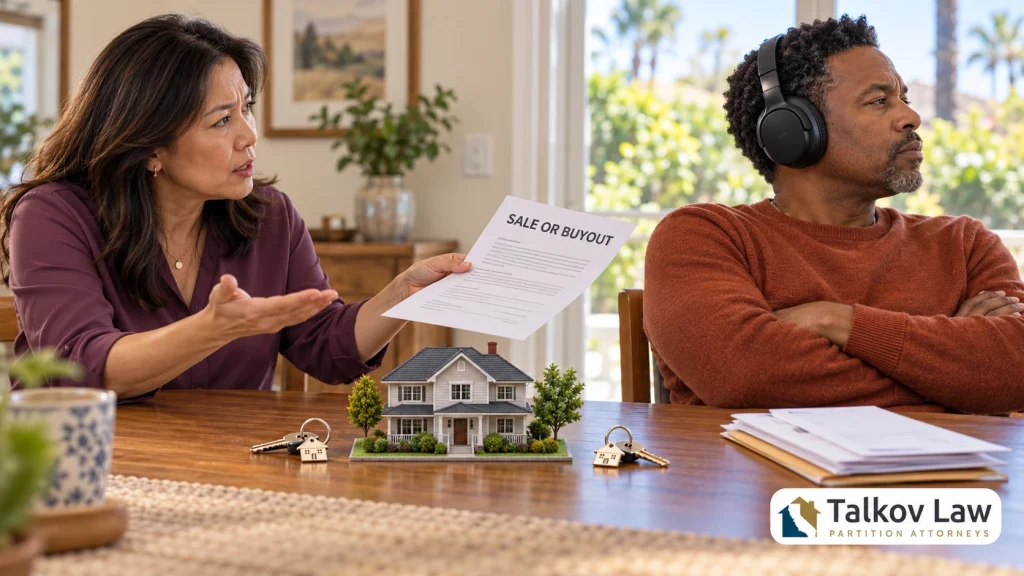
When a co-owner refuses to communicate about selling jointly owned property, California law allows you to force a resolution through a partition action. For the co-owner seeking a resolution, this lack of response can feel like being trapped in a situation with no clear path forward. That feeling is common, but your co-owner’s silence cannot stop a partition action. Based on Talkov Law’s completed-case data, the average partition action resolves in seven to nine months.
Is your co-owner ignoring you about a sale or buyout? You can force a resolution through a partition action. Get a free 30-minute consultation or call (877) PARTITION (727-8484). No fees until you win.
Why Co-Owners Refuse to Communicate
It is common for co-owners to avoid communication when there is a disagreement about whether to sell the property. In many cases, one co-owner may believe that ignoring the situation will delay or prevent a sale altogether.
This “silent treatment” can leave the co-owner who wants to sell feeling stuck, especially when mortgage payments, maintenance, or property taxes continue to accrue. However, your co-owner refusing to communicate does not stop your legal rights as a co-owner.
Sending a Formal Letter Before Filing a Partition Action
Before filing a lawsuit, one effective step is to have a partition attorney send a formal letter warning of a partition action on your behalf. This approach signals that the situation is serious and that legal action may follow if the issue is not resolved.
A letter from an attorney can:
- Show that you are prepared to take legal action
- Clearly explain your absolute right to partition under California law
- Outline the financial and legal consequences of continued inaction
- Provide an opportunity to resolve the dispute without litigation
In many cases, this step alone is enough to prompt a response from an otherwise unresponsive co-owner.
Filing a Partition Action in California
If your co-owner continues to refuse communication, filing a partition action may be the most effective solution.
California law is clear that co-owners have a right to force the division or sale of property.
California Code of Civil Procedure section 872.710(b) (CCP 872.710(b)) states that partition of real property “shall be as of right unless barred by a valid waiver.”
This means that even if your co-owner ignores you entirely, the court can step in to resolve the dispute. In most cases, this results in a partition by sale, where the property is sold and the proceeds are divided among the co-owners.
What Happens If Your Co-Owner Ignores the Lawsuit?
Ignoring or delaying a partition lawsuit does not stop the case. In fact, it can significantly harm the unresponsive co-owner.
If a co-owner fails to respond after being served with a partition complaint, the court may enter a default partition judgment. A default judgment occurs when a defendant fails to appear in the action, which can result in the court granting the relief requested.
Once a default is entered, the non-responding co-owner may lose the ability to participate in the case, and the court can proceed toward ordering the sale of the property by way of a partition referee.
Take Action to Resolve a Co-Ownership Dispute
A co-owner’s refusal to communicate can be frustrating, but it does not prevent you from moving forward. California law provides a clear path to resolution through a partition action, even when the other party refuses to engage.
Talkov Law has 12 full-time partition attorneys and has handled 650 partition actions throughout California. Call (877) PARTITION (727-8484) or contact us online to get help resolving your co-ownership dispute.








