

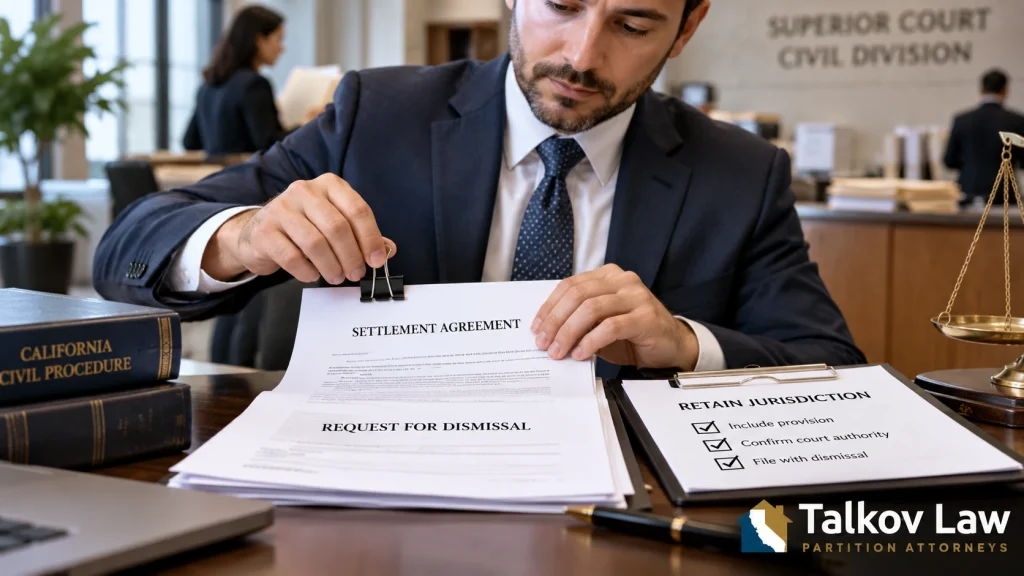
Do Not Dismiss the Partition Until the Settlement Has Closed
Most partition actions end in a settlement after filing: a buyout, an agreed sale, or a sale with an agreed split of proceeds. Negotiated settlements are common, but a signed settlement is not a finished one. The money moves at the close of escrow, sometimes months later. If the plaintiff’s attorney dismisses the case when the settlement is signed, the court that could have enforced it is gone.
What Code of Civil Procedure Section 664.6 Allows
Code of Civil Procedure section 664.6 lets a court enter judgment on a settlement that the parties sign or state orally in court. Since January 1, 2025, it also lets the court dismiss the case without prejudice and keep jurisdiction “until performance in full of the terms of the settlement” when the parties or their counsel stipulate to that in writing or orally before the court.
An attorney can sign a settlement on the client’s behalf, and an attorney who signs without the client’s express authorization risks professional discipline. After a notice of conditional settlement, the court can also set a hearing on its own motion on whether to dismiss the case and retain jurisdiction.
Why a Retention Clause in the Settlement Agreement Is Not Enough
In Mesa RHF Partners, L.P. v. City of Los Angeles (2019) 33 Cal.App.5th 913, the attorneys filed dismissal forms stating that the court “shall retain jurisdiction to enforce settlement” under section 664.6, and the clerk entered the dismissals. Years later, the plaintiffs moved to enforce the settlements. The Court of Appeal held the trial court had no jurisdiction, because no one had asked the court to retain it before the dismissal. The settlement agreements were never presented to the court, and the court refused to treat the dismissal forms as that request.
Mesa required the request to come from the parties themselves. The 2025 statute says “the parties to the settlement agreement or their counsel.” Until a published decision reconciles the two, have every co-owner sign.
Three Ways to Handle the Dismissal in a Partition Action
- Keep the case open until the settlement is consummated. File a notice of settlement, but do not file the dismissal until the buyout has closed, the deed is recorded, and the money is paid. If a co-owner defaults first, a motion to enforce can still be heard in the same case.
- File the dismissal as part of the escrow closing. Have the plaintiff sign the request for dismissal in advance and deliver it with the escrow instructions, to be filed only when escrow closes. The instructions should say who files it, when, and whether it is with prejudice.
- If the dismissal cannot wait, ask the court to retain jurisdiction first. Before the dismissal is filed, file a stipulation and proposed order signed by the parties, or use the Judicial Council’s revised dismissal form, which offers a “without prejudice, court retaining jurisdiction” option. The request must be in front of the court before the dismissal.
Keep the Lis Pendens Until the Deal Closes
The lis pendens protects the property while the case is pending. Withdraw it at closing, not at signing. Under Code of Civil Procedure section 405.50, the notice of withdrawal must be acknowledged, so schedule the notary with the escrow signing, including by remote online notarization.
If the Case Is Already Dismissed
Section 664.6 is no longer available. The settlement is still a contract, and the remedy is a new action for breach of contract, with a new filing fee and service. The lis pendens that protected the property in the first case will be gone. This is one reason co-owner settlement agreements need careful drafting from the start.
Checklist for Settling a Partition Action
- Every co-owner signs the settlement and any request to retain jurisdiction.
- The settlement states the escrow deadline, who pays costs, and what happens on default.
- The dismissal is held until closing or filed through escrow.
- The lis pendens stays until closing.
- The closing and the last payment are calendared, because retained jurisdiction runs until full performance.
Talkov Law can help. With 12 full-time partition attorneys and experience in over 650 partition actions throughout California, our team helps co-owners end disputes over jointly owned real estate. Call (877) PARTITION (727-8484) today or contact us online to get started.








