

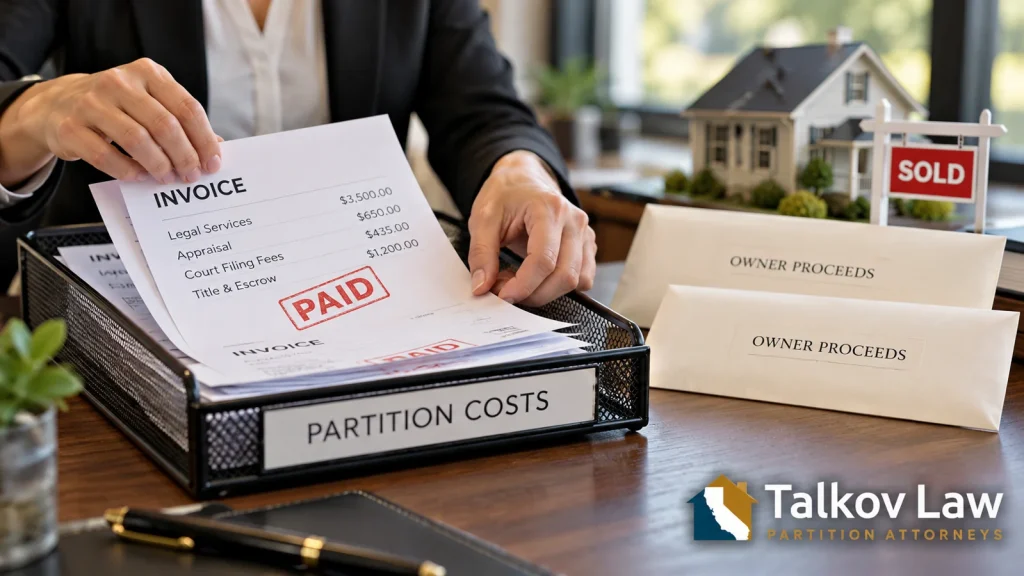
California Code of Civil Procedure section 874.110 (CCP 874.110) sets the timing for paying the costs of a partition action. The court can order the costs, as it has apportioned them, paid in whole or in part before judgment, and any costs still unpaid must be listed in the judgment. It is one of the California partition statutes on paying the costs of partition.
Full Text of CCP 874.110
(a) The costs of partition as apportioned by the court may be ordered paid in whole or in part prior to judgment.
(b) Any costs that remain unpaid shall be included and specified in the judgment.
California Code of Civil Procedure section 874.110 (added by Statutes 1976, chapter 73)
What CCP 874.110 Means for Paying Partition Costs
Most costs of partition are paid at the end. When the property is sold, CCP 873.820 applies the sale proceeds to the costs of partition before anything goes to the co-owners. Section 874.110 gives the court two more tools. Under subdivision (a), it can order the co-owners to pay their apportioned costs earlier, such as a deposit the partition referee needs before marketing the property. Under subdivision (b), whatever is still unpaid when the case ends goes into the judgment, so it is enforceable.
A cost listed in the judgment becomes a lien on the responsible co-owner’s share under CCP 874.120 and can be collected under CCP 874.140.
Example: A Referee Deposit One Co-Owner Will Not Pay
The court orders two equal co-owners to fund a $5,000 deposit for the referee before the sale, $5,000 ÷ 2 = $2,500 each. One pays; the other does not. When the house sells, the referee’s fees are paid from the proceeds first. If any of the second co-owner’s $2,500 share is still unpaid at the end, the judgment lists it, and it comes out of that co-owner’s share.
The Assembly Legislative Committee Comment on CCP 874.110
The Assembly Legislative Committee’s 1976 comment on section 874.110 reads:
Section 874.110 supersedes portions of former Section 796. While subdivision (a) requires payment by the parties, it should be noted that, in the case of sale of the property, the proceeds are to be applied first to discharge the costs of partition before disbursement to the parties. Section 873.820.
Subdivision (b) requires the judgment to list only amounts remaining unpaid rather than all amounts apportioned to the parties under the former provision. See also former Section 798.
The judgment referred to in this section and is Sections 874.130 and 874.140 is the judgment entered at the conclusion of the case in the trial court.
Assembly Legislative Committee Comment to Code of Civil Procedure section 874.110 (1976)
Common Questions About CCP 874.110
Do I Have to Pay Partition Costs Before the House Sells?
Only if the court orders it. Most costs are paid from the sale proceeds at closing. Subdivision (a) lets the court order earlier payment when it is needed to move the case forward.
What Happens to Costs That Are Never Paid?
They must be included and specified in the judgment, become a lien on that co-owner’s share, and can be enforced like a money judgment under CCP 874.140.
Where CCP 874.110 Fits in the California Partition Statutes
CCP 874.110 is part of Chapter 8 of the California partition statutes, which covers the costs of partition. Article 1 decides what counts as a cost and who bears it: 874.010 lists the costs of partition, 874.020 adds expenses from related cases that protect title, 874.030 allows interest on payments made at the court’s direction, 874.040 apportions the costs among the co-owners, and 874.050 deals with the share charged to a future interest.
Article 2 covers payment. Under section 874.110 the court can order costs paid before judgment and must list any unpaid costs in the judgment, 874.120 makes those costs a lien with top priority on the responsible co-owner’s share, 874.130 allows a sale to pay cost liens, and 874.140 lets the person owed the costs enforce the judgment. When the property is sold, CCP 873.820 pays the costs of partition from the sale proceeds before the co-owners receive their shares.
Talkov Law Partition Attorneys Can Help
Getting costs paid on time keeps a partition moving. When a co-owner refuses to pay their share, the statutes give the court ways to order it and collect it.
Talkov Law can help. With 12 full-time partition attorneys and experience in over 650 partition actions throughout California, our team handles every step of the process, from the complaint and the court-ordered sale through the final accounting and the distribution of proceeds. Call (877) PARTITION (727-8484) today or contact us online to get started.








