

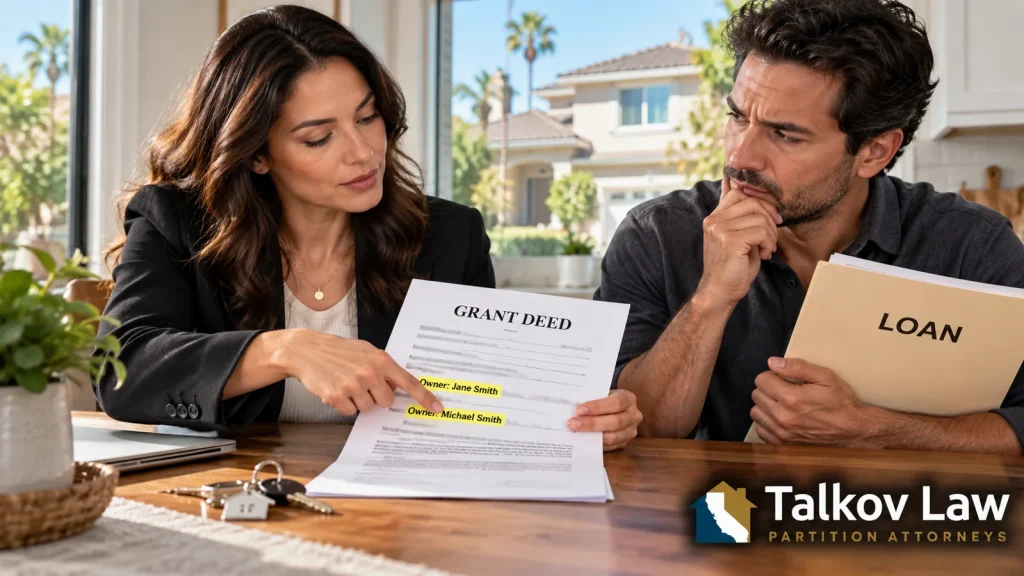

Yes. If your name is on the deed, you are a co-owner, even if your co-owner says you were “just a co-signer” added to help get the loan. Courts rarely accept that argument, because California presumes the deed is correct and makes the co-owner who says otherwise prove it by clear and convincing evidence. As a co-owner, you can file a partition action to force a sale or buyout and get your share. Who owns what matters in a partition because of the requirement that an interlocutory judgment of partition find “the interests of the parties in the property….” Code of Civil Procedure section 872.720(a) (CCP 872.720(a)). This refers to “the statute’s plain requirement that the parties’ ownership interests be determined” in the interlocutory judgment. Summers v. Superior Court (2018) 24 Cal.App. 5th 138, 143.
Co-Signer vs. Co-Borrower vs. Co-Owner
These three words get mixed up, but they mean different things:
- Co-signer: signs the loan and promises to pay if the borrower does not. A co-signer owns nothing unless their name is also on the deed.
- Co-borrower: shares the loan and the payments, and is usually on the deed too.
- Co-owner: anyone named on the deed, whatever their role on the loan.
The deed decides who owns the house, not the loan. Once a co-signer is added to the deed, the law treats them as a co-owner.
Is a Co-Signer Considered an Owner?
Only if they are on the deed. A co-signer who signed the loan but not the deed is not an owner, even though they are responsible for the debt. A co-signer who is on the deed is a co-owner, and California presumes the deed is correct about who owns the house. The co-owner who says otherwise has to prove it by clear and convincing evidence, as explained below.
What Rights Does a Co-Signer Have on a House?
A co-signer on the deed has the same rights as any other co-owner, including the right to:
- Use and live in the property along with the other owners
- Keep their share, since no one can take them off the deed without their signature or a court judgment
- Receive a share of the money when the property is sold, after credits for the payments each owner made
- Force a sale through a partition action when the owners cannot agree
A co-signer who is only on the loan has none of these rights. They owe the debt but do not own the house.
Why Courts Reject the “Just a Co-Signer” Argument
The argument usually goes like this: your co-owner claims you were only a co-signer or co-borrower, added to title so the lender would approve the purchase or refinance, and turns the partition action into an ownership dispute. That claim asks the court to decide whether the record title (legal title) as reflected in the deed history should be deemed to accurately reflect the equitable ownership (true ownership).
A co-owner who says you are just a co-signer runs into California Evidence Code Section 662, which is a fundamental rule of California real estate law that prevents record owners from being subjected to low probability claims that the record title does not reflect the equitable ownership.
“According to the ‘form of title’ presumption, the description in a deed as to how title is held is presumed to reflect the actual ownership interests in the property.” Carne v. Worthington (2016) 246 Cal.App. 4th 548, 556 (quoting In re Marriage of Brooks & Robinson (2008) 169 Cal.App.4th 176, 184–185).
This fundamental rule of California real estate is codified as Evidence Code § 662, which provides that: “The owner of the legal title to property is presumed to be the owner of the full beneficial title. This presumption may be rebutted only by clear and convincing proof.”
“This section applies when there is no dispute as to where legal title resides but there is question as to where all or part of the beneficial title should rest.” Coyne v. De Leo (2018) 26 Cal.App. 5th 801, 819, as modified on denial of reh’g (Aug. 28, 2018).
Generally speaking, these claims that the plaintiff was merely a co-borrower, despite being on the deed (record title), involve some type of oral agreement for which there is little or no documentary evidence of such an understanding at the time that the plaintiff became a co-owner. This claim usually centers around the time when the defendant and plaintiff jointly acquired the property, though it can also involve claims when the property is refinanced after acquisition.
“Significantly, ‘the presumption [under Evidence Code 662] cannot be overcome solely by tracing the funds used to purchase the property, nor by testimony of an intention not disclosed to the grantee at the time of the execution of the conveyance.’ Nor can the presumption be rebutted by evidence that title was taken in a particular manner merely to obtain a loan.” In re Marriage of Brooks & Robinson (2008) 169 Cal.App.4th 176. In plain terms, being added to the deed to help qualify for the loan does not make you any less of an owner.
“Section 662 applies to allegations that a party has beneficial rights to property pursuant to an oral agreement, even if title is not in their name.” DeMartini v. DeMartini, No. 214CV02722JAMCKD, 2018 WL 2102350, at *6 (E.D. Cal., May 4, 2018). The DeMartini court cited to California law providing that Section 662 applies where the “issue at trial was whether the parties had entered into an oral agreement that they were purchasing the property as equal partners.” Murray v. Murray (1994) 26 Cal.App.4th 1062, 1067. Thus, a plaintiff who “sought to establish a 50% interest in the property pursuant to an oral partnership agreement” based on “a contractual agreement which, if proven, would rebut the presumption that the…owners of legal title, [was] also the full beneficial owner…was required to establish her claim by clear and convincing evidence.” Tannehill v. Finch (1986) 188 Cal. App. 3d 224, 228.
The form of title “presumption cannot be overcome solely by tracing the funds used to purchase the property.” In re Marriage of Broderick (1989) 209 Cal. App. 3d 489, 496. This means claims that the defendant made the down payment, by itself, should be deemed insufficient to overcome this presumption of legal title since unequal down payments generally form the basis of offsets and accounting.
The clear and convincing evidence standard required by California Evidence Code section 662 is high. “[T]he Supreme Court has repeatedly characterized [the clear and convincing evidence standard] as requiring evidence which is ‘clear, explicit, and unequivocal,’ ‘so clear as to leave no substantial doubt’ and ‘sufficiently strong to demand the unhesitating assent of every reasonable mind.’” In re Marriage of Weaver (1990) 224 Cal. App. 3d 478, 487, n. 8 (applying Evid. Code § 662)[1]
If you are on the deed, do not let the “just a co-signer” claim stop you from filing a partition action in California despite claims by their co-owner of being the full owner of the property with little or no evidence.
Your co-owner also has to get past the statute of frauds in California real estate.
Code of Civil Procedure § 1971 makes clear that: “No estate or interest in real property, other than for leases for a term not exceeding one year, nor any power over or concerning it, or in any manner relating thereto, can be created, granted, assigned, surrendered, or declared, otherwise than by operation of law, or a conveyance or other instrument in writing, subscribed by the party creating, granting, assigning, surrendering, or declaring the same, or by the party’s lawful agent thereunto authorized by writing.”
Civil Code § 1624(a)(3) explains that: “The following contracts are invalid, unless they, or some note or memorandum thereof, are in writing and subscribed by the party to be charged or by the party’s agent:… An agreement…for the sale of real property, or of an interest therein.”
Often, the co-owner making the co-signer claim has nothing but an oral promise and no documents. The statute of frauds places strict limits on these types of claims.
Sometimes, the only evidence is the claim by the defendant that they paid the entire down payment. However, the form of title “presumption cannot be overcome…by testimony of an intention not disclosed to the grantee at the time of the execution of the conveyance.” In re Marriage of Broderick (1989) 209 Cal.App. 3d 489, 496.
If you are the owner of record title in a grant deed, quitclaim deed, trust transfer deed, or other conveyance showing that you are the owner, but your co-owner says you are just a co-signer, contact a partition attorney in California today to discuss your options to force the sale of your property to unlock your equity.
Talkov Law's Partition Attorneys Can Help
If your co-owner won’t agree to sell or buy you out, a partition action ends the co-ownership for good. Talkov Law can help. With 12 full-time partition attorneys and experience in over 650 partition actions throughout California, Talkov Law is California’s #1 partition law firm. Our team handles every step of the process, from filing the partition action through the sale or buyout and the final division of the proceeds. Not a single court has denied our clients the right to partition.
Call (877) PARTITION (727-8484) today or contact us online for a free consultation with a partition attorney.
References
| ↑1 | See People v. Caruso (1968) 68 Cal. 2d 183, 190 (“The phrase ‘clear and convincing evidence’ has been defined as ‘clear, explicit, and unequivocal,’ ‘so clear as to leave no substantial doubt,’ and ‘sufficiently strong to demand the unhesitating assent of every reasonable mind.’”); see also Butte Fire Cases (2018) 24 Cal. App. 5th 1150. |
|---|







