

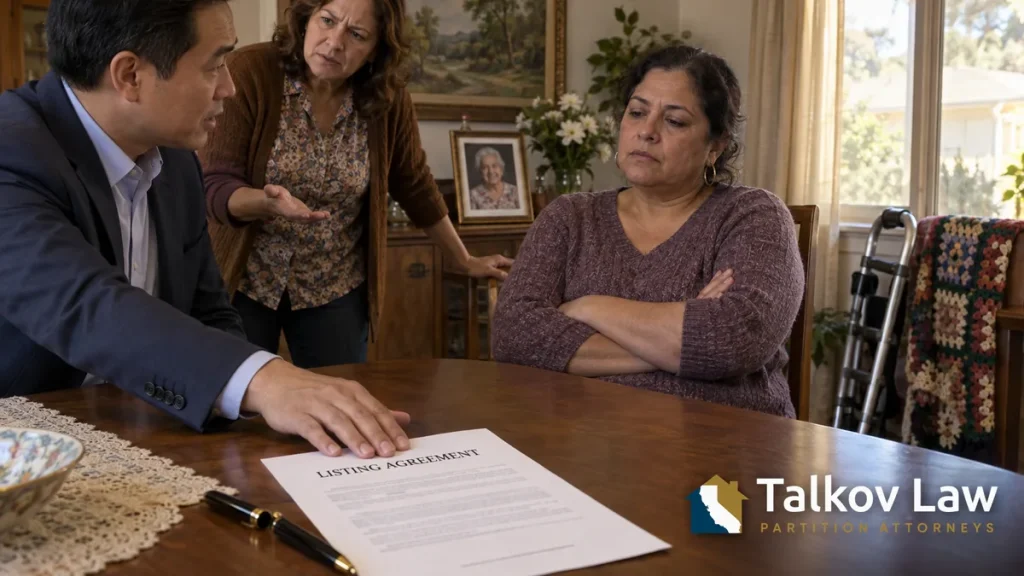
You can force the sale of your deceased parents’ house, because what Mom put in writing is what controls. In California, the right to live in a house for life is a life estate, and a life estate has to be created in a signed writing, such as a deed, a will or a trust. If Mom’s trust, will or deed leaves the house to all of you and says nothing about your sister living there for life, that is Mom’s plan, your sister is a co-owner like everyone else, and a partition action lets you force the sale and collect your share.
The story is almost always the same, and it usually starts after the death of the last surviving parent. It can be a brother or a sister; take a sister as the example. Your sister moved in to take care of Mom in her last years. Mom died, and the trust left the house to the children equally. Now your sister says Mom told her she could stay for the rest of her life, so the house can’t be sold. Mom may well have told her how grateful she was and how much she loved her. But when Mom sat down to make her estate plan, she chose to leave the house to all of her children. If Mom or Dad had wanted to leave the house to your sister, or give her a life estate, they could have said so in the trust, will or deed. They didn’t. Following the trust is following Mom’s wishes. The same is true if the promise is said to have come from Dad, a grandparent, or anyone else who left you the house.
Why Your Parent’s Written Plan Controls
California’s statute of frauds requires a signed writing to create or transfer an interest in real estate. Code of Civil Procedure section 1971 says no estate or interest in real property, other than a lease of a year or less, can be created except by operation of law or by a written instrument signed by the person creating it. A right to live in a house for life is exactly that kind of interest. Our article on why oral life estates are not legally recognized in California walks through the code sections and the cases.
The deed is on your side too. Under Evidence Code section 662, the people on title are presumed to own the full beneficial title, and anyone who says otherwise must prove it by clear and convincing proof. A conversation nobody wrote down, recalled by the brother or sister who benefits from it, rarely clears that bar.
What If Mom Deeded the House to You Before She Died?
Sometimes there is no will or trust to read, because Mom transferred the house to her children during her life by signing and recording a deed, often a quitclaim deed. Then the deed is Mom’s written plan. If it names you and your sister as owners and does not reserve a life estate for anyone, you each own your share today, and a spoken promise can’t add a life estate that the deed left out. California courts do not let oral testimony cut down what a deed grants, as our article on oral life estates explains.
A lifetime transfer also means there is no probate or trust administration to wait for. You and your sister are already co-owners on title, so you can file a partition action now.
What If the Will or Trust Gives Your Brother or Sister the Right to Live There?
Then the answer is different, because a written life estate is valid. Read the will, the trust and the deed before anything else. If Mom’s trust says your sister may live in the house for life, she has a life estate, and the rest of you own what is left after it ends.
Mom’s trust may instead give your sister a right of occupancy, meaning the right to live in the house rent-free for life or for a set number of years. That is not a life estate: it gives her no ownership, she can’t sell or transfer it, and the trustee holds title while it lasts. Either way, the right comes from the written will or trust, not from a conversation. If your sister does hold a written life estate, the court in a partition sale sets aside a just and reasonable share of the proceeds for it under Code of Civil Procedure section 873.840, which also explains how a right of occupancy differs from a life estate.
Even then, the exact words matter. A life estate that lasts only while your sister lives in the house ends when she moves out, and in Forrest v. Elam (1979) 88 Cal.App.3d 164, the Court of Appeal held that a son with that kind of life estate received nothing for it once the house was sold in a partition. He still received his equal share as an heir.
If the house is still in probate or in Mom’s trust, your sister is not a co-owner yet. The executor or trustee controls the house until it is distributed, as our guide on whether all heirs must agree to sell inherited property explains.
“But I Took Care of Mom for Years”
Caring for a parent is real work, and it often feels like it should count. But caregiving does not turn a spoken promise into ownership. California recognizes narrow exceptions to the writing requirement, such as part performance and estoppel, but they take far more than a promise and years of living in the house.
Your sister can live in the house for now, because each co-owner may occupy the whole property, and she generally does not owe the rest of you rent just for living there. But if she asks for credit for paying the property taxes, insurance or repairs, the court can charge the rental value of her exclusive use against those credits in the partition accounting.
Yes, You Can Get Your Brother or Sister Out of Your Deceased Parents’ House
You don’t need your sister’s agreement, and you don’t need a separate lawsuit about the promise. In a partition action, the court decides who owns what, including any claimed life estate, before it orders the house sold, under Code of Civil Procedure section 872.610.
Once the court orders the sale, a partition referee sells the house, and the referee can obtain a writ of possession, the same order a landlord gets in an eviction, to remove anyone still living there. So yes, you can get your sister out. Our article on evicting a sibling living rent-free in an inherited house explains each step.
Example: Mom’s House in San Diego
Say you and your sister inherited Mom’s paid-off house in San Diego through her trust, half each. Your sister has lived there alone for three years since Mom died, says Mom promised her the house for life, and refuses to sell. The trust says nothing about a life estate.
You file a partition action. The court denies your sister’s claimed life estate entirely, because nothing in writing created one, and orders the house sold. It appoints a partition referee, who takes charge of the sale. When your sister refuses to move out, the referee obtains a writ of possession, removes her, and lists the house. She receives nothing for the life estate she claimed, only her half as a co-owner. The house sells for $900,000, about 5 percent ($45,000) goes to costs of sale, and $855,000 is left, or $427,500 for each half. Your sister asks for credit for your half of the $15,000 in property taxes she paid, or $7,500. The rental value of your half for the 36 months she lived there alone, at $1,500 a month, is $54,000, which more than cancels her $7,500 credit, so you each receive $427,500. These are illustrative numbers before attorney’s fees.
Talkov Law can help. With 12 full-time partition attorneys and experience in over 650 partition actions throughout California, our team helps brothers and sisters end inherited co-ownership when one of them claims the house for life. No fees until you win. Call (877) PARTITION (727-8484) or contact us online for a free 30-minute consultation.







