

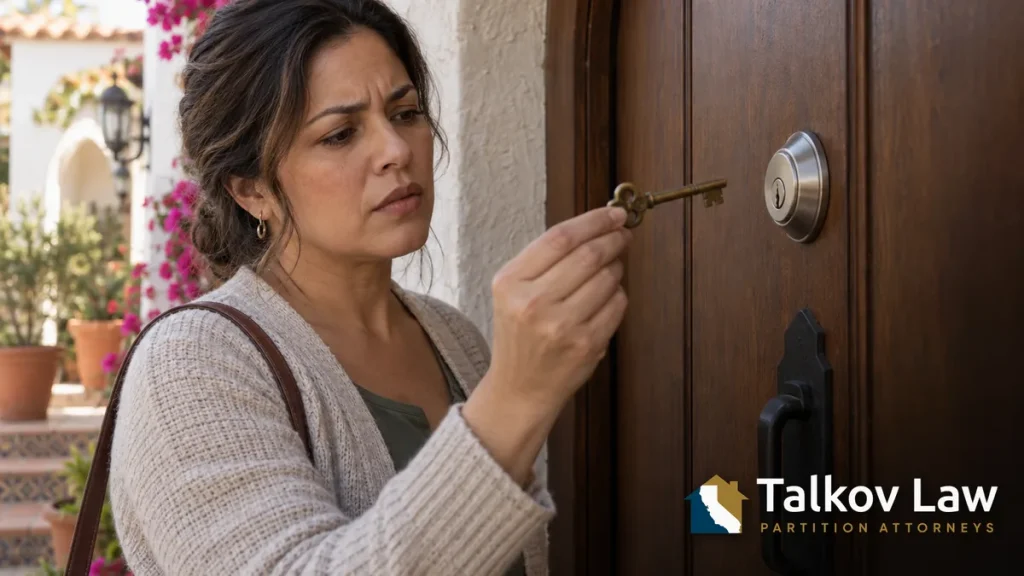

Co-owners can agree in writing not to partition their property, and California courts will enforce a valid waiver. But a co-owner cannot break the agreement and still hide behind it. In De Harlan v. Harlan (1946) 74 Cal.App.2d 555, also cited as Harlan v. Harlan, the Court of Appeal held that a father-in-law who locked his daughter-in-law out of their jointly owned home gave up the right to use their agreement to block a sale, and owed her half the rental value for the time she was kept out.
Why De Harlan v. Harlan Matters
- A waiver of partition is possible. The right to partition is not absolute and can be given up by contract.
- But the promises run both ways. A co-owner who breaks their own side of the agreement loses the right to rely on it as a waiver.
- Locking out a co-owner has a price. The excluded owner recovered half the property’s rental value for the months she was kept out.
- A sale may be the only real fix. When co-owners can no longer live under one roof, a court order letting the excluded owner move back in does not solve the problem.
The Facts: A Beverly Hills Home and a Joint Tenancy Agreement
Warren Harlan, a widower, built a house in Beverly Hills in 1937. He paid most of the cost, about $15,000 including a loan, and his son Richard and daughter-in-law Mericia added $7,100 to finish it. In 1938, Warren deeded the house to himself and Mericia as joint tenants, and they signed an agreement the same day.
Under the agreement, Warren had the exclusive right during his lifetime to sell, mortgage, rent, or encumber the house, and Mericia promised to sign whatever documents he needed. Warren also had the right to live in the home together with her for the rest of his life.
For years the family lived there together. Then Warren remarried, and Mericia and Richard separated. In May 1944, Warren and his new wife moved in and Mericia left. She testified that Warren ordered her out that month, and that when she returned in November 1944 he ordered her out again and told her the house was not hers. She sued for a declaration of her rights and for partition. Warren cross-complained to cancel the deed, claiming fraud and undue influence.
The trial court rejected Warren’s claims, confirmed Mericia’s joint tenancy interest, ordered the house sold, and awarded her $50 a month from May 1944 until the sale, as a lien on Warren’s half. Warren appealed.
How the Court of Appeal Decided the Case
The Right to Partition Can Be Waived by Contract
The court began with the rule that co-owners may contract away partition:
“It is the settled law that the right to have partition is not absolute and that it may be waived by contract.”
De Harlan v. Harlan (1946) 74 Cal.App.2d 555, 560
Warren argued that his lifetime right to live in the house, and his exclusive right to decide when to sell, waived Mericia’s right to force a sale.
Each Owner Had an Equal Right to Live There
The court disagreed with Warren’s reading. His right to occupy was a right to live there together with Mericia, and she had the same right as a joint tenant and under the agreement. “Neither had a right to occupy the premises to the exclusion of the other.” (De Harlan, at p. 561.) Her promise to join in renting or selling did not give up her half of any rents or sale proceeds.
Breaking the Agreement Forfeited the Waiver
The court said the agreement might have been read as a waiver if Warren had kept his side of it. He had not. The promises were mutual and dependent: Mericia’s right to live in the home was what she received for agreeing that Warren could control a sale. By throwing her out, Warren lost the benefit of her promises:
“He has by his wrongful conduct deprived himself of the right to stand upon the agreement as a waiver of plaintiff’s right to have a sale of the property in partition.”
De Harlan v. Harlan (1946) 74 Cal.App.2d 555, 562
Warren argued that an excluded joint tenant can only ask to be let back in. The court answered that the family conflict had made it impossible for Mericia to live under the same roof, so an order letting her move back in would not cure anything, and a partition sale was her only effective remedy.
Damages for the Lockout
The court upheld the award of $50 a month, based on evidence that the house had a rental value of $100 a month. Because Warren did not argue that the damages claim belonged outside the partition case, the court expressed no opinion on that procedural point. It affirmed both the interlocutory and final judgments.
The Law Today: Waivers Under CCP 872.710
The partition statute De Harlan applied, former Code of Civil Procedure section 752, was replaced in 1976. Today, Code of Civil Procedure section 872.710 (CCP 872.710, the right to partition) makes partition of concurrent interests a matter of right unless a valid waiver bars it:
“Except as provided in Section 872.730, partition as to concurrent interests in the property shall be as of right unless barred by a valid waiver.”
CCP 872.710, subdivision (b)
Whether a waiver is valid is still decided by case law, and courts read claimed waivers narrowly. In Heber v. Yaeger, for example, agreements about who would run co-owned property and collect its income did not waive partition. De Harlan adds a second limit: even a real waiver is lost by the co-owner who breaks the agreement it is part of.
What De Harlan v. Harlan Means for California Co-Owners
- Read the agreement first. An agreement about who controls a sale or who may live in the property is not automatically a waiver of partition.
- Watch for a breach. A co-owner who claims a waiver while excluding the other owner may have forfeited it.
- Every co-owner may use the whole property. As Johns v. Scobie explains, one co-owner cannot keep another out. Shutting a co-owner out is called ouster, and it can make the owner in possession liable for the excluded owner’s share of the rental value.
- Put it plainly in writing. Co-owners who sign a tenancy in common or joint ownership agreement should state clearly that partition is not waived, so there is no argument later.
Locked Out of a Co-Owned Property?
De Harlan v. Harlan shows that a co-owner cannot use an agreement as a shield while ignoring their own promises. If a co-owner has shut you out, a partition attorney can help you force a sale and recover what you are owed.
Talkov Law can help. With 12 full-time partition attorneys and experience in over 650 partition actions throughout California, our team handles every step, from the complaint through the referee’s sale and the final distribution of proceeds. Call (877) PARTITION (727-8484) today or contact us online to get started.







