

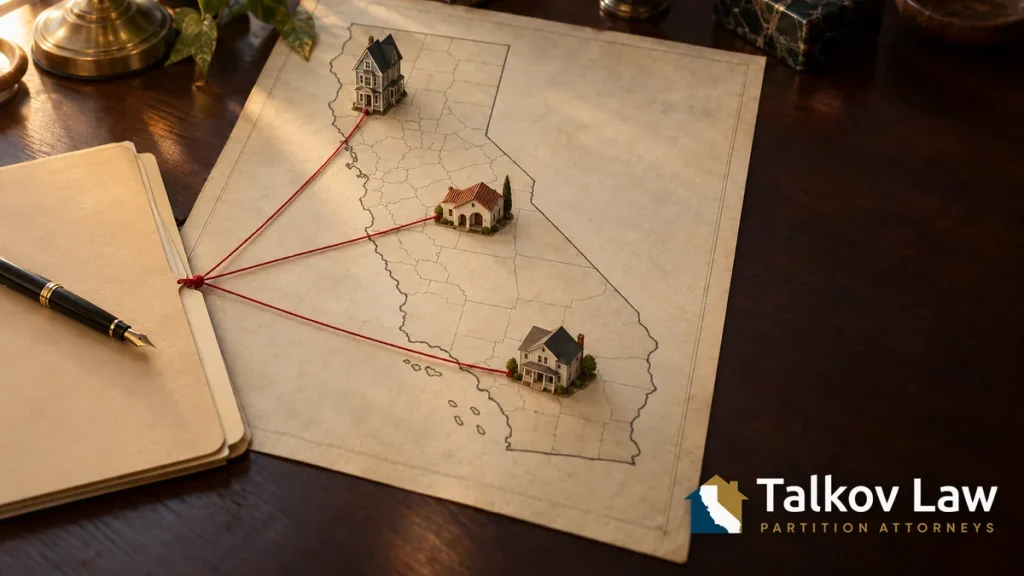

If you and the same co-owners own more than one property, you do not need a separate lawsuit for each one. In Middlecoff v. Cronise (1909) 155 Cal. 185, the California Supreme Court confirmed that one partition action can cover several properties, even in different counties, and can be filed in any county where one of them is located. The one condition is that the properties share the same group of co-owners, or trace back to a property those co-owners once held together.
The case also confirms that a partition settles every claim to the property in one case, a rule the Court of Appeal later applied in Blodgett v. Haddock (1949) 95 Cal.App.2d 17. This post covers what the Supreme Court decided and the statutes that apply today.
Why Middlecoff v. Cronise Matters
- One lawsuit can cover several properties. Two or more parcels can be partitioned in a single action. (Middlecoff, at p. 188.)
- County lines do not matter. The case can be filed in any county where part of the property is located. (Middlecoff, at p. 188.)
- The shares can differ from one property to the next. What must match is the group of owners, not their percentages. (Middlecoff, at p. 188.)
- A co-owner’s sale of part of the property does not split the case. The buyer steps into the seller’s place, subject to the other co-owners’ right to partition. (Middlecoff, at p. 189.)
- Outside claims are decided in the same case. Anyone claiming the property against the co-owners can have that claim decided in the partition. (Middlecoff, at p. 191.)
The Facts: Three Properties in Three Counties
Eliza F. H. Middlecoff and one of her two minor children filed a partition action in Los Angeles County against her other minor child and Maria H. Cronise. The complaint asked the court to partition three separate properties: one in San Francisco, one in Los Angeles County, and one in San Joaquin County. (Middlecoff, at p. 186.)
The ownership did not line up. Mrs. Cronise had an interest in the San Francisco property only. The Los Angeles and San Joaquin properties belonged to the Middlecoffs alone, and the Los Angeles property had come from a different original owner altogether. The complaint itself showed that Mrs. Cronise “neither has nor ever had any interest whatever in the property situated in the county in which this action was brought.” (Middlecoff, at p. 187.)
The Middlecoffs had a practical reason for combining everything. The San Francisco fire had destroyed the buildings on that property, and they wanted the money from selling the other two properties used to rebuild on their part of the San Francisco lot. (Middlecoff, at pp. 191–192.) Mrs. Cronise objected that the case about the San Francisco property had been combined with a separate matter among the Middlecoffs. The trial court agreed, the Middlecoffs chose not to amend, and the case was dismissed. (Middlecoff, at pp. 187–188.)
How the Supreme Court Decided the Case
Several Properties, One Lawsuit
The court began with the rule that helps co-owners who hold more than one property together:
“It is thoroughly established that partition may be had in one action of two or more tracts or parcels of land, and the fact that such tracts are situated in different counties cannot affect this right; the action being maintainable in such a case in any county in which a part of the property is situated.”
Middlecoff v. Cronise (1909) 155 Cal. 185, 188
The properties can be combined “even though the interest of each co-tenant is not the same in each parcel.” What the court required is that “each parcel of land must be owned by the same persons.” (Middlecoff, at p. 188.) Two siblings who own half each of one house and 70 percent and 30 percent of another can partition both in one case.
A Co-Owner’s Sale of Part Does Not Split the Case
The court then stated an exception that protects the co-owner who wants out. A co-owner cannot hurt the other owners by selling or deeding away an interest in one piece of the shared property. “The grantee or successor of such a co-tenant simply steps into the shoes of his grantor, subject to all the rights of the other co-tenants and their successors as to partition.” (Middlecoff, at p. 189.)
For partition, everything the co-owners originally held together “continues to be a unit, the subject-matter of a single action, just as if no change in the ownership of any interest therein had occurred.” (Middlecoff, at p. 189.) The Supreme Court applied the same idea a few years later in East Shore Co. v. Richmond Belt Railway (1916) 172 Cal. 174.
Why the Middlecoffs’ Complaint Fell Short
Neither rule fit the Middlecoffs’ complaint. The three properties were not owned by the same people, and they had never been held together by all of the co-owners or the people they got title from. Between properties like that, “there is no such unity of title and tenancy as authorizes the joinder of both in the same proceeding.” (Middlecoff, at p. 190.) The wish to use money from two properties to rebuild on the third did not change the answer, because that went only to how the Middlecoffs would settle up among themselves. (Middlecoff, at p. 192.)
Outside Claims Are Decided in the Same Case
The court separated that problem from a different situation. Citing Adams v. Hopkins (1904) 144 Cal. 19, it confirmed that when the co-owners do share title, “the claims of any and all persons adverse to the co-tenants in regard to the property may be determined in the action, in order to settle all controversies to the title in one action.” (Middlecoff, at p. 191.) Deciding those claims is part of the partition of the co-owned property, not a separate lawsuit.
The Result
The Supreme Court affirmed the dismissal. (Middlecoff, at p. 192.) The Middlecoffs lost nothing but time. The court laid out the path for them: partition the San Francisco property first, then bring one action covering the San Joaquin property, the Los Angeles property, and their part of the San Francisco property. (Middlecoff, at p. 192.) When they asked on rehearing for confirmation that they could file new cases, the court answered: “The judgment of affirmance in no way affects plaintiffs’ rights in that regard.” (Middlecoff, at p. 193.)
The Statutes on Partitioning Several Properties Today
Middlecoff v. Cronise was decided under the former partition law. The current California partition statutes, enacted in 1976, keep its rules:
- Where to file. Under Code of Civil Procedure section 872.110 (CCP 872.110), the proper county for a partition of real property is “the county in which the real property, or some part thereof, is situated.” See CCP 872.110 on jurisdiction and venue and our guide to venue in a partition action.
- Describing every property in the complaint. CCP 872.230 on the contents of a partition complaint requires a description of the property. The 1976 legislative comment to that section says that “several properties may be joined in one complaint even though located in different counties,” and points to Middlecoff for properties with different owners.
- Combining real estate with other property. Under CCP 872.240 on joinder of property, “Real and personal property may be partitioned in one action.”
- Naming everyone with a claim. CCP 872.510 on joining defendants requires the plaintiff to name the people who have or claim interests in the property, and CCP 872.610 on the interests of the parties lets the court decide all of those interests in the partition.
What Middlecoff v. Cronise Means for California Co-Owners
- Same co-owners, several properties: file once. Heirs who inherited a house and a rental, or partners who bought several buildings together, can file one partition action for all of them, in any county where one of the properties is located.
- Different percentages are not a problem. Your share can be one-half of one property and one-quarter of another. The court sets each owner’s share property by property.
- A co-owner cannot dodge the case by deeding part away. Whoever takes that interest takes it subject to your right to partition the whole.
- Different owner groups mean separate cases, and nothing is lost. If one property has an owner the others do not, that property gets its own case. The right to partition each property stays intact.
- Every claim is settled in one place. Anyone who claims the property against the co-owners is named in the partition, and the court decides that claim there. That is why a partition is often paired with a claim to quiet title.
Co-Own More Than One Property With the Same People? One Partition Can Cover Them All
Middlecoff v. Cronise was decided in 1909, and the rule has not changed: co-owners who hold several properties together can end all of the co-ownership in a single case, wherever in California the properties are. If the properties were inherited, our inherited property partition attorney page explains how these cases work.
Talkov Law can help. With 12 full-time partition attorneys and experience in over 650 partition actions throughout California, our team handles partitions of several properties at once, from confirming who owns each one through the partition sale and the final distribution of proceeds. Call (877) PARTITION (727-8484) today or contact us online to get started.







