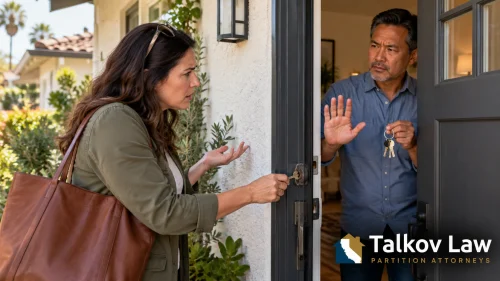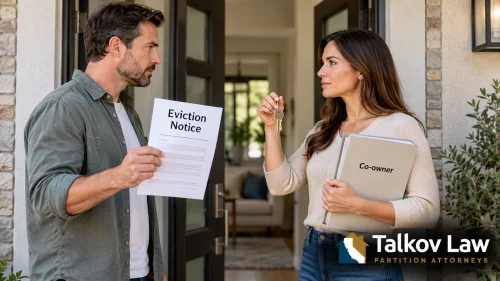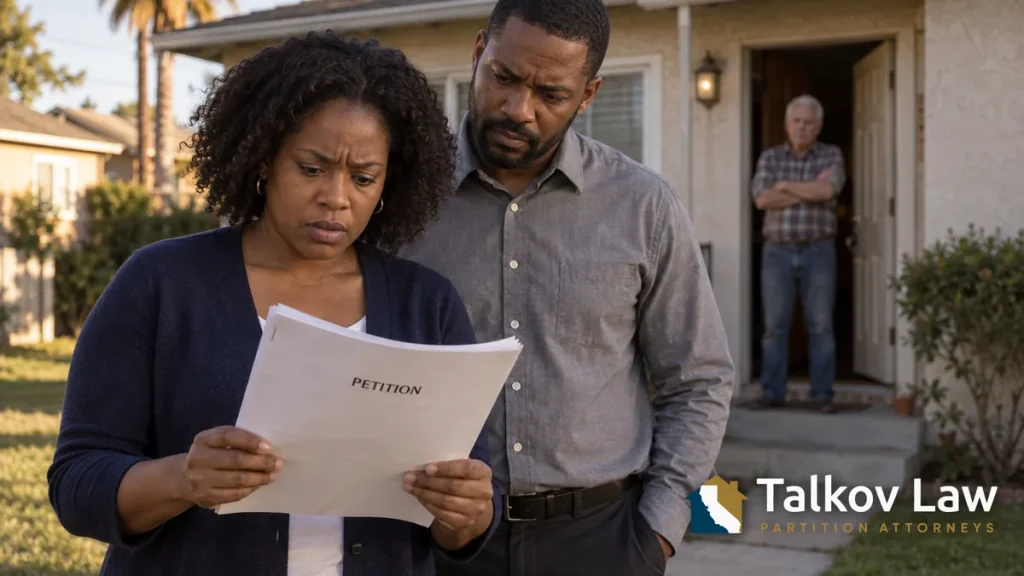
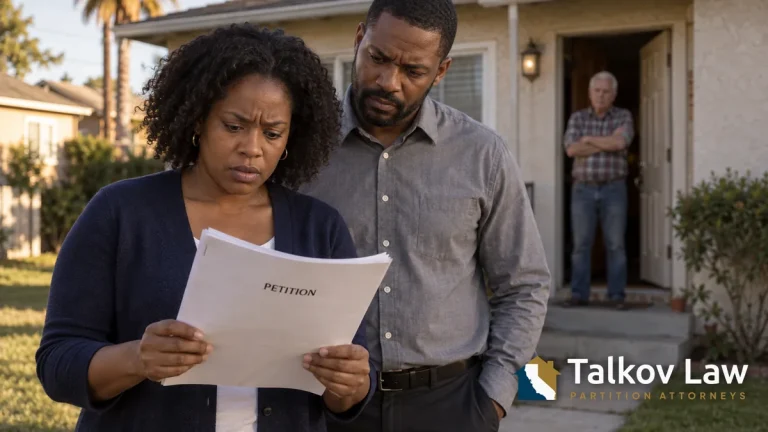
A co-owner who simply lives in a house does not owe the other owners rent. But a co-owner who goes to court and claims to own the whole property has ousted the others, and from then on can be charged for the rental value. That is the lesson of Estate of Hughes (1992) 5 Cal.App.4th 1607, where the California Court of Appeal held that a widower’s petitions claiming “100 percent of the property” were “the functional equivalent of changing locks or posting ‘no trespassing’ signs.” (Hughes, at p. 1614.)
Why Estate of Hughes Matters
Inherited houses are where this comes up most. One heir moves in, the others stay away, and years later someone asks who owes what. Hughes answers three questions every co-owner in that situation has:
- Is living in the house enough to owe rent? No. “Absent an ouster a cotenant out of possession has no right to recover the rental value of the property from a cotenant in possession.” (Hughes, at p. 1611.)
- What counts as an ouster? Words can be enough. A formal claim that you own the whole property excludes the other owners just as surely as a new lock.
- When does the clock start? From the date of the ouster. Here, that was the date the occupying co-owner filed his first petition claiming the house as his own.
The case is often cited for its discussion of ouster, including by the Court of Appeal in Hacienda Ranch Homes.
The Facts: A Widower, Two Children, and a San Diego House
Kathryn Marlow Hughes died on February 12, 1975. She and her husband, George, had lived in her separate-property house on Browning Street in San Diego, then worth about $45,000. (Hughes, at p. 1609.)
George had been left out of Kathryn’s 1965 will. As an omitted spouse, he took a one-third interest in the house. Her two children, Victoria Wiseman and Charles Marlow, shared the rest. (Hughes, at pp. 1609–1610.)
George stayed in the house, and after he remarried, his new wife, Sylvia, lived there too. They paid the loan installments but never paid rent. George died in November 1986. Sylvia stayed until July 1988, and paid $350 a month only after the court ordered it in July 1987. (Hughes, at p. 1610.)
In the meantime, the special administratrix of Kathryn’s estate, Danice Diemoz, never charged rent. When a new administrator, Ben G. Patton, took over in 1987, he went after the lost rent on behalf of the children. The probate court said no one owed it. Patton appealed. (Hughes, at pp. 1610–1611.)
How the Court of Appeal Decided the Case
Living There Was Not an Ouster
Every co-owner has the right to occupy the whole property. So the court agreed that George’s living in the house, without more, was not an ouster. Without evidence that he actually kept the children out, there was nothing to charge him rent for. (Hughes, at p. 1613.)
Claiming the Whole House Was
George did more than live there. On September 15, 1982, he filed a community property petition, and on November 19, 1982, he filed a second petition under former Probate Code section 1080. Both claimed the house was community property, that he was entitled to “100 percent of the property as the surviving spouse,” and that the children owned nothing. (Hughes, at p. 1614.)
The court held that those petitions were an ouster. Formally denying the other owners’ title in court excluded them just as effectively as a physical lockout. (Hughes, at p. 1614.)
Why Civil Code 843 Came Up
The court also noted that proving an ouster used to be hard enough that the California Law Revision Commission recommended a fix. The Legislature responded in 1984 with Civil Code section 843, which lets a co-owner out of possession serve a written demand. If the co-owner in possession does not provide “unconditional concurrent possession of the property” within 60 days, the ouster is established. (Hughes, at pp. 1612–1613.) The court mentioned this history to show how hard ouster can be to prove, not to fault anyone for not using the statute. (Hughes, at p. 1613.)
The Result
The Court of Appeal reversed the order finding no one liable for rent and sent the case back. (Hughes, at p. 1616.) Finding an ouster did not end the case automatically. The trial court still had to decide whether the heirs’ long delay in seeking partition, while the property rose sharply in value, barred some of the claim, and whether George’s estate had acquired the children’s shares by adverse possession running from the date of his first petition. (Hughes, at p. 1616.)
What Estate of Hughes Means for California Co-Owners
- A co-owner living in the property does not owe you rent just for living there. See whether you can collect rental value from a co-owner in possession.
- If your co-owner claims in writing or in court that they own the whole property, that may be an ouster, and rental value can run from that date.
- Keep copies of any petition, letter, or email in which your co-owner denies your ownership. It is your proof of the ouster date.
- If there is no clear act of exclusion, you can create one by serving a notice under Civil Code section 843.
- Do not wait. An ouster can also start the adverse possession clock, and a long delay invites arguments that you gave up your claim.
- Even without an ouster, the occupying co-owner’s rental value can be offset against their claims for the mortgage and taxes under Hunter v. Schultz, and everything is settled through partition offsets.
Inherited a House With a Relative Who Claims It All? File for Partition
Hughes shows what happens when heirs wait a decade: a fight over rent, defenses based on delay, and a risk of losing their shares. A partition action ends the co-ownership instead. Any co-owner can file under Code of Civil Procedure section 872.210 (CCP 872.210), whether or not they live in the property, and the court orders the property sold or divided and credits each owner for what they are owed. Learn more about inherited property partitions or how to file a partition lawsuit.
Talkov Law can help. With 12 full-time partition attorneys and experience in over 650 partition actions throughout California, our team handles every step of the process. Call (877) PARTITION (727-8484) today or contact us online to get started.