

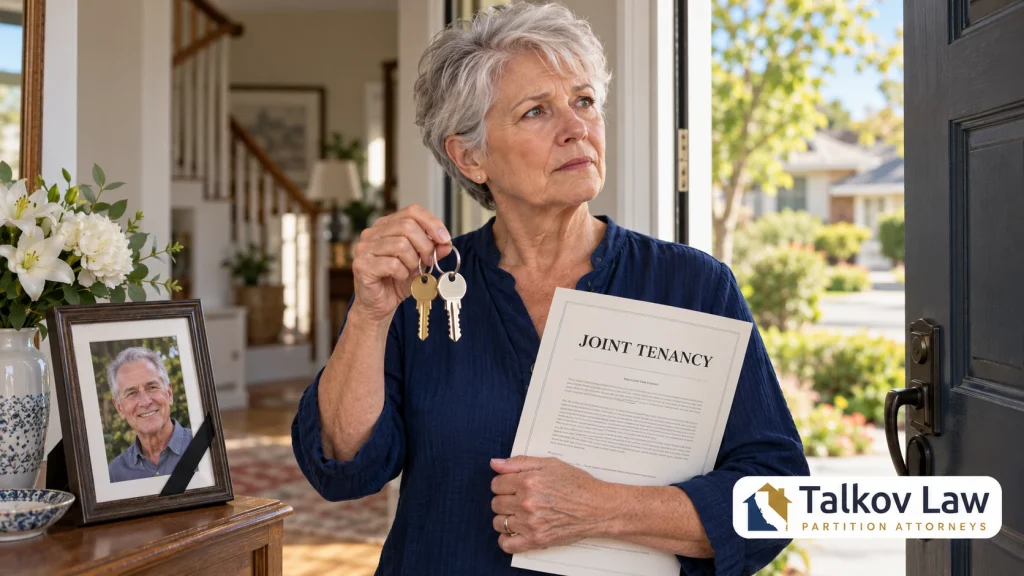
The right of survivorship determines whether property skips probate—or sparks a legal dispute. In California, this powerful legal principle allows a surviving co-owner to automatically inherit the deceased owner’s share of real estate—but only if title is held in a very specific way. When the deed does not create a form of ownership that carries survivorship, co-owners who are not spouses are treated as holding a tenancy in common, and disputes often lead to partition actions.
Unsure whether you have a right of survivorship? It applies only if title is held the right way. Get a free 30-minute consultation or call (877) PARTITION (727-8484). No fees until you win.
The right of survivorship plays a central role in real estate co-ownership disputes, with significant consequences when ownership expectations don’t match what’s written on the title. In Demetris v. Demetris (1954) 125 Cal.App.2d 440, a father learned during a falling out that his deed made him a joint tenant with his son and daughter-in-law, which would have sent his share to them instead of his daughters; the court reformed the deed to a tenancy in common (see our summary of Demetris v. Demetris).
Contact California Partition Attorneys Who Understand Survivorship Disputes
Talkov Law is California’s leading law firm exclusively dedicated to partition actions. We’ve handled over 650 partition cases across California, including complex disputes involving alleged survivorship rights, unclear title language, and competing ownership claims.
We know how to navigate these legal issues and protect your interest in jointly owned property.
What Is the Right of Survivorship?
The right of survivorship is a legal principle that automatically transfers a deceased co-owner’s share of real estate to the surviving owner(s) without requiring probate.
This transfer happens instantly and bypasses the court system—but only if the recorded title creates a form of ownership that carries survivorship, such as joint tenancy.
When Does the Right of Survivorship Apply in California?
There are two main forms of co-ownership in California that include the right of survivorship:
- Joint Tenancy
- Community Property with Right of Survivorship (available only to spouses or registered domestic partners)
If the deed doesn’t include one of these specific structures, survivorship does not apply—regardless of the parties’ intentions.
Joint Tenancy with Right of Survivorship
In a joint tenancy, two or more individuals own property together with equal interests. A key feature of joint tenancy is the Right of Survivorship: when one owner dies, their interest automatically passes to the remaining co-owner(s), outside of probate.
Equal interests on the deed are the starting point, not always the final split. A joint tenancy deed creates a rebuttable presumption that the owners own equally, which can be overcome “only by evidence tending to prove a common understanding or an agreement that the character of the property was to be other than joint tenancy.” (Machado v. Machado (1962) 58 Cal.2d 501, 506.) Showing only who paid more is not enough (Gudelj v. Gudelj (1953) 41 Cal.2d 202, 212), but proof that the owners agreed their shares would follow what each paid is, as in Cosler v. Norwood. Our Civil Code 683 page explains the rule.
Example:
If siblings John and Mary hold title as “joint tenants,” and John passes away, Mary becomes the sole owner—regardless of John’s will or any claims from his heirs.
To create a joint tenancy, the deed must expressly declare it, with language such as:
“John Doe and Mary Doe, as joint tenants.”
If the deed is silent or ambiguous, California law treats co-owners who are not spouses as holding a tenancy in common, which does not include survivorship rights. This is based on Civil Code § 683, which requires joint tenancy to be expressly declared in the deed or will. The words “with right of survivorship” are common but not required, because every joint tenancy carries survivorship.
Community Property with Right of Survivorship
Married couples and registered domestic partners in California can hold title as community property with right of survivorship. This form of ownership combines the survivorship features of joint tenancy with the tax benefits of community property, including a full step-up in basis.
Example:
Joe and Jane, a married couple, hold title as “community property with right of survivorship.” When Jane dies, Joe becomes the sole owner without going through probate.
This form of title must also be expressly declared in the deed (Civil Code § 682.1). Without that language, property spouses acquire during marriage is generally presumed to be community property (Family Code § 760), which carries no automatic right of survivorship. Without survivorship, Probate Code section 100 gives each spouse half of the community property at death, and the deceased spouse can leave their half to someone else. That is how a surviving spouse ends up co-owning the house with stepchildren who inherited half of it.
Tenants in Common: No Survivorship Rights
Unless joint tenancy or community property with right of survivorship is properly established in writing, co-owners who are not spouses are considered tenants in common by default.
Under Civil Code § 686, tenancy in common is presumed when multiple parties who are not spouses own real estate in California without specific title language. This form of ownership:
- Allows unequal shares
- Permits each owner to transfer or will their interest independently
- Offers no right of survivorship
If one co-owner dies, their share becomes part of their estate and passes to heirs—not the surviving co-owner. This frequently results in competing claims and partition lawsuits.
Survivorship in Partition Actions
Disputes about the Right of Survivorship often arise in partition lawsuits, particularly when:
- A surviving co-owner claims full ownership based on an oral understanding
- Heirs of the deceased co-owner claim a legal interest in the property
- The deed lacks clear survivorship language
- One party relies on a verbal agreement rather than recorded title
Even if parties claim they had a verbal agreement, those arguments are typically rejected under California’s Statute of Frauds (Civil Code § 1624(a)(3)), which bars oral agreements concerning real property interests.
If survivorship cannot be proven through the deed, the court will treat the co-owners as tenants in common—making the property subject to partition by sale or division.
Filing a partition does not end survivorship either: in Teutenberg v. Schiller (1955) 138 Cal.App.2d 18, a husband died while his wife’s partition case was waiting for trial, and she took the whole property as the surviving joint tenant.
Why Survivorship Language Matters
Creating a valid right of survivorship in California requires clear, written language in the deed. Oral agreements, email exchanges, and family discussions are not enough.
Acceptable deed phrases include:
- “As joint tenants” (often written “as joint tenants with right of survivorship”)
- “As community property with right of survivorship”
Without one of these phrases, co-owners who are not spouses default to tenancy in common, and spouses are generally presumed to hold community property. Neither carries automatic survivorship.
Severing a Joint Tenancy
Sometimes, co-owners would prefer not to be in a joint tenancy, but rather would like to decide where to leave their property if they die under a will, a trust, or simply under the default rules when there is no will or trust known as intestate succession. In those situations, it is critical for a joint tenancy severance to be recorded in compliance with California law. A joint tenant can do this alone, without the co-owner’s consent, by deeding the interest to himself or herself as a tenant in common, as the Court of Appeal held in Riddle v. Harmon (1980) 102 Cal.App.3d 524. Joint tenants can also end survivorship together by agreement: in McDonald v. Morley (1940) 15 Cal.2d 409, a divorce agreement that each owner’s share would go to their daughter at death turned the owners into tenants in common. Survivorship also overrides a transfer on death deed: if the owner still held title in joint tenancy at death, the deed is void and the surviving joint tenant takes the property.
Talk to California’s Leading Partition Attorneys
If you’re facing a dispute involving co-ownership, survivorship rights, or unclear title language, Talkov Law can help. Our attorneys understand how these legal structures impact partition actions, probate, and long-term ownership rights.
Call Talkov Law at (877) PARTITION (727-8484) or contact us online for a free consultation with one of our 12 experienced partition attorneys.








