

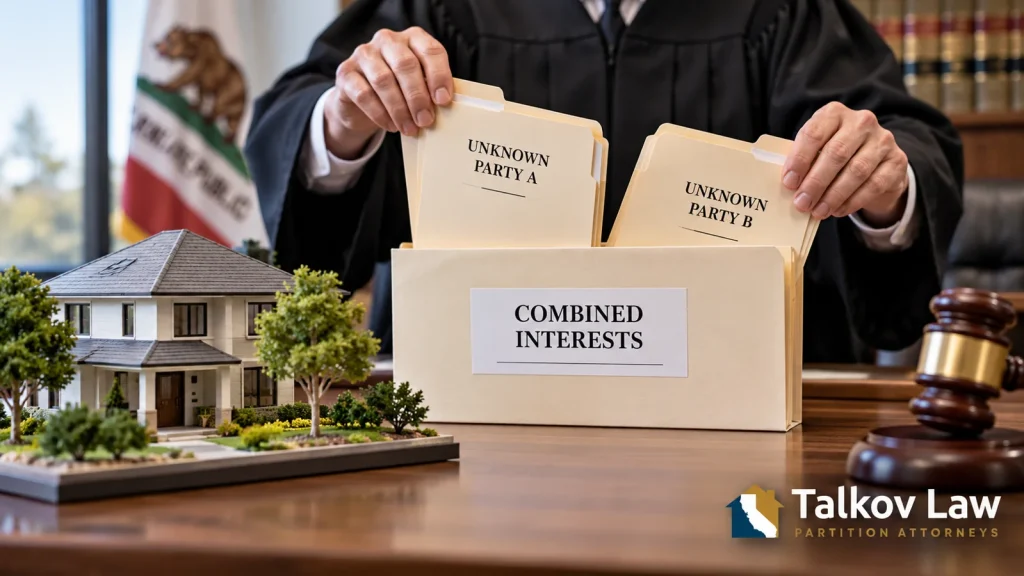
California Code of Civil Procedure section 872.640 (CCP 872.640) lets the court in a partition action consider the interests of two or more unknown parties together, rather than deciding what each unknown party owns as between themselves. It is one of the California partition statutes on determining the interests of the parties.
Full Text of CCP 872.640
The statute provides:
Where two or more parties are unknown, the court may consider their interests together in the action and not as between each other.
California Code of Civil Procedure section 872.640 (added by Statutes 1976, chapter 73)
When two or more parties are unknown, the court may consider their interests together. This permits the partition to address their combined interest without deciding their separate shares among themselves. It does not eliminate the need to identify, join, and serve the proper parties.
What CCP 872.640 Means in a Partition Action
- It applies only to unknown parties. The section is used when two or more parties to the partition cannot be identified, such as distant heirs after generations of informal transfers.
- Their interests are treated as one block. The court may consider the unknown parties’ interests together in the action, against the known parties, and not as between each other.
- The court has discretion. The statute says the court “may” consider the interests together, so the court decides whether grouping them fits the case.
- It carries through to a division. If the property is divided in kind, CCP 873.270 addresses the combined interests of unknown parties, whose share remains undivided.
Suppose a title investigation establishes that a known owner holds a three-quarter interest and that the remaining quarter belongs collectively to two or more unknown heirs. Section 872.640 allows the court to consider that quarter together without deciding how those unknown heirs divide it among themselves. The example assumes the combined share is supported by evidence; the statute does not supply an ownership percentage when the title record is unclear.
Does Grouping Unknown Interests Eliminate Them?
No. Considering the interests together is a way of handling the partition, rather than a transfer of the unknown owners’ rights to the known owners. If property is physically divided, CCP 873.270 provides that the entire portion allocated to the unknown parties remains undivided. The Law Revision Commission comment to that section also explains what can happen if an unknown owner becomes known during the action.
Grouping does not substitute for properly joining and serving the parties. The complaint, title evidence, service, and judgment must still support the relief requested. An owner whose identity is known but whose address is missing also presents a different problem from determining the separate shares of two or more unidentified owners.
CCP 872.640 and the Partition of Real Property Act
The Partition of Real Property Act, which applies to real property held in tenancy in common in partition actions filed on or after January 1, 2023 (CCP 874.311), has its own rule for grouping co-owners who are not in court. Under CCP 874.318, subdivision (d), when the court orders partition in kind it allocates one part of the property to the co-owners who are unknown, unlocatable, or the subject of a default judgment, representing their combined interests. It differs from the older rule as follows:
| Older statutes (CCP 872.640 and 873.270) | CCP 874.318(d) | |
|---|---|---|
| Which cases | Every partition | Only partitions governed by the Partition of Real Property Act |
| Who is grouped | Two or more unknown parties | Co-owners who are unknown, unlocatable, or the subject of a default judgment, if their interests were not bought out |
| Is it required | No. The court may consider their interests together | Yes. The court shall allocate them one part of the property |
| When it applies | When the court determines the parties’ interests, and again if the property is divided | When the court orders partition in kind |
The Act also has a buyout the older statutes lack. Under CCP 874.317, subdivision (g), a co-owner entitled to buy under the Act may ask the court to authorize the sale of the interests of co-owners who were named as defendants and served with the complaint but did not appear.
Law Revision Commission Comment to CCP 872.640
The California Law Revision Commission’s 1976 comment explains where the section came from:
Section 872.640 continues the last portion of former Section 759.
Law Revision Commission Comment to California Code of Civil Procedure section 872.640 (1976)
Common Questions About CCP 872.640
Who Counts as an Unknown Party in a Partition?
An unknown name and an uncertain ownership interest are related but distinct issues. CCP 872.520 addresses both. Section 872.640 specifically addresses two or more unknown parties. For notice and service issues, see our guide to service by publication in a partition action.
Not under this section. Section 872.640 permits consideration of the unknown parties’ combined interest without resolving their separate shares among themselves. The reach of the judgment depends on proper joinder and service and the applicable judgment statutes, including CCP 874.210.
Where CCP 872.640 Fits in the California Partition Statutes
Section 872.640 closes the article on determining the interests of the parties, after CCP 872.610 on trying the interests of plaintiffs and defendants, CCP 872.620 on ascertaining the state of the title, and CCP 872.630 on liens. The court then decides the right to partition under CCP 872.710 and enters an interlocutory judgment.
Talkov Law Partition Attorneys Can Help
Unknown owners are common in partitions of inherited and long-held property, and handling them correctly is what lets the judgment clear the title.
Talkov Law can help. With 12 full-time partition attorneys and experience in over 650 partition actions throughout California, our team handles partitions involving unknown owners, including service by publication, and every step through the partition sale and the final distribution of proceeds. Call (877) PARTITION (727-8484) today or contact us online to get started.








