

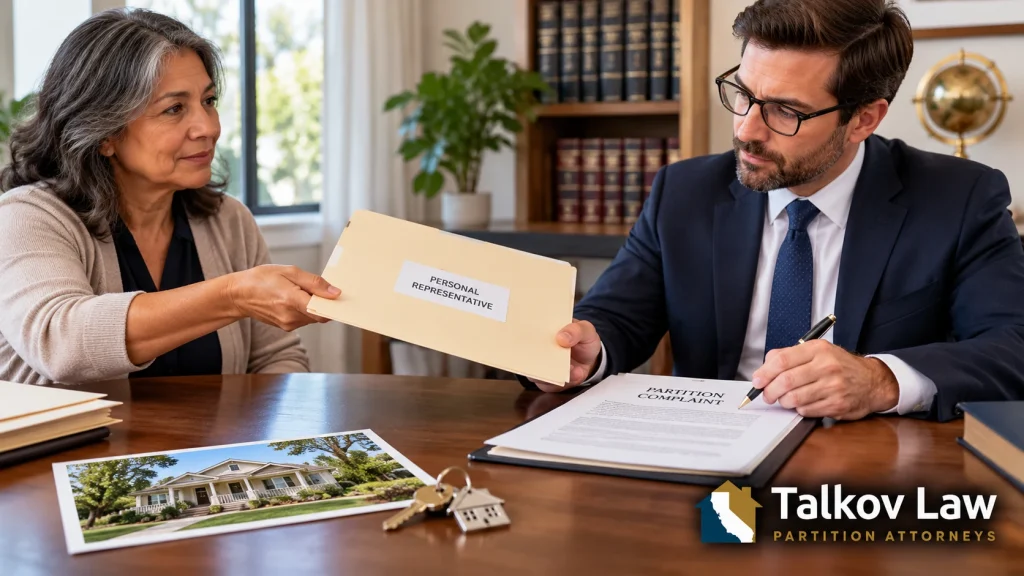

California Code of Civil Procedure section 872.530 (CCP 872.530) explains how to file a partition action when a co-owner or other person who must be joined has died or is believed to have died. If the plaintiff knows of a personal representative, that representative is joined; if not, the plaintiff files an affidavit and joins the person’s testate and intestate successors. The section is one of the California partition statutes on the parties.
Full Text of CCP 872.530
The statute provides:
(a) If a person described in Section 872.510 is dead and the plaintiff knows of a personal representative, the plaintiff shall join such personal representative as a defendant.
(b) If a person described in Section 872.510 is dead, or is believed by the plaintiff to be dead, and the plaintiff knows of no personal representative:
(1) The plaintiff shall state these facts in an affidavit filed with the complaint.
(2) Where it is stated in the affidavit that such person is dead, the plaintiff may join as defendants “the testate and intestate successors of __________ (naming such deceased person), deceased, and all persons claiming by, through, or under said decedent,” naming them in that manner.
(3) Where it is stated in the affidavit that such person is believed to be dead, the plaintiff may join such person as a defendant, and he may also join “the testate and intestate successors of __________ (naming such person) believed to be deceased, and all persons claiming by, through, or under such person,” naming them in that manner.
California Code of Civil Procedure section 872.530
This statute references CCP 872.510, which provides that: “The plaintiff shall join as defendants in the action all persons having or claiming interests of record or actually known to the plaintiff or reasonably apparent from an inspection of the property, in the estate as to which partition is sought.”
The statute does not clarify what is to occur when there is a vacancy in the office of a trustee of a trust holding a fractional interest in property. However, California Probate Code § 15644 provides that: “When a vacancy has occurred in the office of trustee, the former trustee who holds property of the trust shall deliver the trust property to the successor trustee or a person appointed by the court to receive the property and remains responsible for the trust property until it is delivered.” Seemingly, the former trustee can still be named as a party in the partition case until actions are taken to appoint a successor trustee.
Witkin’s Summary of California Law explains the issue as follows: “If a person who should be joined is known to be dead, the plaintiff must join the decedent’s known personal representative as a defendant. (C.C.P. 872.530(a).) If none is known, the plaintiff must so state in an affidavit and join the decedent’s testate and intestate successors and all persons claiming by, through, or under the decedent. (C.C.P. 872.530(b)(1), (b)(2).) A similar procedure is required if the putative defendant is simply believed by plaintiff to be dead. (C.C.P. 872.530(b)(3).) These provisions are derived from C.C.P. 1250.220(b), which governs eminent domain. (Legislative Com. Comment; see 8 Summary (11th), Constitutional Law, § 1340.)” 12 Witkin, Summary 11th Real Prop (2023) § 66.
Sometimes a party who dies during the case is the trustee of a trust, most commonly a revocable living trust. Code of Civil Procedure sections 377.40 and 377.41 allow a pending case against a party who dies to continue against that party’s personal representative or successor in interest.
What CCP 872.530 Requires in Plain English
- A known personal representative. If a person who must be joined under CCP 872.510 has died and the plaintiff knows of an executor or administrator, that personal representative is joined as a defendant.
- No known representative. If the person has died, or is believed to have died, and the plaintiff knows of no personal representative, the plaintiff states those facts in an affidavit filed with the complaint. Our affidavit regarding the death of a co-owner is a sample.
- Joining the successors. The plaintiff may then join “the testate and intestate successors” of the person and all persons claiming through that person, using the statute’s wording, and may also join the person believed to be dead.
- Service by publication. Defendants joined under subdivision (b) are served by publication under CCP 872.310.
This is how co-owners can force the sale after a co-owner’s death without probate, and our post on selling property after a co-owner’s death compares the options.
Common Questions About CCP 872.530
Do I Have to Wait for Probate to File a Partition?
No. When no personal representative is known, section 872.530 lets the plaintiff file against the deceased co-owner’s successors, using the affidavit and the statute’s wording, without waiting for a probate case to be opened.
Who Counts as a Personal Representative?
An executor named in a will and appointed by the probate court, or an administrator the court appoints when there is no will or no executor. If one has been appointed and the plaintiff knows it, subdivision (a) requires joining that person.
The Legislative Committee Comment on CCP 872.530
The Assembly’s legislative committee comment explains CCP 872.530 as follows:
Section 872.530 is new. It is derived from Section 1250.220(b) (eminent domain).
Where CCP 872.530 Fits in the California Partition Statutes
Section 872.530 follows CCP 872.510 on joinder and CCP 872.520 on unknown names and interests, and comes before CCP 872.540 on oil and gas interests and CCP 872.550 on all persons unknown.
Talkov Law Partition Attorneys Can Help
A partition after a co-owner’s death can move forward without waiting on probate when the parties are joined the way section 872.530 requires.
Talkov Law can help. With 12 full-time partition attorneys and experience in over 650 partition actions throughout California, our team handles partitions involving deceased co-owners, from the affidavit and service by publication through the partition sale and the final distribution of proceeds. Call (877) PARTITION (727-8484) today or contact us online to get started.







