

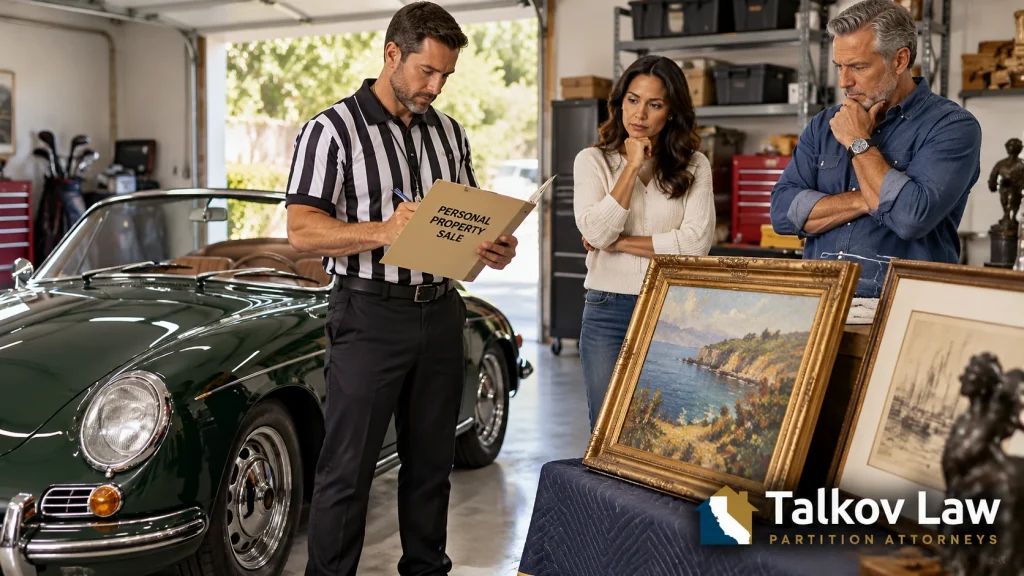
Personal Property in a Partition Action
A partition action in California can certainly force the sale of jointly owned real property, but can it partition personal property, such as cars or artwork? This is a common question we are asked given our experience as California partition lawyers. Indeed, California law does allow for the partition of personal property in a partition action.
The scope of the partition statutes in California sets forth that: “This title governs actions for partition of real property and, except to the extent not applicable, actions for partition of personal property.” Cal. Civ. Proc. Code § 872.020.
In fact, another section sets forth that: “The complaint shall set forth: (a) A description of the property that is the subject of the action. In the case of tangible personal property, the description shall include its usual location.” Cal. Civ. Proc. Code § 872.230(a).
As one court explained: “When several persons are co-owners of real or personal property any one or more of the co-owners may file an action for partition. It then becomes the duty of the court to partition the same and if this cannot be done without great prejudice to such owners, it is the duty of the court to cause the property to be sold and to partition the proceeds among them according to their respective interests.” Rutledge v. Rutledge, 119 Cal. App. 2d 114, 118–19 (Cal. App. 1953) (citing former California Code of Civil Procedure sections 752, 752a).
In Bolan v. Gallagher, 52 Cal. App. 503, 504–05 (Cal. App. 1921), a defendant:
claimed here that the court erred in overruling the demurrer. The action was brought to secure a decree for the partition of real and personal property. Sections 752 and 752a (added by St. 1919, p. 73) Code of Civil Procedure, provide for such relief and the latter section provides that ‘real and personal property may be partitioned in the same action.’ Appellants particularly insist that their demurrer should have been sustained because the alleged causes of action were not separately stated. It is true that the property sought to be partitioned, both real and personal, was described in the single cause of action alleged in the complaint.
Ultimately, the Bolan court affirmed that the demurrer was properly overruled.
While personal property can be partitioned, it is usually only wise to do so in connection with a partition of real property. The legal fees for a dispute over belongings can be close to the fees for the house itself, while the belongings are usually worth far less. A co-owner who wins a dispute over jointly owned furniture recovers only his or her share of what the furniture would sell for. For example, if two siblings co-own a house with $600,000 in equity and disagree over furniture that would sell for $8,000, each sibling’s half is worth about $4,000, which is likely less than the cost of fighting over it in court.
Resale value is not the only measure. A parent’s wedding ring, family photographs, or a table a grandparent built may sell for little and still be irreplaceable. Co-owners can often resolve these items without a court ruling by listing and photographing the belongings, agreeing in writing on who takes which items (taking turns choosing works well for many families), and, when one co-owner keeps items worth more, crediting the agreed value against that co-owner’s share of the sale proceeds as part of the offsets and accounting.
Before spending money on a dispute over belongings, also ask whether the items are co-owned at all. A partition action divides property the parties own together. Belongings one co-owner bought for himself or herself, or received as a completed gift, generally belong to that person alone, and partition does not divide them. California law defines a gift as a voluntary transfer of personal property made without anything given in return, and the giver cannot take it back unless it was made in view of impending death (Civil Code sections 1146 and 1148). Gifts made because a marriage was expected, such as engagement rings, follow a special rule (Civil Code section 1590). Belongings left by a parent who died may be estate property, which the executor or administrator has the right to take possession of until the estate is distributed (Probate Code section 9650). Items permanently attached to the house, such as fixtures bolted, screwed or cemented in place, are generally part of the real property (Civil Code sections 658 and 660) and go with the house when it is sold.
Selling the house does not by itself decide who owns the furniture and other belongings inside it. Agreeing in writing, before the sale closes, on who will remove which items keeps a second dispute from starting when the house must be delivered to the buyer. When jointly owned belongings are valuable enough to fight over, they can be included in the same partition action as the house, because real and personal property may be partitioned in one action (CCP 872.240).
Talkov Law's Partition Attorneys Can Help
If your co-owner won’t agree to sell or buy you out, a partition action ends the co-ownership for good. Talkov Law can help. With 12 full-time partition attorneys and experience in over 650 partition actions throughout California, Talkov Law is California’s #1 partition law firm. Our team handles every step of the process, from filing the partition action through the sale or buyout and the final division of the proceeds. Not a single court has denied our clients the right to partition.
Call (877) PARTITION (727-8484) today or contact us online for a free consultation with a partition attorney.







