

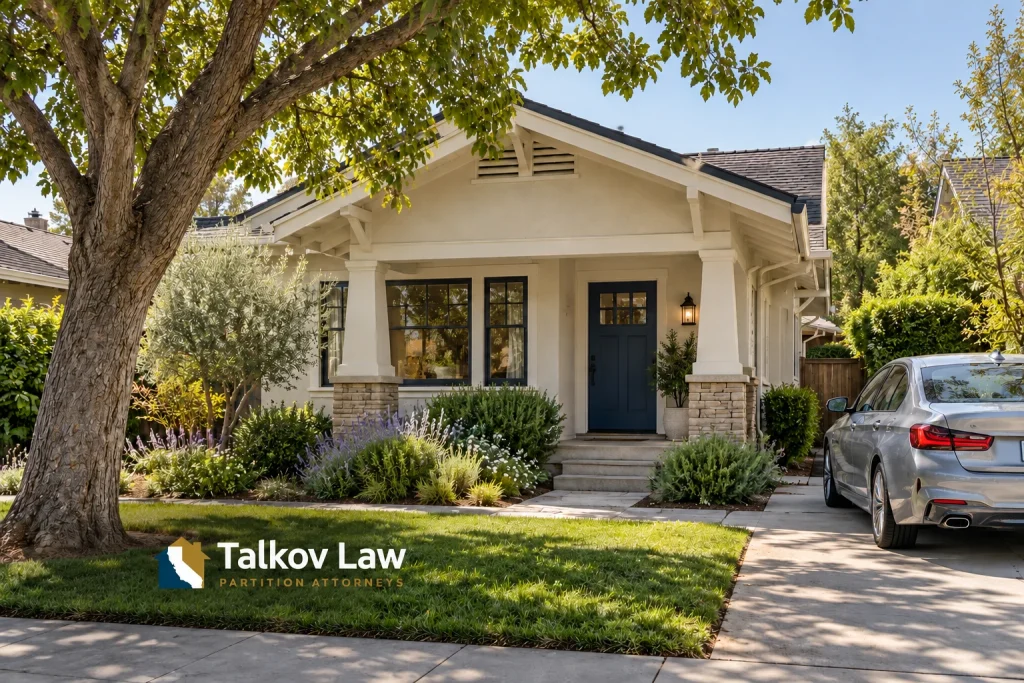

California Code of Civil Procedure section 872.020 (CCP 872.020) says what properties the California partition law covers. A co-owner can use a partition action to divide or sell real property, such as a house or land, and personal property, such as a car or equipment. It is one of the opening sections of the California partition statutes.
Full Text of CCP 872.020
This title governs actions for partition of real property and, except to the extent not applicable, actions for partition of personal property.
California Code of Civil Procedure section 872.020 (added by Statutes 1976, chapter 73)
What CCP 872.020 Means in Plain English
The section is one sentence long, but it settles three practical questions for anyone who wants to force the sale of jointly owned property:
- Real property is fully covered. Every rule in the partition title applies to houses, land, condominiums, and other real property, from who may file through the sale and the division of proceeds.
- Personal property is covered too. Vehicles, equipment, artwork, and other movable property can be divided or sold through the partition of personal property, using the same procedures.
- Some rules apply only to land. The words “except to the extent not applicable” recognize that provisions written for real estate, such as recording a notice of the action or the Partition of Real Property Act, do not fit a car or a piece of equipment.
Section 872.020 works together with CCP 872.210, which says who may bring the case. As the Law Revision Commission noted, owners of both real and personal property may bring the case under section 872.210. That is why the absolute right to partition extends to both kinds of property.
What Counts as Real Property in a Partition Action
The partition title does not define “real property” itself; it borrows the general definition in the Civil Code. Real property is land, things permanently attached to the land, and rights that go with the land. A house and its lot, an apartment building, a commercial building, and vacant land are all real property. Furniture, vehicles, and other movable belongings are personal property, which CCP 872.240 lets a co-owner include in the same case.
Real or immovable property consists of: 1. Land; 2. That which is affixed to land; 3. That which is incidental or appurtenant to land; 4. That which is immovable by law; except that for the purposes of sale, emblements, industrial growing crops and things attached to or forming part of the land, which are agreed to be severed before sale or under the contract of sale, shall be treated as goods and be governed by the provisions of the title of this code regulating the sales of goods.
California Civil Code section 658
Three related Civil Code sections fill in the edges. Section 660 says a thing is “affixed” to land when it is attached by roots, embedded in it, permanently resting on it, or permanently attached to something that is itself permanent, which is how loose building materials become part of the house once they are installed as cabinets, plumbing, or a wall. Section 662 explains when a right, such as an easement over a neighbor’s driveway, is incidental or appurtenant to land. Section 663 provides that every kind of property that is not real property is personal property.
| Property or item | Usual classification |
|---|---|
| Vacant land | Real property, even without a building or utilities |
| A house, garage, or commercial building | Real property; the structure is permanently attached to the land |
| Built-in cabinets, plumbing, and permanently installed fixtures | Part of the real property |
| Rooted trees, shrubs, and permanent fences | Part of the real property; special rules apply to crops or items sold for removal |
| An easement benefiting the parcel | A right that goes with the land |
| A sofa, dining table, or freestanding television | Personal property, even when kept inside the house |
| A car parked in the driveway | Personal property; its location on the land does not make it real estate |
The distinction matters in a partition case because the house and its contents can be owned by different people. Suppose two siblings inherit a house containing their parent’s furniture, artwork, and jewelry. The house and land are real property, and the partition title governs them in full. The movable contents are personal property; owning the house does not, by itself, establish who owns every item inside it, and selling the house does not resolve a dispute over its contents. Co-owners preparing for a sale should inventory which items belong to one owner, which belong to the co-owners together, and which are fixtures that stay with the property, as our guide to the partition of personal property explains. Paying for an installed item does not give one co-owner a right to remove it, though it may support a claim for a compensatory adjustment under CCP 872.140.
The Law Revision Commission Comment on CCP 872.020
The California Law Revision Commission recommended the partition statutes the Legislature enacted in 1976. Its comment on section 872.020 reads:
Section 872.020 is derived from the second sentence of former Section 752a. Owners of both real and personal property may maintain a partition action. See Section 872.210. This title does not apply to property divisions under The Family Law Act or in other types of cases specifically governed by other statutes.
California Law Revision Commission Comment to Code of Civil Procedure section 872.020 (1976)
The last sentence of the comment is the one that matters most in practice. The partition title is the general remedy for co-owners, but it steps aside when another statute already supplies a specific way to divide the property, as in a divorce or a probate estate.
How California Courts Treat Real and Personal Property in One Partition Case
Section 872.020 carries forward a rule California courts applied long before 1976. In Rutledge v. Rutledge (1953) 119 Cal.App.2d 114, 118–119, the Court of Appeal explained: “When several persons are co-owners of real or personal property any one or more of the co-owners may file an action for partition. It then becomes the duty of the court to partition the same and if this cannot be done without great prejudice to such owners, it is the duty of the court to cause the property to be sold and to partition the proceeds among them according to their respective interests.”
Earlier still, in Bolan v. Gallagher (1921) 52 Cal.App. 503, 504–505, the plaintiff sought partition of real and personal property in a single cause of action. The Court of Appeal held the demurrer was properly overruled, because former section 752a provided that real and personal property may be partitioned in the same action. Today the complaint simply describes each item, and under CCP 872.230(a), the description of tangible personal property must include its usual location.
Common Questions About the Scope of the Partition Statutes
Can Spouses Use a Partition Action to Divide Community Property?
No. Section 872.210(b) provides that “an action between spouses or putative spouses for partition of their community or quasi-community property or their quasi-marital interest in property may not be commenced or maintained under this title.” Those assets are divided in the family law case. A third party who co-owns with a married couple can still file, as our post on the partition of property co-owned with a divorcing couple explains, and a partition action is often faster than seeking a sale under Family Code section 2108.
Can Heirs Partition Property That Is Still in a Probate Estate?
Usually through the probate court first. When two or more beneficiaries are entitled to undivided interests in estate property, Probate Code section 11950 lets any of them petition the probate court for a partition, allotment, or other division. Once the estate distributes the property to the heirs as co-owners, the partition title governs, which is how most disputes over inherited property end up in a partition action.
Should Personal Property Be Partitioned on Its Own?
Rarely. A partition of personal property can cost about as much as a partition of real property, while the personal property is often worth far less. It usually makes sense to include it in the same case as the house or land, where the added cost of a partition action is small and the items can be sold alongside the real estate through a partition by sale.
Where CCP 872.020 Fits in the California Partition Statutes
Section 872.020 is one of four preliminary provisions that open title 10.5 of the Code of Civil Procedure. CCP 872.010 defines “property” to include real and personal property, CCP 872.030 applies the ordinary civil rules, and CCP 872.040 keeps other laws on dividing and selling property in force.
The scope rule also reaches property held in different forms. CCP 872.710 covers concurrent and successive estates across the types of co-ownership, and CCP 872.730 lets a court apply the partition title to partnership property “where the rights of unsecured creditors of the partnership will not be prejudiced.”
Talkov Law Partition Attorneys Can Help
Whether the case belongs in partition, family, or probate court is often the first strategic decision, and choosing correctly saves months.
Talkov Law can help. With 12 full-time partition attorneys and experience in over 650 partition actions throughout California, our team handles every step of the process, from deciding which court and which statutes apply through the sale and the final distribution of proceeds. Call (877) PARTITION (727-8484) today or contact us online to get started.







