

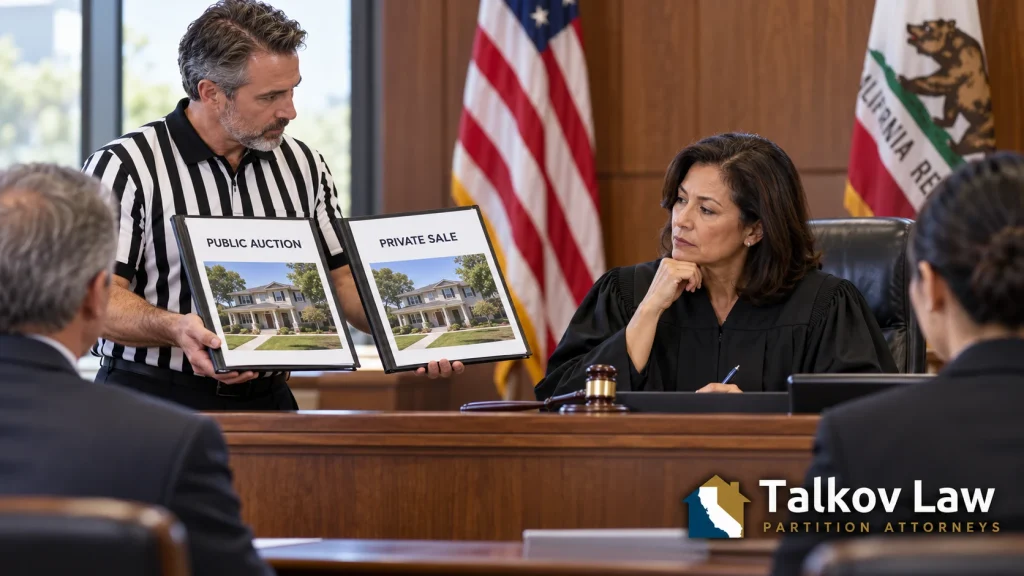

California Code of Civil Procedure section 873.520 (CCP 873.520) is the California partition statute that allows the court to determine whether the property should be sold either at a public auction or through a private sale.
Full Text of CCP 873.520
The property shall be sold at public auction or private sale as the court determines will be more beneficial to the parties. For the purpose of making this determination, the court may refer the matter to the referee and take into account the referee’s report.
California Code of Civil Procedure 873.520
As a practical matter, most properties sold in a partition action are sold through a private sale, not a public auction. That does not mean the partition referee will carry out the sale of the property at a discounted, fire sale price. To the contrary, the property is generally marketed in the normal manner, i.e., through a Realtor listing the property on the Multiple Listing Service (MLS), holding an open house, and allowing a reasonable period of time for purchase offers to come in. This means that the sales price will likely be very similar to a normal sale, the main difference being a short delay after an offer is accepted while the court confirms the sale.
One unpublished decision sheds light on the meaning of the terms in this section, and the discretion of the court to allow a private sale as follows:
Under Code of Civil Procedure section 873.520 the property to be partitioned is sold at public auction or private sale based on the court’s determination of what will be more beneficial for the parties. Here, the trial court concluded that an initial private sale would best serve John’s and William’s interests. William contends a private sale is unfair because it does not test the market. However, evidence was presented that the parcels at issue would most likely be undesirable to third parties and therefore difficult to sell. Certain parcels have problems with access and easements. Also, in order to keep cattle off of a purchased parcel, a third party would have to construct fences along the boundaries at a cost of approximately $10,000. Moreover, John expressed a preference of keeping the property in the family. Under these circumstances, the trial court did not exceed the bounds of reason in ordering an initial private sale.[1]
Jamison is unpublished, so under California Rules of Court, rule 8.1115, it cannot be cited in a California court. A later published decision also limits it. In Cummings v. Dessel (2017) 13 Cal.App.5th 589, 599–600, the Court of Appeal held that the notice rules in CCP 873.640 contain no exception for private sales, so a private sale must be publicly noticed and open to outside buyers. A sale limited to the co-owners or their family works more like a partition by appraisal, which requires the parties’ agreement.
The Law Revision Commission Comments on CCP 873.520
In 1976, the California Law Revision Commission explained CCP 873.520 as follows:
Section 873.520 continues a portion of the first sentence of former Section 775, but makes clear that there is no preference for either public or private sale. The reference to a referee for determination whether public or private sale would be more beneficial may be combined with a reference to determine whether partition by sale is more equitable than partition by division. See Section 872.820 and Comment thereto.
Frequently Asked Questions About Choosing an Auction or a Private Sale
Does California law prefer a public auction or a private sale?
No. The Law Revision Commission comment says section 873.520 makes clear there is no preference for either. The court picks the method that will be more beneficial to the parties.
What role does the referee play in the choice?
The court may refer the question to the referee and take the referee’s report into account. The comment adds that this can be combined with a referral on whether a sale is more equitable than dividing the property under CCP 872.820.
Can part of the property be auctioned and part sold privately?
Yes. CCP 873.530 allows it if that will be more beneficial to the parties.
Does a private sale still need public notice?
Yes. Under Cummings v. Dessel (2017) 13 Cal.App.5th 589, 599–600, the notice rules in CCP 873.640 apply to private sales too. Our article on notice of a private sale explains what that notice looks like.
Frequently Asked Questions About Choosing an Auction or a Private Sale
Does California law prefer a public auction or a private sale?
No. The Law Revision Commission comment says section 873.520 makes clear there is no preference for either. The court picks the method that will be more beneficial to the parties.
What role does the referee play in the choice?
The court may refer the question to the referee and take the referee’s report into account. The comment adds that this can be combined with a referral on whether a sale is more equitable than dividing the property under section 872.820.
Can part of the property be auctioned and part sold privately?
Yes. Section 873.530 allows it if that will be more beneficial to the parties.
Does a private sale still need public notice?
Yes. Under Cummings v. Dessel (2017) 13 Cal.App.5th 589, 599–600, the notice rules in section 873.640 apply to private sales too. Our article on notice of a private sale explains what that notice looks like.
Talkov Law's Partition Attorneys Can Help
If your co-owner won’t agree to sell or buy you out, a partition action ends the co-ownership for good. Talkov Law can help. With 12 full-time partition attorneys and experience in over 650 partition actions throughout California, Talkov Law is California’s #1 partition law firm. Our team handles every step of the process, from filing the partition action through the sale or buyout and the final division of the proceeds. Not a single court has denied our clients the right to partition.
Call (877) PARTITION (727-8484) today or contact us online for a free consultation with a partition attorney.
References
| ↑1 | Jamison v. Jamison (Cal. Ct. App. Dec. 9, 2004) No. F043236, 2004 WL 2827711, at *2 |
|---|







