

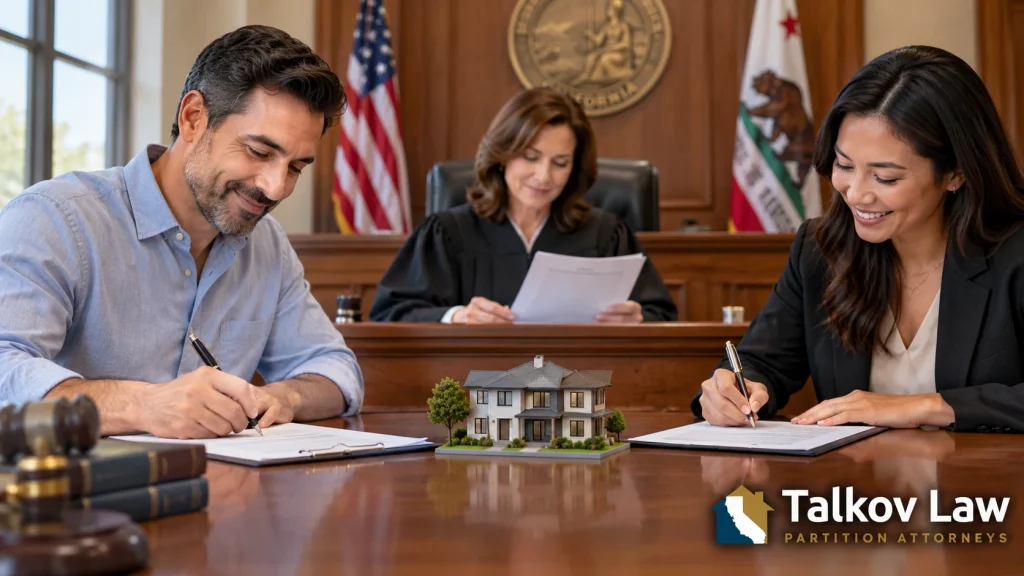
California Code of Civil Procedure section 873.600 (CCP 873.600) requires the court to order a partition sale by the methods and on the terms that all the parties have expressly agreed to in writing. Section 873.600 is the California partition statute that lets co-owners write their own sale rules.
Full Text of CCP 873.600
Notwithstanding any other provision of this title, the court shall order sale by such methods and upon such terms as are expressly agreed to in writing by all the parties to the action.
California Code of Civil Procedure 873.600
What CCP 873.600 Means in Plain Language
Most partition sales follow the court’s procedures. This statute is an exception: if every party agrees, in writing, on how the property will be sold, the court must go along. It has three requirements:
- In writing. The methods and terms must be “expressly agreed to in writing.”
- All the parties. Every party to the action must agree. The Law Revision Commission comment says the consent of all parties is necessary whether or not they have appeared. A party who was named but not served and has not appeared does not need to consent, because that party’s interests will not be affected by the judgment.
- Before the sale is made. In Sullivan v. Dorsa (2005) 128 Cal.App.4th 947, 961, the court held that the section is intended only to empower the owners to specify terms and conditions of sale before the referee enters into a contract.
For example, three co-owners might sign a stipulation that the referee will list the house with a named broker at an agreed price and that the net proceeds will be held in escrow until the court orders release. The comment also says the section cannot be used where unknown owners are parties unless a guardian ad litem has been appointed for them. The court has separate power to prescribe sale terms under CCP 873.610. Our article How Does a Partition Referee Sell Property in California? walks through a referee sale, and our stipulation and order template shows the usual form of a stipulation.
This statute “permits the parties to agree to sales procedures that may vary from the procedures prescribed in this chapter. In order for Section 873.600 to be operative, the consent of all parties is necessary whether or not they have appeared. As a consequence, this section cannot be used where unknown owners are made parties unless a guardian ad litem has been appointed for them. On the other hand, the consent of persons named as parties who are not served and who have not appeared is unnecessary since their interests will not be affected by the judgment in the action. It should be noted that the court also has authority to prescribe additional sales procedures. See CCP 873.610.”[1]
“Section 873.600 is intended only to empower the owners to specify terms and conditions of sale prior to the referee’s entry into a contract.”[2]
As one court explained in providing extensive analysis to this very short statute:
By declaring that “the court shall order sale” in accordance with agreed methods and terms, section 873.600 explicitly speaks from the time before a sale has occurred, i.e., before the referee has entered into an agreement. This understanding is consistent with the placement of section 873.600 in article 2 of title 10.5 of chapter 6 of the Code of Civil Procedure. That article—which the Law Revision Commission entitled “Sales Procedures” (13 Cal. Law Revision Com. Rep. [(1976)] p. 451)—empowers the court to direct, approve, or prescribe various terms of sale, the contents of any notice of sale, and the procedures to be employed in selling the property. (See §§ 873.600–873.690.) The article is thus concerned with matters to which the court must attend before the property is sold. Section 873.600 therefore cannot be understood to empower the court to impose new terms after a sale is reported by the referee, and while its confirmation is pending. The statutes governing those proceedings appear in article 3 of the above cited chapter, under the title Consummation of Sale. (13 Cal. Law Revision Com. Rep., supra, at p. 457.)
This context confirms the sense conveyed by the wording of the statute itself that section 873.600 is intended only to require that the court give effect to the unanimously expressed wishes of the parties in formulating an interlocutory judgment and deciding what terms to include in the order of reference or notice of sale. This is not to say that section 873.600 loses all force after an interlocutory judgment has entered. The owners may well be entitled to come forward at some later time and, by unanimous consent, seek an order prescribing new terms to be included in instructions to the referee or in any future notice of sale. Further, the owners’ wishes, or more precisely their unanimous belief that the property can and should be sold on substantially more advantageous terms than those offered for confirmation, may and should be weighed by the court in deciding whether to confirm a sale. But section 873.600 cannot reasonably be understood to grant the owners a peremptory veto over a sale that has already been made and is now brought before the court for confirmation. To make the owners’ belatedly expressed preferences binding on the court at that stage would license them to trifle with the court, wasting its time and that of other participants, and ultimately reducing the efficacy of judicial partition sales by reducing the willingness of purchasers and others (including brokers) to participate in such transactions.[3]
Agreed sale terms can also decide who gets paid. In Starcevic v. Pentech Financial Services, Inc. (2021) 66 Cal.App.5th 365, 381–382, the parties stipulated that one co-owner’s share of the sale proceeds would be held in escrow and released only on court order or final judgment, citing section 873.600. A creditor with a judgment against that co-owner argued it was entitled to part of the proceeds because escrow closed before its judgment expired. The Court of Appeal disagreed: the money was still held under the stipulated terms when the judgment expired, and an expired judgment can no longer be collected, so the creditor received nothing.
Frequently Asked Questions About Agreed Terms of a Partition Sale
Can co-owners agree on how a partition sale is carried out?
Yes. Under section 873.600, the court must order a sale by the methods and on the terms that all the parties to the action expressly agree to in writing.
Does every co-owner have to sign?
Every party must consent. The Law Revision Commission comment says consent of all parties is necessary whether or not they have appeared, but the consent of persons named as parties who have not been served and have not appeared is unnecessary.
Can the agreement bind an unknown owner?
Not without extra steps. The comment says the section cannot be used where unknown owners are made parties unless a guardian ad litem has been appointed for them.
Can the owners change the terms after the referee has made a sale?
Not as of right. Sullivan v. Dorsa held that section 873.600 empowers the owners to specify terms before the referee enters into a contract, and does not give them a veto over a sale already made and pending confirmation. The court added that the owners’ unanimous belief that the property can be sold on better terms may be weighed in deciding whether to confirm. Our article on the partition sale and fair market value also discusses sales run by a referee.
What happened in the Starcevic case?
The parties stipulated that sale proceeds would be placed in escrow and released only on court order or final judgment. A judgment creditor then sought a share of the proceeds because escrow closed before its judgment expired. The court denied it because the money was still held under the stipulation when the judgment expired. CCP 873.610 covers the court’s own power to set terms, and our partition sale FAQs article answers other common questions.
Talkov Law's Partition Attorneys Can Help
If your co-owner won’t agree to sell or buy you out, a partition action ends the co-ownership for good. Talkov Law can help. With 12 full-time partition attorneys and experience in over 650 partition actions throughout California, Talkov Law is California’s #1 partition law firm. Our team handles every step of the process, from filing the partition action through the sale or buyout and the final division of the proceeds. Not a single court has denied our clients the right to partition.
Call (877) PARTITION (727-8484) today or contact us online for a free consultation with a partition attorney.








