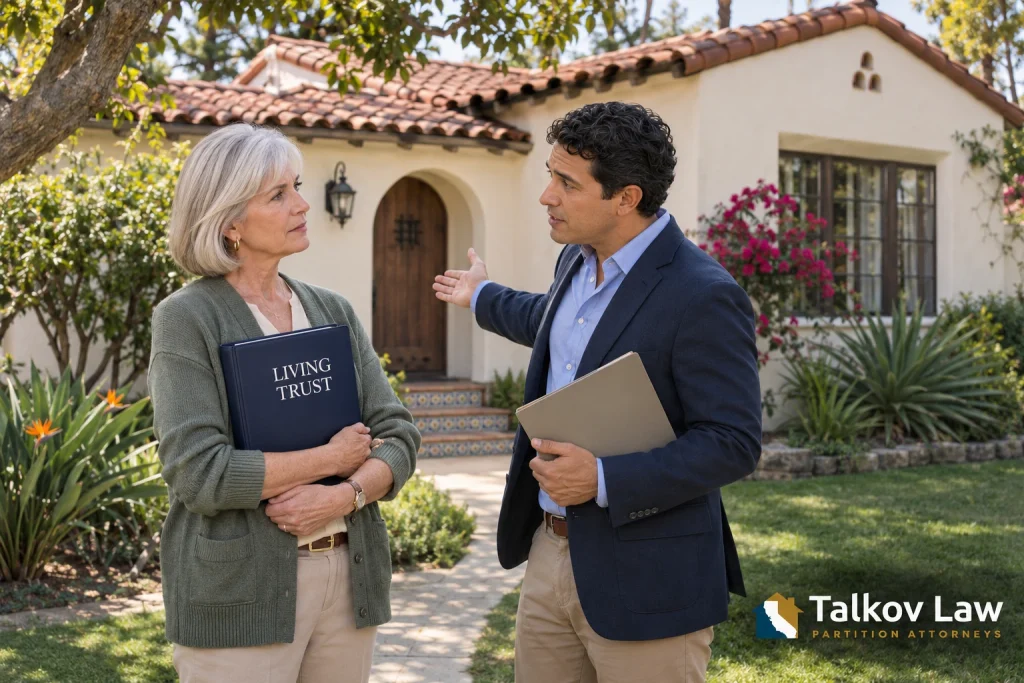

Yes. In most cases, putting real estate in a trust does not stop a partition action. If a co-owner moved their share of a house into their own living trust, you can still force a sale. You simply sue the trustee, who holds title for the trust. The answer changes in one situation: when a single trust owns the entire property and the trust is still being administered. Then the beneficiaries are not yet co-owners, and the path to a sale usually runs through the probate court first. This guide explains which situation you are in and what to do next.
Can You Partition Property Held in a Trust?
Start by asking who is on title. Pull the most recent deed and look at how the owners are listed. Most trust questions fall into one of three patterns:
- Your co-owner’s share is in their own trust. For example, the deed reads “Maria Lopez, Trustee of the Lopez Family Trust, as to an undivided one-half interest.” The trust is just a co-owner. A partition action works the same way it would against Maria personally.
- Your own share is in your trust. You, as trustee, can file the partition action for the trust.
- One trust owns the whole property. For example, a parent’s trust holds the family home and the children are the beneficiaries. Until the trustee distributes the house, the beneficiaries are not co-owners on title, and the main tools are in the probate court.
Many co-owners move their share into a revocable living trust for estate planning, sometimes in the middle of a dispute. Doing so changes who signs the documents, but it does not take away your right to end the co-ownership. Code of Civil Procedure section 872.210 (CCP 872.210) lets a co-owner of real property file a partition action, and Code of Civil Procedure section 872.710 (CCP 872.710) makes partition of concurrent interests a matter of right.
Because the trustee holds legal title, the trustee is named as the defendant, in their capacity as trustee. Code of Civil Procedure section 872.510 (CCP 872.510) requires you to name everyone with an interest of record, so the title report decides exactly who goes in the caption. If the trustee has died, the successor trustee steps in; see what happens if your co-owner dies during a partition action.
Moving a share into a trust has another effect worth knowing. It usually severs a joint tenancy, which ends the right of survivorship. Read more about putting a co-owned house into trust.
If you hold your share as trustee of your own trust, you file the partition action as trustee. One practical rule applies: a trustee who sues for a trust is representing the beneficiaries’ interests, so a trustee who is not a lawyer must hire one. See do you need a lawyer for a partition action.
How Courts Handle Trust Interests in a Partition
Code of Civil Procedure section 872.840 (CCP 872.840) speaks directly to property subject to an express trust, meaning a trust someone deliberately created, like a living trust. When the property or an interest in it is held in an express trust, the court may, in its discretion, order the property sold. Whatever share or sale money is allotted to the trustee is then held by the trustee under the terms of the trust, with no further action needed from the partition court.
The Court of Appeal has described CCP 872.840 this way: “This section is explicit and gives the trial court the power to use its own sound discretion in determining whether under all of the facts and all of the evidence presented to it the property should be partitioned in kind or sold.” (Richmond v. Dofflemyer (1980) 105 Cal.App.3d 745, 758.)
In plain terms, a trust on title does not change the outcome for the other co-owners. For a single-family home, which cannot be split in half, the usual result is still a partition by sale. The trust simply receives its share of the money.
Questions About Partitioning Trust Property
Can a trustee be forced to sell a house in a partition action?
Yes, when the trust owns only a share and you own another share. The court can order the whole property sold, and the trustee receives the trust’s share of the proceeds.
The trustee, in their capacity as trustee of the named trust, as shown on the deed and title report.
Can a trust beneficiary file a partition action?
A beneficiary of an active trust that owns the whole property generally starts in the probate court. Once the house is distributed to the beneficiaries as co-owners, any of them can file for partition.
Talkov Law’s Partition Attorneys Can Help
A trust on title adds a step, not a roadblock. The right first move depends on who holds title and whether the trust is still being administered, and a short conversation with a partition attorney will sort that out. Learn more about our work with inherited property.
Talkov Law can help. With 12 full-time partition attorneys and experience in over 650 partition actions throughout California, our team handles every step of the process, from filing through the referee’s sale and the final distribution of proceeds. Call (877) PARTITION (727-8484) today or contact us online to get started.