
Quiet Title and Partition Actions for Co-Ownership Disputes
A quiet title action asks a court to decide who owns property. In co-ownership disputes, it is often paired with a partition action, which ends the co-ownership.
A quiet title action asks a court to decide who owns property. In co-ownership disputes, it is often paired with a partition action, which ends the co-ownership.
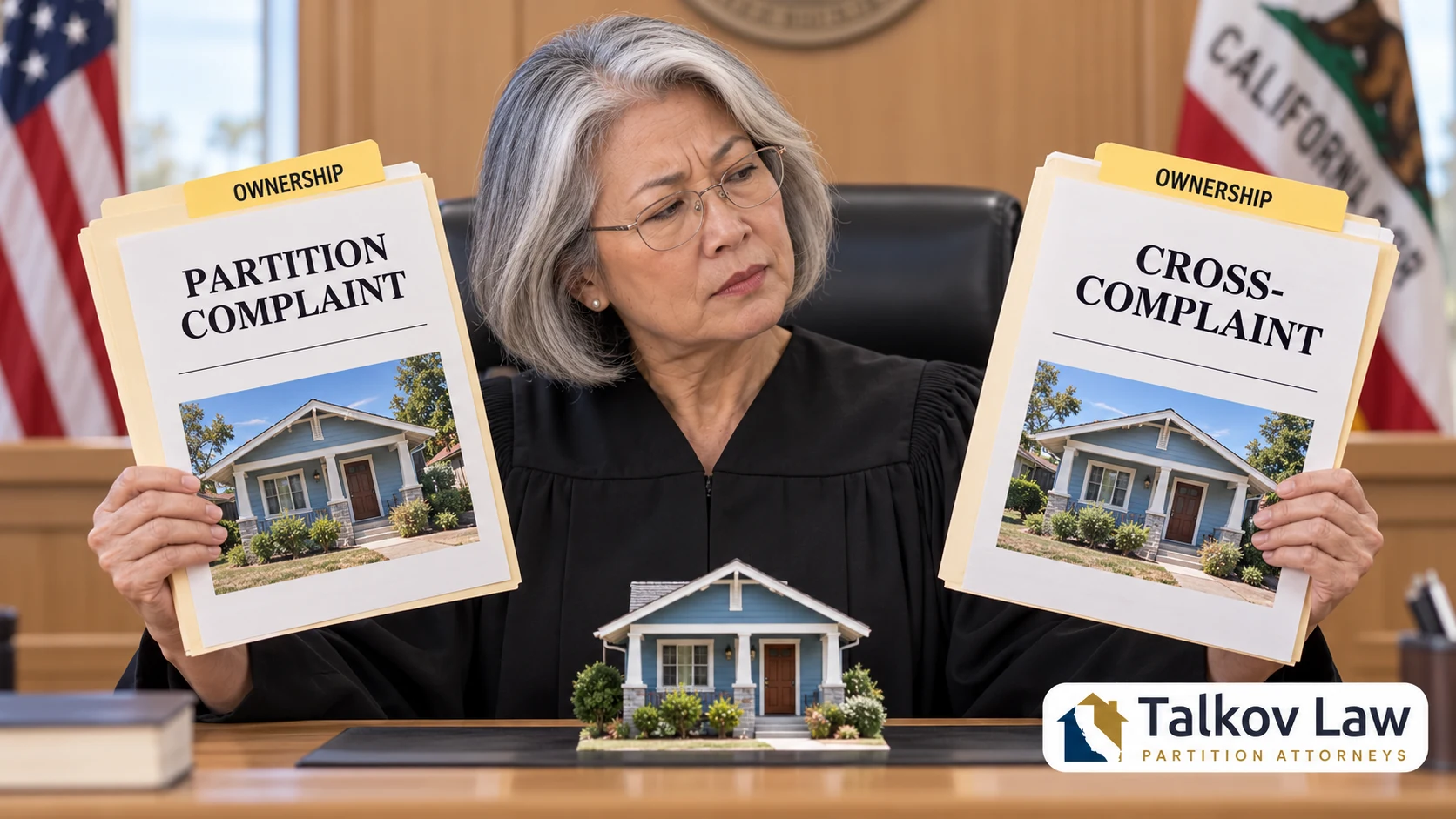
A cross-complaint for declaratory relief can clarify the parties’ rights in a partition action. But its value is limited for ownership disputes, since ownership is already at issue in every partition.

Recording a deed gives the public notice of ownership. An unrecorded deed creates uncertainty that can complicate a partition action.

Partition defendants who claim their co-owner was only a co-borrower face an uphill battle, because Evidence Code section 662 presumes the person on title is a true owner.

Legal title is who appears on the deed. Equitable title can belong to someone else. The difference often matters when a partition action involves a quiet title dispute.

Quiet title claims often arise alongside partition actions. Here is a sample California quiet title complaint under Code of Civil Procedure sections 760.010 to 764.010.

Joint tenants have a right of survivorship. California Civil Code section 683.2(c) limits attempts to sever a joint tenancy after a joint tenant has died.

A partition action is the court process for ending co-ownership disputes in California. Here are practical strategies for coming out ahead.

Code of Civil Procedure section 872.610 provides that the interests of all parties, plaintiff and defendant alike, may be tried and decided in the partition action.
Code of Civil Procedure section 872.620 lets the court determine the state of the title as part of the partition action.

Representing co-owners statewide. Find your nearest Talkov Law office.
Practical guides from attorneys who focus exclusively on California partition actions.
The information on this site, including the Talkov Law Blog, is intended for general information purposes only. By using this site, you agree that any information contained in the site does not constitute legal, financial or any other form of professional advice. Information on this site may be changed without notice and is not guaranteed to be complete, accurate, correct or up-to-date.







