

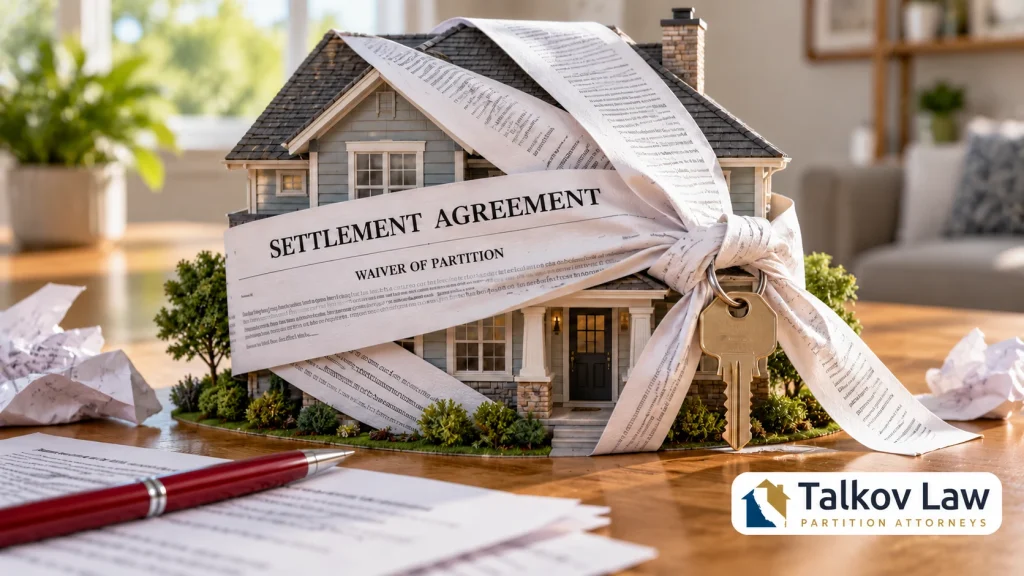
When co-owners of real estate face disputes, drafting a co-ownership settlement agreement often seems like a logical and cost-effective way to avoid litigation. However, when co-owners draft these agreements without a skilled partition attorney, they often set themselves up for legal and financial trouble. The biggest danger is trading the straightforward and cost-effective remedy of a partition action for an expensive and complex breach of contract lawsuit.
The Partition Action: A Powerful, Statutory Right
California law provides co-owners with the absolute right to partition their jointly owned property. A partition action is a court-supervised process for dividing or selling the property when one co-owner no longer wants to co-own. This right is not dependent on any prior agreements between the parties and cannot be waived without clear and explicit language.
A partition action is generally predictable, as it follows well-defined partition statutes. Courts are obligated to grant partition unless an exception, such as an explicit contractual waiver, applies. This makes partition actions a relatively straightforward remedy when co-owners can no longer work together.
DIY Agreements: Trading Simplicity for Complications
Many co-owners who draft their own agreements overlook the legal implications of waiving their right to partition. Whether intentional or not, these agreements often include provisions that require mediation, arbitration, or even perpetual co-ownership under specific terms. Once signed, these agreements replace the simplicity of a partition action with the need to litigate over the interpretation and enforcement of contractual terms.
Breach of contract lawsuits are often complex and expensive. Unlike partition actions, breach of contract claims require:
- Proof of the Agreement’s Validity – The agreement must meet all legal requirements, such as being sufficiently specific and supported by consideration.
- Interpretation of Terms – Ambiguities in DIY agreements often lead to disputes about what the parties intended. These disputes can involve costly expert testimony and prolonged discovery.
- Enforcement of Obligations – Courts may hesitate to impose remedies that seem impractical, inequitable, or contrary to public policy, further complicating the process. Since many DIY agreements are vague as to the method of enforcement, the court must be persuaded as to the proper remedy.
Common Pitfalls in DIY Agreements
- Ambiguity: Language drafted by non-lawyers often lacks the precision needed to avoid conflicting interpretations. That invites a lawsuit.
- Unrealistic Obligations: Agreements that impose unworkable or one-sided obligations are ripe for challenges in court.
- Improper Waivers: Failing to explicitly and clearly waive the right to partition can leave the agreement open to legal challenges.
- Failure to Address Future Disputes: DIY agreements rarely say what happens when someone does not perform, which leaves a lawsuit as the only option.
Why Professional Guidance Matters
At Talkov Law Partition Attorneys, we have seen many co-owners who thought a DIY settlement agreement would save time and money, only to end up in longer, costlier litigation. A well-drafted agreement, prepared by an experienced partition attorney, can:
- Clarify each party’s rights and obligations.
- Preserve the statutory right to partition unless a waiver is explicitly intended.
- Ensure enforceability and avoid ambiguities that lead to disputes.
Timing matters too. If a partition case is already pending, dismissing it before the settlement closes can leave the agreement unenforceable in that case; see how to settle a partition without losing the court’s power to enforce the deal.
Talkov Law Partition Attorneys Can Help
While drafting your own co-ownership settlement agreement might seem like a quick fix, it’s a gamble that often leads to expensive and avoidable consequences. Many DIY agreements merely list hopes and dreams of what the parties think should happen, but fail to consider what will happen when the terms of the agreement are not fulfilled. Without professional guidance, co-owners risk forfeiting their right to a straightforward partition action in exchange for the uncertainty of a breach of contract lawsuit.
At Talkov Law Partition Attorneys, our team of experienced partition attorneys drafts settlement agreements that protect your rights and say exactly what happens if your co-owner does not perform. If you’re considering a co-ownership agreement or facing a dispute, contact us today for a consultation.
Don’t trade a simple solution for a costly problem. Let us help you resolve your co-ownership issues the right way.







