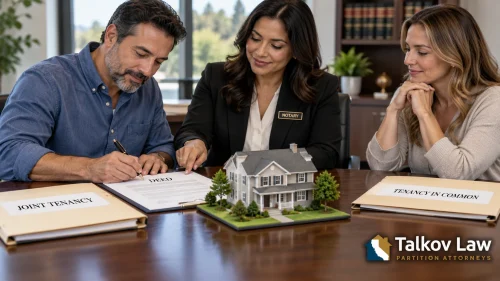

California Civil Code section 683 is the statute that defines a joint tenancy. It says a joint tenancy exists only when two or more people own property in equal shares, under a single deed or will that expressly declares a joint tenancy. That express declaration is what gives joint tenants their best-known feature, the right of survivorship: when one joint tenant dies, the survivors own the whole property without probate. Without that declaration, co-owners are tenants in common. Either way, any co-owner who wants out, from Los Angeles to Sacramento, can end the co-ownership through a partition action.
Full Text of Civil Code 683
(a) A joint interest is one owned by two or more persons in equal shares, by a title created by a single will or transfer, when expressly declared in the will or transfer to be a joint tenancy, or by transfer from a sole owner to himself or herself and others, or from tenants in common or joint tenants to themselves or some of them, or to themselves or any of them and others, or from spouses, when holding title as community property or otherwise to themselves or to themselves and others or to one of them and to another or others, when expressly declared in the transfer to be a joint tenancy, or when granted or devised to executors or trustees as joint tenants. A joint tenancy in personal property may be created by a written transfer, instrument, or agreement.
(b) Provisions of this section do not apply to a joint account in a financial institution if Part 2 (commencing with Section 5100) of Division 5 of the Probate Code applies to such account.
California Civil Code section 683 (amended by Statutes 2016, chapter 50, section 9, effective January 1, 2017)
The first words of the statute set the rule that separates a joint tenancy from every other form of co-ownership: a joint interest is “owned by two or more persons in equal shares.” Two joint tenants each hold one-half. Three joint tenants each hold one-third. No deed can create a joint tenancy in which one owner holds 70 percent and the other 30 percent.
The courts read the statute the same way. “A joint tenancy is a joint interest owned by two or more persons, who have equal interests among themselves.” (Grothe v. Cortlandt Corp. (1992) 11 Cal.App.4th 1313, 1317.) “One of the characteristics of joint tenancy is the equality of the interest held by the respective tenants.” (Stark v. Coker (1942) 20 Cal.2d 839, 844.)
Equal shares on paper are not always equal shares in a partition, however. A joint tenancy deed creates a presumption that the owners hold equal shares, and a co-owner who paid more can sometimes overcome it, as explained below.
Civil Code 683(a): The Deed Must Expressly Declare a Joint Tenancy
Section 683 does not create a joint tenancy just because two people are on title. The will or transfer must be “expressly declared” to be a joint tenancy. In practice, that means the deed names the owners “as joint tenants.” Most buyers make that choice on the escrow vesting worksheet during the purchase, and the title company carries it onto the deed.
When the deed says nothing about how the owners hold title, Civil Code section 686 fills the gap: an interest created in favor of several people is an interest in common unless it is declared to be a joint interest under section 683, acquired in partnership, or acquired as community property. A deed to two sisters, with nothing more, makes them tenants in common. Our comparison of joint tenants vs. tenants in common explains what that difference means in practice.
Civil Code 683(a): The Four Unities and the Single Transfer
California courts describe a joint tenancy by its four unities. A joint tenancy “requires unity of interest, unity of title, unity of time, and unity of possession.” (McDonald v. Morley (1940) 15 Cal.2d 409, 412.) Section 683 builds those unities into its text:
- Unity of interest: the owners hold “equal shares.”
- Unity of title and time: the owners take “by a title created by a single will or transfer,” so every joint tenant gets title from the same document at the same moment.
- Unity of possession: each joint tenant has the right to possess the whole property, not a separate part of it. A co-owner living in the house cannot lock the others out, as we explain in our post on whether you can change the locks without your co-owner’s permission.
The rest of subdivision (a) lists the transfers that can create a joint tenancy even though, under the old common law rule, they would have broken the unities of time and title. A sole owner can deed the property to himself or herself and others as joint tenants. Tenants in common can deed to themselves as joint tenants. Spouses holding community property can convert it to a joint tenancy. And a will or deed can name executors or trustees as joint tenants. None of these transfers needs a “strawman,” a third person who takes title only to deed it back.
The Right of Survivorship Comes From the Deed, Not the Will
The right of survivorship is the reason most people choose a joint tenancy. As the Court of Appeal explained, “when one joint tenant dies, the entire estate belongs automatically to the surviving joint tenant(s).” (Grothe v. Cortlandt Corp. (1992) 11 Cal.App.4th 1313, 1317.) The same court added: “Nothing ‘passes’ from the deceased joint tenant to the survivor; rather, the survivor takes from the instrument by which the joint tenancy was created.” (Grothe v. Cortlandt Corp. (1992) 11 Cal.App.4th 1313, 1317.)
Three practical results follow:
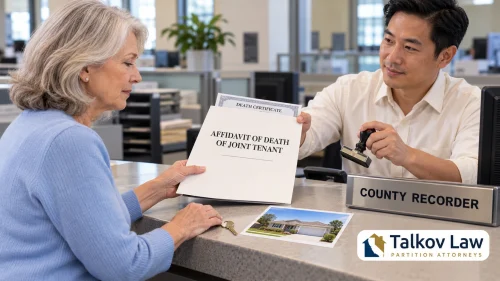
- The deceased joint tenant’s share does not go through probate. The survivor usually clears title by recording an affidavit of death of a joint tenant.
- A will cannot leave a joint tenant’s share to someone else. To keep a share from passing to the other owners, a joint tenant must sever the joint tenancy and record the severance before death under Civil Code 683.2, the statute on severing a joint tenancy.
- Survivorship applies only while the joint tenancy lasts. “A joint tenancy [may be] terminated by a voluntary conveyance … by a judgment in partition, or by an execution sale.” (Grothe v. Cortlandt Corp. (1992) 11 Cal.App.4th 1313, 1317, quoting Clark v. Carter (1968) 265 Cal.App.2d 291, 294.) A joint tenant who transfers their interest turns the buyer into a tenant in common with the remaining owners.
Civil Code 683(b): Bank Accounts Follow the Probate Code
Subdivision (b) takes joint bank accounts out of section 683 when the multiple-party account rules of the Probate Code, beginning at section 5100, apply to them. Those rules decide who owns a joint account during life and at death. For real estate, section 683 controls.
A Joint Tenancy Deed Is a Starting Point, Not the Final Word
Because section 683 requires equal shares, a deed that says “joint tenants” is strong evidence that the owners agreed to own the property equally. But it is evidence, not a final answer. A joint tenancy deed “creates a rebuttable presumption that it is held in joint tenancy,” which can be overcome “only by evidence tending to prove a common understanding or an agreement that the character of the property was to be other than joint tenancy.” (Machado v. Machado (1962) 58 Cal.2d 501, 506.) The presumption “may not be rebutted solely by evidence as to the source of the funds used to purchase the property.” (Gudelj v. Gudelj (1953) 41 Cal.2d 202, 212.) That fits the general rule of Evidence Code 662, which requires clear and convincing proof to overcome record title.
For a co-owner who paid more than half, those cases point to what matters: proof that the owners agreed their shares would track what each paid. With that proof, courts have divided joint tenancy property unequally:
- In Cosler v. Norwood (1950) 97 Cal.App.2d 665, 666, the court upheld a three-fourths and one-fourth split between joint tenants based on what each paid toward the purchase. See our summary of Cosler v. Norwood.
- In Kershman v. Kershman, the court held that co-owners on a joint tenancy deed can own unequal shares if they agreed their shares would follow what each paid.
- In Demetris v. Demetris, the court changed a mistaken joint tenancy deed into a tenancy in common and repaid a father’s extra down payment.
The opposite result is a “true joint tenancy,” in which the owners agreed to own equally no matter who paid what. In a true joint tenancy, the court “may not order reimbursement or contribution on account of differences in the amounts the parties have paid toward the initial acquisition of the property.” (Milian v. De Leon (1986) 181 Cal.App.3d 1185, 1195.) Our post on true joint tenancy under Milian v. De Leon explains how courts decide which kind of joint tenancy they are looking at, and our guide to unequal down payments and ownership interests covers how a down payment is repaid.
Joint Tenants Have the Same Right to Partition as Any Co-Owner
Section 683 says how a joint tenancy begins. It does not lock anyone in. A joint tenant can force the sale of the whole property through a partition action, just like a tenant in common. As the California Supreme Court put it, “in the absence of a waiver a joint tenant is entitled as a matter of right to have his interest severed from that of his cotenant.” (Lazzarevich v. Lazzarevich (1952) 39 Cal.2d 48, 50.) Today, Code of Civil Procedure section 872.710 (CCP 872.710 on the right to partition) makes partition between co-owners a matter of right unless barred by a valid waiver.
One timing point matters for joint tenants in particular. Filing a partition does not by itself sever the joint tenancy; the judgment does. A joint tenant who files should record a severance under Civil Code 683.2 at the start of the case, so that the right of survivorship cannot hand the whole property to the other owner if the filing owner dies first. Our guide to how to sever a joint tenancy in California walks through the steps, and our post on forcing the sale of jointly owned property explains the rest of the process.
Common Questions About Civil Code 683
Not as joint tenants. Section 683 requires equal shares. But a deed that says “joint tenants” can be shown to be wrong about the shares when the owners agreed otherwise, as in Cosler v. Norwood and Kershman v. Kershman. In that case the court treats the owners as holding unequal shares and divides the proceeds of a partition sale accordingly.
What If Our Deed Does Not Say How We Hold Title?
Then you are almost certainly tenants in common. Under Civil Code section 686, co-ownership is a tenancy in common unless the deed declares a joint tenancy, the property was acquired in partnership, or it was acquired as community property. Tenants in common have no right of survivorship, and each owner’s share passes under their will or trust, or to their heirs.
Do I Need My Co-Owner’s Permission to End a Joint Tenancy?
No. Under Civil Code 683.2, any joint tenant can sever the joint tenancy as to their own share without the other owners’ consent. Our sample deed to sever a joint tenancy shows how. Severing changes how you hold title. To get your money out, you still need a co-owner buyout or a partition action.
Is a Joint Tenancy Between a Parent and Child a Good Idea?
It avoids probate for the parent’s share if the parent dies first, but it also makes the child a co-owner with the same right to sever and the same right to force a sale. Our post on joint tenancy with a parent covers what happens when one of them changes course.
Joint Tenancy Starts With a Deed. Partition Ends It.
Civil Code section 683 explains how you and your co-owner came to share title. It does not decide how much of the money you receive when the co-ownership ends, and it does not require you to stay.
Talkov Law can help. With 12 full-time partition attorneys and experience in over 650 partition actions throughout California, our team handles every step of the process, from proving your share of the property through the partition sale and the final distribution of proceeds. No fees until you win. Call (877) PARTITION (727-8484) today or contact us online for a free 30-minute consultation.