Scott Talkov

What Information Should a Co-owner Gather for a Partition Action

What Information Should a Co-owner Gather for a Partition Action

In a partition action, gathering evidence to substantiate improvements or to prove your opposing party wrong is crucial. This evidence can significantly impact the offsets awarded and the credibility of your case. In this article, seasoned partition attorneys at Talkov Law share the variety of evidence that co-owners preparing for a partition may want to … Read More
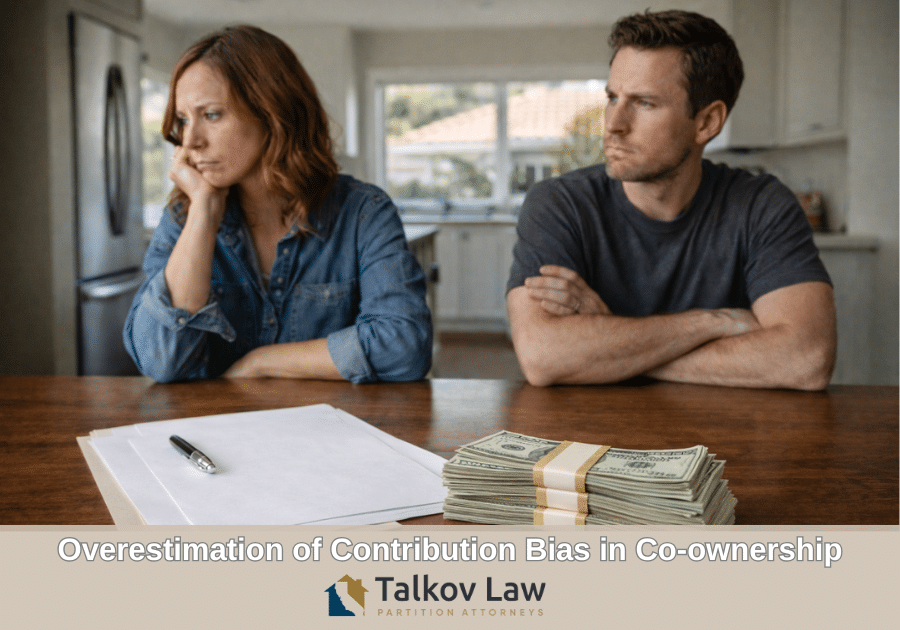
Overestimation of Contribution Bias in Co-ownership

Co-owning property with someone else can feel like a partnership—until it’s time to divide what’s yours. Disputes often arise because people tend to believe they contributed more than their fair share. This isn’t always intentional. It’s often due to something called overestimation of contribution bias, a common psychological tendency where people remember their own efforts … Read More

Down Payment Gifts in Partition Actions

In partition actions, where co-owners seek to divide or sell jointly owned property, the issue of down payment gifts can become a contentious matter. When one party receives a substantial financial gift from their family members or friends, intended to be used as a down payment for their share of the property, it can complicate … Read More

Can I Pick the Realtor in a Partition Action?

When a partition action calls for the sale of real property, picking a Realtor is a pivotal step. Co-owners can have an important role in selecting the Realtor, but they do not necessarily have the final authority on who will serve as the property’s Realtor. This article will explore the complexities and strategies surrounding the … Read More

Allocation of Costs of Partition Under the Partition of Real Property Act

Allocation of Costs of Partition Under the Partition of Real Property Act

Partition actions involve dividing co-owned property, which can be a complex and costly legal process. The Partition of Real Property Act in California guides how these costs should be allocated among the co-owners, focusing on fairness and the specific circumstances of each case. This article explores the principles behind the allocation of partition costs and … Read More

Joint Tenancy with a Parent: What Happens When the Parent Decides to Sever the Joint Tenancy?

In California, joint tenancy is a common way for parents and children to co-own property, often with the understanding that the property will automatically transfer to the surviving joint tenant, presumably the child, upon the death of the other, presumably the parent. However, joint tenancies can be severed, and this can cause significant issues when … Read More

Avoiding Double Counting Errors in Partition Actions

Avoiding Double Counting Errors in Partition Actions: A Common Pitfall in Real Estate Dispute Accounting

Partition actions, which resolve disputes between co-owners of real estate, often involve detailed accounting of costs, contributions, and reimbursements. Despite the best efforts of partition attorneys and courts, one common error that can significantly impact the fairness of a partition judgment is the double counting error. This occurs when costs or contributions are improperly included … Read More

Joint Tenant Trasfer of Interest

What Happens When a Joint Tenant Transfers Their Interest? Understanding Joint Tenancy in California

Joint tenancy is a common form of property ownership in California that includes the right of survivorship, meaning when one joint tenant dies, their interest automatically passes to the surviving joint tenant(s). However, what happens if one joint tenant decides to transfer their interest during their lifetime? This is a critical question that often arises … Read More

Prove Unpaid Rent in a California Partition Action

How to Prove Unpaid Rent in a California Partition Action

Proving Unpaid Net Rental Proceeds Collected by a Co-Owner in a California Partition Action Co-owning a property in California can be a profitable arrangement, particularly when it’s rented out. But what happens if one co-owner collects all the rent, perhaps for decades, but refuses to share the income? In a partition action, you may be … Read More

What Information Should a Co-owner Gather to Prove Mortgage Payments for a Partition Action?

Proving Mortgage Payments in a Partition Action Accounting

When co-owned property results in a partition action, the court or partition referee may require evidence of who paid the mortgage to divide the proceeds of sale. This article explains how to meticulously gather and organizing documents, including digital payment records between co-owners, to allow co-owners to present a compelling case to prove and recover … Read More

Talkov Law is Rated out of 5 stars based on 169 reviews

Contact Us Today for a Free Consultation

For select matters, payment can be deferred until resolution, with monthly billing also available.

Awards and Recognition

We Have Been Featured On:

Offices Throughout California

Los Angeles Partition Attorneys
10880 Wilshire Blvd Ste 1101
Los Angeles, CA 90024
Phone: (310) 496-3300

Orange County Partition Attorneys
4000 MacArthur Blvd Ste 655
Newport Beach, CA 92660
Phone: (949) 888-8800

San Jose Partition Attorneys
99 S. Almaden Blvd Suite 600
San Jose, CA 95113
Phone: (408) 777-6800

San Diego Partition Attorneys
11622 El Camino Real Ste 100
San Diego, CA 92130
Phone: (858) 800-3300

San Francisco Partition Attorneys
50 California St, Ste 1500
San Francisco, CA 94111
Phone: (415) 966-3300

Riverside Partition Attorneys
3610 Central Ave, Ste 400
Riverside, CA 92506
Phone: (951) 888-3300

Sacramento Partition Attorneys
500 Capitol Mall, Suite 2350
Sacramento, CA 95814
Phone: (916) 668-3300

The information on this site, including the Talkov Law Blog, is intended for general information purposes only. By using this site, you agree that any information contained in the site does not constitute legal, financial or any other form of professional advice. Information on this site may be changed without notice and is not guaranteed to be complete, accurate, correct or up-to-date.