Talkov Law Trending legal topics
Newest Blog Posts and Legal Articles
Abandoned Property Partition Action: What to Do When a Co-Owner Walks Away
A co-owner who abandons a property in California does not lose their ownership rights, but their absence often creates financial strain that can be resolved through a partition action. When one co-owner stops contributing, the remaining co-owner is often left covering the mortgage and upkeep alone. This situation is common among unmarried couples, family members, … Read More

Can You Force a Co-Owner to Buy Your Share?
When co-owners of real estate decide to go their separate ways, a buyout is often the first solution discussed. One party keeps the property and pays the other for their share. However, this only works if the co-owner has the financial ability and is willing to follow through. When the buyout does not happen, many … Read More
What Happens When a Co-Owner Refuses to Communicate About Sale or Buyout? (Partition Actions)
When a co-owner refuses to communicate about selling jointly owned property, California law allows you to force a resolution through a partition action. For the co-owner seeking a resolution, this lack of response can feel like being trapped in a situation with no clear path forward. Why Co-Owners Refuse to Communicate It is common for … Read More
Most Popular Blogs and Real Estate Legal Guides
[metaslider id=”29611″]
Offsets in Partition
Abandoned Property Partition Action: What to Do When a Co-Owner Walks Away
A co-owner who abandons a property in California does not lose their ownership rights, but their absence often creates financial strain that can be resolved through a partition action. When one co-owner stops contributing, the remaining co-owner is often left covering the mortgage and upkeep alone. This situation is common among unmarried couples, family members, … Read More
Co-Owner Can’t Force You to Pay Their Capital Gains Tax in a Partition Sale
Among the more creative arguments in partition action cases is the idea that one co-owner should pay the capital gains taxes of the other co-owner. When co-owned property is sold, especially in a partition action, disputes often arise over who gets what, known as a partition accounting. Usually, these claims about accounting relate to unequal … Read More

Taxes Every California Real Estate Owner Should Understand
Owning real estate in California can create significant financial opportunity — and significant tax complexity. Whether the property is a residence, rental, inherited asset, or co-owned investment, multiple layers of taxes may apply at different stages of co-ownership. For co-owners in particular, taxes often become critically important when a dispute arises, a buyout is negotiated, … Read More
Cost of Partition
Improvements and Repairs
Down Payment Recovery
Mortgage Payments
Rental Income
Procedures in Partition
Lis Pendens in Partitions
Partition Statutes
Filing for Partition
Referees in Partition
How Does a Partition Referee Sell Property in California?
When co-owners of real estate cannot agree on what to do with the property, a court may order a partition by sale to ensure each owner receives their fair share. The person responsible for carrying out that sale is the partition referee, a neutral professional appointed by the court to handle everything from hiring a … Read More
Partition Action Timeline: What to Expect from Start to Finish
As California’s first, most popular, and fastest partition law firm, we are often asked how long a partition will take. Talkov Law generally completes partitions in an average of just 7 months to obtain a settlement or judgment of partition, which is followed by a sale or refinance- all without a trial. Other firms lacking … Read More

Forcing the Sale after the Death of a Co-Owner Without Probate
Californians with a deceased co-owner can force the sale of the property without going through probate by filing a partition action. In California, the court can proceed with the partition by joining the deceased co-owner’s representative or successor, or simply their estate if their is no representative. This ensures that the property can be sold … Read More
Judgements in Partitions
Probate Code § 11950 – Two or More Beneficiaries Entitled to Undivided Interests; Petition for Partition, Allotment or Other Division (Probate Actions)
California Probate Code § 11950 is the California probate statute that allows two or more beneficiaries who are entitled to undivided interests in estate property to petition the court for a partition, allotment, or other division of that property. This statute ensures that co-beneficiaries can equitably divide estate property subject to administration and avoid the … Read More
Partition Action Timeline: What to Expect from Start to Finish
As California’s first, most popular, and fastest partition law firm, we are often asked how long a partition will take. Talkov Law generally completes partitions in an average of just 7 months to obtain a settlement or judgment of partition, which is followed by a sale or refinance- all without a trial. Other firms lacking … Read More

How Are Proceeds Divided After a Partition Sale?
When co-owners of real estate can no longer agree on how to manage, use, or sell a property, a partition action becomes the legal solution to resolve the dispute. One of the most common outcomes of a partition action is a partition by sale, where the property is sold, and the proceeds are divided among … Read More
Discovery in Partition
Partition Action Timeline: What to Expect from Start to Finish
As California’s first, most popular, and fastest partition law firm, we are often asked how long a partition will take. Talkov Law generally completes partitions in an average of just 7 months to obtain a settlement or judgment of partition, which is followed by a sale or refinance- all without a trial. Other firms lacking … Read More

Deposition Objections in California: A Guide for Attorneys
Depositions are a critical part of litigation, allowing attorneys to gather testimony and establish facts before trial. In California, however, the rules governing deposition objections are stricter than in the courtroom. Knowing which objections are proper is essential to preserve the record and avoid unnecessary disruptions. Here’s a quick guide to the proper objections at … Read More

How to Prove Unpaid Rent in a California Partition Action
Proving Unpaid Net Rental Proceeds Collected by a Co-Owner in a California Partition Action Co-owning a property in California can be a profitable arrangement, particularly when it’s rented out. But what happens if one co-owner collects all the rent, perhaps for decades, but refuses to share the income? In a partition action, you may be … Read More
Forms in Partition

What is a Notice of Ouster? (Civil Code § 843)
A notice of ouster is a demand to the co-owner in possession for concurrent possession of the property issued by a tenant out of possession. The law requires that “[t]he written demand shall make specific reference to this section [Civil Code § 843] and to the time within which concurrent possession must be offered under … Read More

Partition Action Forms [California Template Sample Example]
Each partition action presents unique challenges. However, all partition actions start with a complaint for partition, sometimes known as a petition to partition property, which is usually a partition by sale. We have provided free online forms for partition actions that should only be used in conjunction with a partition attorney in California. As the … Read More
![What to Do When a Co-Owner Dies in a Partition Action [Form Template Example - Code of Civil Procedure 872.530(b)] Affidavit re Death of Co-Owner.jpg](https://talkovlaw.com/wp-content/uploads/What-do-Do-When-a-Co-Owner-Dies-in-a-Partition-Action-Form-Template-Example-Code-of-Civil-Procedure-872.530b-Affidavit-re-Death-of-Co-Owner-500x361.jpg)
What to Do When a Co-Owner Dies During or Before a Partition Action [Form Template Example – Code of Civil Procedure 872.530(b)]
Affidavit re: Death of Co-Owner [Sample] Co-owning real estate in California comes with many different challenges. If you’re ready to sell but your co-owner refuses, a partition action is the only court-ordered way to force the sale of property. Litigants in partition actions may find themselves in the unfortunate situation of having to declare that … Read More
Co-Ownership
Abandoned Property Partition Action: What to Do When a Co-Owner Walks Away
A co-owner who abandons a property in California does not lose their ownership rights, but their absence often creates financial strain that can be resolved through a partition action. When one co-owner stops contributing, the remaining co-owner is often left covering the mortgage and upkeep alone. This situation is common among unmarried couples, family members, … Read More
What Happens When a Co-Owner Refuses to Communicate About Sale or Buyout? (Partition Actions)
When a co-owner refuses to communicate about selling jointly owned property, California law allows you to force a resolution through a partition action. For the co-owner seeking a resolution, this lack of response can feel like being trapped in a situation with no clear path forward. Why Co-Owners Refuse to Communicate It is common for … Read More
Amundson v. Catello (2025) – Can Heirs Force a Partition Sale?
The recent decision in Amundson et al. v. Catello (2025) 111 Cal.App.5th 817 serves as an important reminder that not everyone who expects to own property has the legal right to bring a partition action. Background of the Case In Amundson, siblings of a decedent sought to partition real property that was still subject to … Read More
Transfer in Co-Ownership
Quiet Title in Partition
Amundson v. Catello (2025) – Can Heirs Force a Partition Sale?
The recent decision in Amundson et al. v. Catello (2025) 111 Cal.App.5th 817 serves as an important reminder that not everyone who expects to own property has the legal right to bring a partition action. Background of the Case In Amundson, siblings of a decedent sought to partition real property that was still subject to … Read More
Oral Agreement Cannot Prevent Joint Tenancy Severance in California
Within the law of California real estate co-ownership, among the most common myths in joint tenancy is that an oral agreement can establish prevent the joint tenancy from being severed. California law is clear: it cannot. The same is true for the creation of a joint tenancy. This issue is critical as many joint tenants … Read More

Severance of a Joint Tenancy After the ATRO in a Marital Dissolution: Implications for Partition Actions
In California, spouses frequently hold real estate as joint tenants, meaning that if one spouse dies, their interest automatically passes to the surviving spouse by right of survivorship. However, when a marriage dissolves, one spouse may wish to sever the joint tenancy and transfer their half interest to a living trust to ensure the property … Read More
Possession & Co-Ownership

Sibling Rivalries and Co-Ownership Partition Actions: When Family Heirlooms Become Legal Disputes
When siblings inherit a house together, the property is often more than a set of walls and a roof. It is the last place everyone remembers Mom cooking holidays, the hallway where Dad used to stand telling stories, and the backyard where the older brother taught the younger brother how to throw a ball. But … Read More
When a Co-Owner in Possession Refuses to Cooperate in California
One of the most common reasons a co-owner refuses to cooperate with a sale is simple: they are already getting what they want. If your co-owner is living in the property, they may have little incentive to sell or buy you out. In fact, they may actively delay, obstruct, or ignore your requests in hopes … Read More
Inheriting a House with an Uncooperative Family Member
Inheriting a home can feel like a blessing, but it often turns into a nightmare when one family member refuses to cooperate. A common problem occurs when a sibling or relative moves into the inherited home, refuses to sell, and doesn’t contribute to property expenses. Meanwhile, the other heirs are left paying taxes, insurance, and … Read More
Joint Tenancy
Right of Survivorship in California: How It Affects Co-Ownership and Partition Actions
The right of survivorship determines whether property skips probate—or sparks a legal dispute. In California, this powerful legal principle allows a surviving co-owner to automatically inherit the deceased owner’s share of real estate—but only if title is held in a very specific way. When survivorship rights are not clearly stated in the deed, the property … Read More
What to Do If a Majority Owner Refuses a Partition Action
When the majority owner refuses a partition action, you don’t have to stay trapped—California law is on your side. When co-owners of real estate don’t see eye to eye, disputes are inevitable—especially when one party wants to sell, but the majority owner(s) disagrees. Fortunately, California law provides a clear legal path forward for minority owners … Read More
Oral Agreement Cannot Prevent Joint Tenancy Severance in California
Within the law of California real estate co-ownership, among the most common myths in joint tenancy is that an oral agreement can establish prevent the joint tenancy from being severed. California law is clear: it cannot. The same is true for the creation of a joint tenancy. This issue is critical as many joint tenants … Read More
Tenants in Common
Right of Survivorship in California: How It Affects Co-Ownership and Partition Actions
The right of survivorship determines whether property skips probate—or sparks a legal dispute. In California, this powerful legal principle allows a surviving co-owner to automatically inherit the deceased owner’s share of real estate—but only if title is held in a very specific way. When survivorship rights are not clearly stated in the deed, the property … Read More
What to Do If a Majority Owner Refuses a Partition Action
When the majority owner refuses a partition action, you don’t have to stay trapped—California law is on your side. When co-owners of real estate don’t see eye to eye, disputes are inevitable—especially when one party wants to sell, but the majority owner(s) disagrees. Fortunately, California law provides a clear legal path forward for minority owners … Read More

Selling Inherited Property: Do All Heirs Have to Agree?
Can you sell inherited property if the other heirs say no? Yes—you can. That answer surprises many California heirs. When multiple heirs inherit real estate in California, it’s not uncommon for disagreements to arise—especially when one heir wants to sell the property but others do not. Many co-owners assume that all heirs must unanimously agree … Read More
Manner of Partition
Abandoned Property Partition Action: What to Do When a Co-Owner Walks Away
A co-owner who abandons a property in California does not lose their ownership rights, but their absence often creates financial strain that can be resolved through a partition action. When one co-owner stops contributing, the remaining co-owner is often left covering the mortgage and upkeep alone. This situation is common among unmarried couples, family members, … Read More
What Happens When a Co-Owner Refuses to Communicate About Sale or Buyout? (Partition Actions)
When a co-owner refuses to communicate about selling jointly owned property, California law allows you to force a resolution through a partition action. For the co-owner seeking a resolution, this lack of response can feel like being trapped in a situation with no clear path forward. Why Co-Owners Refuse to Communicate It is common for … Read More
Amundson v. Catello (2025) – Can Heirs Force a Partition Sale?
The recent decision in Amundson et al. v. Catello (2025) 111 Cal.App.5th 817 serves as an important reminder that not everyone who expects to own property has the legal right to bring a partition action. Background of the Case In Amundson, siblings of a decedent sought to partition real property that was still subject to … Read More
Partition By Sale

Can You Force a Co-Owner to Buy Your Share?
When co-owners of real estate decide to go their separate ways, a buyout is often the first solution discussed. One party keeps the property and pays the other for their share. However, this only works if the co-owner has the financial ability and is willing to follow through. When the buyout does not happen, many … Read More
How Does a Partition Referee Sell Property in California?
When co-owners of real estate cannot agree on what to do with the property, a court may order a partition by sale to ensure each owner receives their fair share. The person responsible for carrying out that sale is the partition referee, a neutral professional appointed by the court to handle everything from hiring a … Read More
Inheriting a House with an Uncooperative Family Member
Inheriting a home can feel like a blessing, but it often turns into a nightmare when one family member refuses to cooperate. A common problem occurs when a sibling or relative moves into the inherited home, refuses to sell, and doesn’t contribute to property expenses. Meanwhile, the other heirs are left paying taxes, insurance, and … Read More
Partition of Real Property Act
Can You Force a Co-Owner to Buy Your Share?
When co-owners of real estate decide to go their separate ways, a buyout is often the first solution discussed. One party keeps the property and pays the other for their share. However, this only works if the co-owner has the financial ability and is willing to follow through. When the buyout does not happen, many … Read More
Multi-Property Partitions: Should I Leave One Property Out of the Partition?
Multi-property partitions can become one of the most complicated real estate disputes co-owners face. When co-owners purchase or when families inherit multiple properties together, it doesn’t take long before disagreements arise. Some co-owners want to sell everything, while others insist on keeping certain properties in the family. This raises an important question: Should all properties … Read More
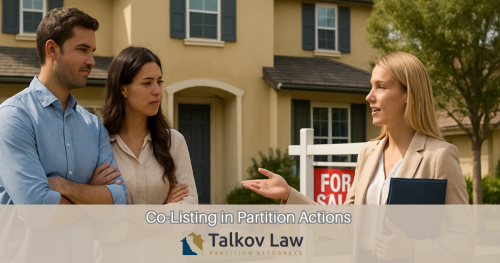
Co-Listing as a Solution to Settle Co-Owned Property Disputes
Many co-owners agree that their property should be sold, but end up deadlocked of whose Realtor should be the listing agent. A simple solution is to allow co-listing whereby two listings agents place the property on the market, thereby allowing each co-owner to have an agent they trust handling the sale of the property. This … Read More
Partition in Kind
Probate Code § 11953 – Division Proportionate to Party’s Interest; Sale Instead of Division; Agreement to Accept Undivided Interest (Probate Actions)
California Probate Code § 11953 is the California probate statute that governs how property should be divided among multiple beneficiaries who hold undivided interests in estate property, i.e., co-ownership. This section ensures that each beneficiary receives a portion of property equal in value to their share of the estate and allows for a sale when … Read More
Multi-Property Partitions: Should I Leave One Property Out of the Partition?
Multi-property partitions can become one of the most complicated real estate disputes co-owners face. When co-owners purchase or when families inherit multiple properties together, it doesn’t take long before disagreements arise. Some co-owners want to sell everything, while others insist on keeping certain properties in the family. This raises an important question: Should all properties … Read More
Partition Action Timeline: What to Expect from Start to Finish
As California’s first, most popular, and fastest partition law firm, we are often asked how long a partition will take. Talkov Law generally completes partitions in an average of just 7 months to obtain a settlement or judgment of partition, which is followed by a sale or refinance- all without a trial. Other firms lacking … Read More
Partition By Appraisal

Code of Civil Procedure 873.980 – Relation of Agreement to Other Remedies (Partition by Appraisal)
California Code of Civil Procedure 873.980 is the California partition statute that addresses that the agreement between co-owners to proceed with a partition by appraisal is binding on third parties. The statute provides that: The provisions of this chapter are cumulative and if, for default or other cause, interests are not transferred and acquired pursuant to this … Read More

Code of Civil Procedure 873.970 – Agreement as Binding Heirs, Executors, Etc.; Default (Partition by Appraisal)
California Code of Civil Procedure 873.970 is the California partition statute that addresses that the agreement between co-owners to proceed with a partition by appraisal is binding on third parties. The statute provides that: The agreement binds the heirs, executors, administrators, successors, and assigns of the parties. In the event of default, the aggrieved parties may specifically … Read More

Code of Civil Procedure 873.960 – Hearing; Confirmation of Report; Conditions; Judgment (Partition by Appraisal)
California Code of Civil Procedure 873.960 is the California partition statute that addresses the confirmation of the report the partition referee upon transfer of the property in a partition by appraisal. The statute provides that: At the hearing, the court shall examine the report and witnesses. If the court determines that the proceedings have been regularly conducted, … Read More
Strategies in Partition
Abandoned Property Partition Action: What to Do When a Co-Owner Walks Away
A co-owner who abandons a property in California does not lose their ownership rights, but their absence often creates financial strain that can be resolved through a partition action. When one co-owner stops contributing, the remaining co-owner is often left covering the mortgage and upkeep alone. This situation is common among unmarried couples, family members, … Read More
Can You Force a Co-Owner to Buy Your Share?
When co-owners of real estate decide to go their separate ways, a buyout is often the first solution discussed. One party keeps the property and pays the other for their share. However, this only works if the co-owner has the financial ability and is willing to follow through. When the buyout does not happen, many … Read More
Amundson v. Catello (2025) – Can Heirs Force a Partition Sale?
The recent decision in Amundson et al. v. Catello (2025) 111 Cal.App.5th 817 serves as an important reminder that not everyone who expects to own property has the legal right to bring a partition action. Background of the Case In Amundson, siblings of a decedent sought to partition real property that was still subject to … Read More
Defenses to Partition
What to Do If a Majority Owner Refuses a Partition Action
When the majority owner refuses a partition action, you don’t have to stay trapped—California law is on your side. When co-owners of real estate don’t see eye to eye, disputes are inevitable—especially when one party wants to sell, but the majority owner(s) disagrees. Fortunately, California law provides a clear legal path forward for minority owners … Read More
Oral Agreement Cannot Prevent Joint Tenancy Severance in California
Within the law of California real estate co-ownership, among the most common myths in joint tenancy is that an oral agreement can establish prevent the joint tenancy from being severed. California law is clear: it cannot. The same is true for the creation of a joint tenancy. This issue is critical as many joint tenants … Read More

Pleading Requirements for Waiver of Partition
In California, a partition is an absolute right for co-owners, however, the right can be waived by properly pleading the right has been waived. This article explains what constitutes a valid waiver and how to properly plead it in court when seeking to enforce a partition waiver. What is a Waiver of Partition? In California, … Read More
Partition FAQ
Abandoned Property Partition Action: What to Do When a Co-Owner Walks Away
A co-owner who abandons a property in California does not lose their ownership rights, but their absence often creates financial strain that can be resolved through a partition action. When one co-owner stops contributing, the remaining co-owner is often left covering the mortgage and upkeep alone. This situation is common among unmarried couples, family members, … Read More
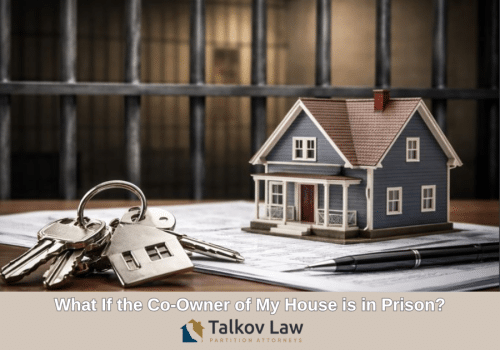
What If the Co-Owner of My House is in Prison?
Owning a house with someone is hard enough when you can talk, negotiate, and sign paperwork together. But when the co-owner is incarcerated, normal solutions often grind to a halt—refinancing stalls, sale decisions get vetoed, and even basic issues like repairs and improvements or rental management turn into disputes. In California, incarceration does not erase … Read More

File a Partition Before Home Prices Drop in California?
Partition actions in California are most effective when filed before home values begin to fall. If you’re involved in the co-ownership of real property and notice signs of a declining market—rising interest rates, increased inventory, or more price cuts—now may be the time to act. Filing early can mean the difference between preserving your equity … Read More
Co-Owner Buyouts
Can You Force a Co-Owner to Buy Your Share?
When co-owners of real estate decide to go their separate ways, a buyout is often the first solution discussed. One party keeps the property and pays the other for their share. However, this only works if the co-owner has the financial ability and is willing to follow through. When the buyout does not happen, many … Read More
File a Partition Before Home Prices Drop in California?
Partition actions in California are most effective when filed before home values begin to fall. If you’re involved in the co-ownership of real property and notice signs of a declining market—rising interest rates, increased inventory, or more price cuts—now may be the time to act. Filing early can mean the difference between preserving your equity … Read More
Multi-Property Partitions: Should I Leave One Property Out of the Partition?
Multi-property partitions can become one of the most complicated real estate disputes co-owners face. When co-owners purchase or when families inherit multiple properties together, it doesn’t take long before disagreements arise. Some co-owners want to sell everything, while others insist on keeping certain properties in the family. This raises an important question: Should all properties … Read More
Arbitration in Partition

A Free Guide on How to Enforce Arbitration Agreements
Arbitration Agreements Govern a Wide Range of Disputes Arbitration agreements are becoming more and more prevalent in a wide range of contracts. For example, depending on the breadth of the arbitration clause governing the parties’ relationship, arbitration may be compelled in real estate litigation, business litigation, breach of contract actions, and business fraud actions. As such, … Read More
Prosecuting the Partition
Amundson v. Catello (2025) – Can Heirs Force a Partition Sale?
The recent decision in Amundson et al. v. Catello (2025) 111 Cal.App.5th 817 serves as an important reminder that not everyone who expects to own property has the legal right to bring a partition action. Background of the Case In Amundson, siblings of a decedent sought to partition real property that was still subject to … Read More
Sibling Rivalries and Co-Ownership Partition Actions: When Family Heirlooms Become Legal Disputes
When siblings inherit a house together, the property is often more than a set of walls and a roof. It is the last place everyone remembers Mom cooking holidays, the hallway where Dad used to stand telling stories, and the backyard where the older brother taught the younger brother how to throw a ball. But … Read More
When a Co-Owner in Possession Refuses to Cooperate in California
One of the most common reasons a co-owner refuses to cooperate with a sale is simple: they are already getting what they want. If your co-owner is living in the property, they may have little incentive to sell or buy you out. In fact, they may actively delay, obstruct, or ignore your requests in hopes … Read More
Settlements in Partition
Co-Listing as a Solution to Settle Co-Owned Property Disputes
Many co-owners agree that their property should be sold, but end up deadlocked of whose Realtor should be the listing agent. A simple solution is to allow co-listing whereby two listings agents place the property on the market, thereby allowing each co-owner to have an agent they trust handling the sale of the property. This … Read More

The Hidden Dangers of DIY Co-Ownership Settlement Agreements
When co-owners of real estate face disputes, drafting a co-ownership settlement agreement often seems like a logical and cost-effective way to avoid litigation. However, when co-owners draft these agreements without a skilled partition attorney, they unknowingly set themselves up for significant legal and financial risks. The most glaring danger? Trading the straightforward and cost-effective remedy … Read More

Can I Pick the Realtor in a Partition Action?
When a partition action calls for the sale of real property, picking a Realtor is a pivotal step. Co-owners can have an important role in selecting the Realtor, but they do not necessarily have the final authority on who will serve as the property’s Realtor. This article will explore the complexities and strategies surrounding the … Read More
Related Partition Issues
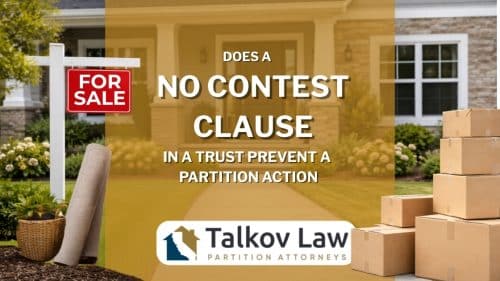
Does a No Contest Clause in a Trust Prevent a Partition?
When a trust beneficiary co-owns inherited property with other beneficiaries, disputes over the property are common. One question that frequently arises is whether a beneficiary who files a partition action to force the sale or division of that property risks triggering a no contest clause buried in the trust. The short answer is: almost certainly … Read More
Co-Owner Can’t Force You to Pay Their Capital Gains Tax in a Partition Sale
Among the more creative arguments in partition action cases is the idea that one co-owner should pay the capital gains taxes of the other co-owner. When co-owned property is sold, especially in a partition action, disputes often arise over who gets what, known as a partition accounting. Usually, these claims about accounting relate to unequal … Read More

Family Code § 2108 – Is a Partition Action the Better Option?
Co-ownership with a divorcing couples presents a challenge to force the sale of a property when a co-owner wants out due to the high burden of Family Code § 2108. This is where a partition action often becomes the more powerful legal tool. What Does Family Code Section 2108 Do? California Family Code Section 2108 … Read More
Bankruptcy in Partition

Bankruptcy Co-Ownership Offset Disputes – Applying Partition Laws in a Section 363(h) Sale of Co-Owned Property – In re Flynn, 297 B.R. 599 (B.A.P. 9th Cir. 2003)
When a co-owner files for bankruptcy in a partition, the bankruptcy trustee or debtor-in-possession may seek to sell the co-owned property under Section 363(h) of the Bankruptcy Code (11 U.S.C. Section 363(h)). However, the Bankruptcy Court is empowered to apply California law on co-ownership offsets to ensure that the proceeds are equitably divided. These bankruptcies … Read More

Terminating Sanctions for Document Fabrication in Federal Court
Federal courts have repeatedly found that terminating sanctions are appropriate when a party commits the cardinal sin of litigation since “fabricating evidence has been referred to as the most egregious misconduct which justifies a finding of fraud upon the Court.” Kenno v. Colorado’s Governor’s Off. of Info. Tech., 2021 WL 2682619, at *19 (D. Colo. June … Read More

11 USC 522(o) – Homestead Exemption Limitations in Bankruptcy
In bankruptcy, creditors can allege that debtors should lose the part of their homestead exemption that is allegedly “attributable to” an “intent to hinder, delay, or defraud a creditor” under 11 U.S.C. § 522(o). This is particularly important given the recent increase in California’s homestead exemption effective January 1, 2021, which is now as high … Read More
Trusts, Probates, and Co-Owner’s Death
Does a No Contest Clause in a Trust Prevent a Partition?
When a trust beneficiary co-owns inherited property with other beneficiaries, disputes over the property are common. One question that frequently arises is whether a beneficiary who files a partition action to force the sale or division of that property risks triggering a no contest clause buried in the trust. The short answer is: almost certainly … Read More
Amundson v. Catello (2025) – Can Heirs Force a Partition Sale?
The recent decision in Amundson et al. v. Catello (2025) 111 Cal.App.5th 817 serves as an important reminder that not everyone who expects to own property has the legal right to bring a partition action. Background of the Case In Amundson, siblings of a decedent sought to partition real property that was still subject to … Read More
Sibling Rivalries and Co-Ownership Partition Actions: When Family Heirlooms Become Legal Disputes
When siblings inherit a house together, the property is often more than a set of walls and a roof. It is the last place everyone remembers Mom cooking holidays, the hallway where Dad used to stand telling stories, and the backyard where the older brother taught the younger brother how to throw a ball. But … Read More
Finance & Liens
What If the Co-Owner of My House is in Prison?
Owning a house with someone is hard enough when you can talk, negotiate, and sign paperwork together. But when the co-owner is incarcerated, normal solutions often grind to a halt—refinancing stalls, sale decisions get vetoed, and even basic issues like repairs and improvements or rental management turn into disputes. In California, incarceration does not erase … Read More

Does the Federal Government Shutdown Impact Partition Actions?
With the federal government shutting down from time to time, many property owners are asking whether this will affect partition actions in California. Partition is the legal process that allows a co-owner to force the sale or division of real estate, so it’s understandable to worry about possible court delays. The good news is that … Read More
How Are Proceeds Divided After a Partition Sale?
When co-owners of real estate can no longer agree on how to manage, use, or sell a property, a partition action becomes the legal solution to resolve the dispute. One of the most common outcomes of a partition action is a partition by sale, where the property is sold, and the proceeds are divided among … Read More
Fraud in Co-Ownership

Why Past Consideration Cannot Support a Contract in California
In California contract law, past consideration cannot form the basis of an enforceable contract. This principle plays a crucial role in real estate and partition disputes, where parties may attempt to retroactively classify a past financial transaction—such as a gift—as a secured loan. This is common in intra-family partitions and ex-boyfriend/ex-girlfriend partitions. Courts have repeatedly … Read More

Will a Judgment Lien Attach if a Property is Transferred?
Transferring ownership of a property is a common occurrence in the world of real estate, whether it be through a sale, gift, or inheritance. When a property is transferred from one owner to another, it is essential to publicly record the change in ownership through a legally binding document known as a deed. This deed … Read More

The Impact of an Unrecorded Deed in California Partition Actions
An unrecorded deed in real estate law introduces uncertainty and potential complications. Recording deeds, such as grant deeds and quitclaim deeds, is a crucial step in establishing and protecting property rights. A properly recorded deed serves as constructive notice of ownership. However, an unrecorded deed, one not officially documented in the public records, can have … Read More
Anti-SLAPP in Partitions

Can You Sue an Attorney for Doing their Job? [Anti-SLAPP Protection for Litigation-Related Activities]
Can an Attorney Be Sued for Representing a Client in Litigation? It may sound ridiculous, but attorneys (or their law firms) are sometimes tacked on as defendants in a complaint. Is this legal? Can another attorney do this? Talkov Law’s attorneys explain how anti-SLAPP law prevents this and the devastating legal repercussions of including a … Read More

Anti-SLAPP Can Be Used to Strike “Mixed Conduct” Claims [Baral v. Schnitt (2016) 1 Cal. 5th 376]
California’s Anti-SLAPP History Like 28 other US states, California has enacted an anti-SLAPP statute in its Code of Civil Procedure. The statute states that “[a] cause of action against a person arising from any act of that person in furtherance of the person’s right of petition or free speech under the United States Constitution or … Read More

Actual Malice Standard for Defamation of Public Figures in California
Public Figures Bear a Heavy Burden to Show Actual Malice for Defamation in California Many public figures have trouble understanding that they enjoy very limited protection from defamation. Instead, they are required to meet a heavy burden to establish actual malice, which can rarely be proven. “To show actual malice, plaintiffs must demonstrate [that the … Read More
Family Law in Partition
Family Code § 2108 – Is a Partition Action the Better Option?
Co-ownership with a divorcing couples presents a challenge to force the sale of a property when a co-owner wants out due to the high burden of Family Code § 2108. This is where a partition action often becomes the more powerful legal tool. What Does Family Code Section 2108 Do? California Family Code Section 2108 … Read More
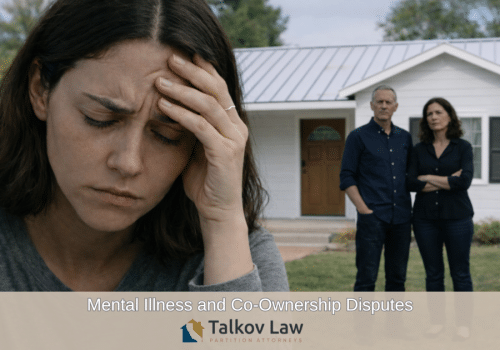
Mental Illness and Co-Ownership Disputes
Mental illness can create challenges, with property co-ownership being particularly challenging under California law. From refusal to sell to unpaid expenses, behavioral health concerns can complicate co-ownership and often lead to property disputes. Conditions like anxiety, depression, or substance use disorders may cause communication breakdowns, financial mismanagement, or outright refusal to cooperate. These issues often … Read More

Partition of Property Co-Owned with Divorcing Couple (Joinder Family Code § 2021)
Co-ownership disputes are complicated when you co-own with a married couple. However, a forced sale of property owned by a third party and a married couple can be addressed 1) through a partition action filed by any co-owner, or 2) through a family law proceeding if the married couple is divorcing, as explained below. Purely … Read More
Cross-Complaints

Code of Civil Procedure § 430.41 – SB 383 Limits Demurrers in California
Effective January 1, 2016, SB 383 severely limits the use of demurrers in California through newly-enacted California Code of Civil Procedure § 430.41.
Real Estate Litigation
Right of Survivorship in California: How It Affects Co-Ownership and Partition Actions
The right of survivorship determines whether property skips probate—or sparks a legal dispute. In California, this powerful legal principle allows a surviving co-owner to automatically inherit the deceased owner’s share of real estate—but only if title is held in a very specific way. When survivorship rights are not clearly stated in the deed, the property … Read More
How Are Proceeds Divided After a Partition Sale?
When co-owners of real estate can no longer agree on how to manage, use, or sell a property, a partition action becomes the legal solution to resolve the dispute. One of the most common outcomes of a partition action is a partition by sale, where the property is sold, and the proceeds are divided among … Read More

Why Oral Life Estates Are Not Legally Recognized in California
California law is clear: a life estate must be in writing to be legally enforceable. In California, real estate transactions conveying ownership interests must follow strict legal requirements, particularly when it comes to life estates. Some property owners mistakenly believe that someone can transfer a life estate through a verbal agreement, but this is not … Read More
Relations of Co-Owners
Amundson v. Catello (2025) – Can Heirs Force a Partition Sale?
The recent decision in Amundson et al. v. Catello (2025) 111 Cal.App.5th 817 serves as an important reminder that not everyone who expects to own property has the legal right to bring a partition action. Background of the Case In Amundson, siblings of a decedent sought to partition real property that was still subject to … Read More
Sibling Rivalries and Co-Ownership Partition Actions: When Family Heirlooms Become Legal Disputes
When siblings inherit a house together, the property is often more than a set of walls and a roof. It is the last place everyone remembers Mom cooking holidays, the hallway where Dad used to stand telling stories, and the backyard where the older brother taught the younger brother how to throw a ball. But … Read More
When a Co-Owner in Possession Refuses to Cooperate in California
One of the most common reasons a co-owner refuses to cooperate with a sale is simple: they are already getting what they want. If your co-owner is living in the property, they may have little incentive to sell or buy you out. In fact, they may actively delay, obstruct, or ignore your requests in hopes … Read More
Inheritance Partitions
Can You Force a Co-Owner to Buy Your Share?
When co-owners of real estate decide to go their separate ways, a buyout is often the first solution discussed. One party keeps the property and pays the other for their share. However, this only works if the co-owner has the financial ability and is willing to follow through. When the buyout does not happen, many … Read More
Does a No Contest Clause in a Trust Prevent a Partition?
When a trust beneficiary co-owns inherited property with other beneficiaries, disputes over the property are common. One question that frequently arises is whether a beneficiary who files a partition action to force the sale or division of that property risks triggering a no contest clause buried in the trust. The short answer is: almost certainly … Read More

Spouse Won’t Sell an Inherited House in California
When a spouse inherits a fractional interest in a house from their family, disagreements can arise within the marriage about what should happen to the co-owned property. One spouse may want to sell the inherited home and use the money to move or invest elsewhere, while the spouse who inherited the property may want to … Read More
Post-Romance Partitions
Severance of a Joint Tenancy After the ATRO in a Marital Dissolution: Implications for Partition Actions
In California, spouses frequently hold real estate as joint tenants, meaning that if one spouse dies, their interest automatically passes to the surviving spouse by right of survivorship. However, when a marriage dissolves, one spouse may wish to sever the joint tenancy and transfer their half interest to a living trust to ensure the property … Read More

Will My Ex Obtain Half the Equity in a Partition?
A common misperception in co-ownership of real estate in California is that ex-boyfriends and ex-girlfriends will each get half the proceeds of sale in a partition. This myth is often repeated by exes who put in less than half the money on the property, but want half now that the romantic relationship has ended since … Read More

Should I Stay on the Mortgage of a Co-Owned House?
Co-owning a home can be a practical solution to rising housing costs, but when circumstances change and you want to sell your partial interest in the property, it raises the question: should you agree to stay on the mortgage or should you be removed from the mortgage? This decision requires careful consideration of several factors … Read More