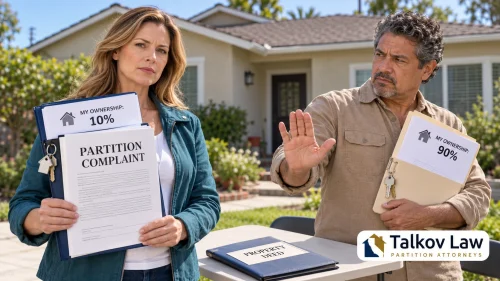

A co-owner cannot stop or postpone a partition because the property earns good rent or because its value is expected to rise. In De Roulet v. Mitchel (1945) 70 Cal.App.2d 120, 123–124, the California Court of Appeal reversed a trial court that refused to sell a co-owned Los Angeles building for exactly those reasons, and it ordered the sale. The case is still quoted for the rule that “a cotenant is entitled to partition as a matter of absolute right.”
Why De Roulet v. Mitchel Matters
Many co-owners who refuse to sell do not deny that the other owner has rights. They argue about timing instead: the tenant pays well, the market will be better next year, and selling now leaves money on the table. De Roulet answers that argument. In a partition action, the court decides whether the plaintiff has the right to partition and whether the property should be divided or sold. It does not decide whether now is a good time to sell.
The Facts: Two Sisters and a Downtown Los Angeles Building
Marie Louise De Roulet and Adelaide Mitchel were sisters. As tenants in common, each owned an undivided one-half interest in land at the corner of 12th and Figueroa Streets in Los Angeles. The land held a four-story reinforced-concrete building used to display, sell, and service automobiles. (De Roulet, at p. 121.)
De Roulet sued for partition and asked the court to sell the property and divide the money. Mitchel answered that the building was leased at $1,400 per month, rising to $1,500 per month, and that “sound financial judgment and sound business policy require that said premises not be sold.” (De Roulet, at pp. 121–122.) At trial, Mitchel testified that she did not want the property sold and preferred to keep it as an investment. (De Roulet, at p. 125.)
The Trial Court Refused to Order a Sale
The sisters agreed that the building could not be physically divided without great prejudice to the owners, so any partition would be a sale at public auction. Even so, the trial court sided with Mitchel. It found that the sisters disagreed about selling, that a sale at that time would not serve their interests, and that the property was worth $160,000 and would increase in value. It ruled that the property should not be sold and dismissed the case. (De Roulet, at p. 122.)
The Court of Appeal: Partition Is a Right, Not a Favor
The Court of Appeal framed the only question as whether a co-owner is entitled to a judgment ordering a sale regardless of the other owner’s wishes, her belief that a sale would be a financial mistake, or even the trial court’s conclusion that an immediate sale would hurt both owners. (De Roulet, at p. 122.) The answer was yes. The court explained:
“[A] cotenant is entitled to partition as a matter of absolute right; that he need not assign any reason for his demand; that it is sufficient if he demands a severance; and that when grounds for a sale are duly established it may be demanded as of right. To grant it is not a mere matter of grace. The only indispensable requirement to its award is that a clear title be shown, and in no event is a partition to be denied because it will result in financial loss to the cotenants.”
De Roulet v. Mitchel (1945) 70 Cal.App.2d 120, 123–124
In plain terms, the co-owner who wants out does not have to explain why. Wanting to end the co-ownership is enough. What matters is proof of ownership, and a prediction that the owners will lose money by selling now is not a reason to deny the partition. This is the same principle discussed in our guide to the absolute right to partition in California, and it is why no majority vote is needed to file a partition action.
A Favorable Lease and a Rising Market Are Not Defenses
The court traced the right to partition back to English law as early as 1272 and noted that courts in other states had reached the same result. Courts in Washington had held that the right is absolute and does not depend on the economic advantages to be gained or lost by the owners. The court also described a Connecticut Supreme Court decision with facts much like these: even with evidence that prices were rising, a partition sale “could not be denied or deferred by reason of a favorable lease or expectation of a rising market.” (De Roulet, at pp. 123–124.)
The Court Chooses How to Partition, Not Whether
Mitchel argued that the trial court had discretion to deny a partition. The Court of Appeal disagreed. The court’s discretion was limited to choosing between a physical division and a sale. As the court put it, “partition by one of the two methods is imperative.” (De Roulet, at p. 123.) If the owners would lose value through a physical division, the court may order a sale; if not, it divides the property. Either way, the co-ownership ends. (De Roulet, at pp. 125–126.)
Answering the Other Side’s Evidence Did Not Waive the Objection
Mitchel also argued that De Roulet could not complain on appeal because she had offered her own evidence about market conditions. The court rejected this. Mitchel had raised the economic argument in her answer, and De Roulet had objected that it was irrelevant. Presenting evidence to meet Mitchel’s proof, after the trial court signaled it would consider market conditions, did not give up that objection. (De Roulet, at pp. 124–125.)
The Result: Sale Ordered
The Court of Appeal did not send the case back for another look at the market. It reversed the dismissal and directed the trial court “to enter judgment ordering a sale of the property and a division of the proceeds.” (De Roulet, at p. 126.)
De Roulet v. Mitchel Under Today’s Partition Statutes
California rewrote its partition statutes in 1976, but the rule in De Roulet is now written into the code. Under Code of Civil Procedure section 872.710 (CCP 872.710), the court determines at trial whether the plaintiff has the right to partition, and under CCP 872.710(b), partition between co-owners “shall be as of right unless barred by a valid waiver.” The court then enters an interlocutory judgment of partition under CCP 872.720’s rule on the interlocutory judgment. As we explain in fairness is not a defense to partition, a co-owner’s view that a sale is unfair or badly timed does not stop the case. Priddel v. Shankie, decided the same year, reached the same conclusion.
The standard for a sale has also become easier to meet. In 1945, a sale required proof that a physical division would cause great prejudice to the owners. Today, under CCP 872.820’s rule on sale of the property, the court orders a partition by sale when the parties agree or when a sale “would be more equitable than division of the property.” That is why most homes and buildings end in a sale rather than a partition in kind.
One thing is different today. When the property is held as tenants in common and a co-owner asks for a sale, the other co-owners may get a chance to buy that owner’s share at the value the court sets, under CCP 874.317’s buyout rule. A co-owner who believes the property will be worth more next year can put that belief to work by buying out the owner who wants to leave. Either way, the owner who wants out is paid. Our post Can My Co-Owner Buy Me Out If I File for Partition? explains how that works.
What De Roulet v. Mitchel Means for Co-Owners
- You do not need a reason. Wanting to end the co-ownership is enough.
- A good lease is not a defense. Strong rent from an investment property does not keep a co-owner locked in.
- A market prediction is not a defense. A court will not deny or delay a partition because prices may rise.
- The court decides how, not whether. The property is divided or sold; the co-ownership ends either way.
- Clear title is what matters. Today, the right to partition can be lost only through a valid waiver.
Ready to Sell, but Your Co-Owner Wants to Wait?
A co-owner who says “not now” is often saying “not ever.” You do not have to wait for your co-owner to agree that the market is right. The rule that freed Marie Louise De Roulet from her sister’s building in 1945 applies to California co-owners today.
Talkov Law can help. With 12 full-time partition attorneys and experience in over 650 partition actions throughout California, our team handles every step of the process, from filing the complaint through the referee’s sale and the final distribution of proceeds. Call (877) PARTITION (727-8484) today or contact us online to get started.