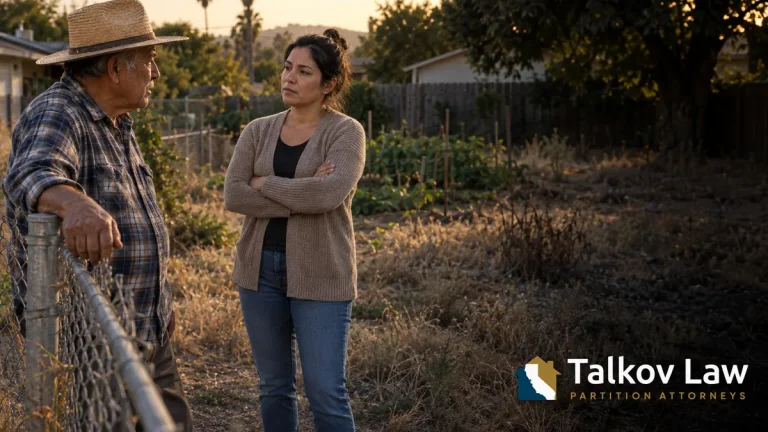
A California co-owner cannot take another owner’s share just by using the property alone for years. In Preciado v. Wilde (2006) 139 Cal.App.4th 321, 323, the Court of Appeal held that an uncle who tore down the house, planted crops, and fenced two lots he co-owned with his niece did not acquire her inherited share by adverse possession. Between co-owners, the proof must be stronger than against a stranger, and “one tenant in common cannot by mere exclusive possession acquire the title of his cotenant.” (Preciado, at p. 325.)
Why Preciado v. Wilde Matters
Families often share property that one relative controls for decades. The relative in possession may come to believe the property is theirs, and the relative who lives elsewhere may worry that staying away has cost them their share. Preciado answers that worry. Because every co-owner has the right to use the whole property, one owner’s exclusive use is not hostile to the others. To take a co-owner’s title by adverse possession, the owner in possession must first oust the others with clear, open acts that tell them they are being shut out.
That is why the case is cited so often: it sets a higher bar for adverse possession between co-owners than between strangers, and it shows how hard that bar is to meet.
The Facts: An Uncle, a Niece, and Two Family Lots
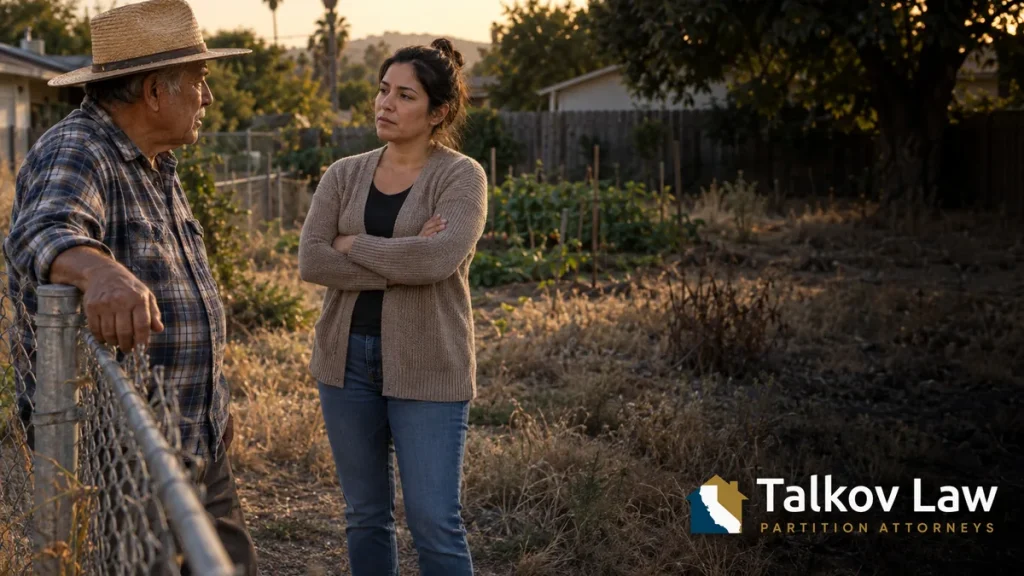
Leonard Preciado and his niece, Elizabeth Wilde, owned two parcels as tenants in common: a lot with a house and a vacant back lot. Wilde owned three-tenths of each parcel, which she inherited from her father. Her father had lived in the house from 1980 until his death in 1984. (Preciado, at p. 323.)
In 2002, Preciado offered to buy Wilde’s interest for $11,604.60. His letter spelled out what she owned: “Parcel (1) you own 2/10 + 1/10 = 3/10” and “Parcel (3) you own 2/10 + 1/10 = 3/10.” Wilde agreed to the price, but Preciado never paid. Instead, he and Jennie Preciado sued to quiet title by adverse possession, claiming Wilde owned nothing. (Preciado, at p. 323.)
At trial, Preciado testified that after Wilde’s father died he demolished the house, planted crops, and the lot was fenced. But the fence was not built to keep Wilde out, and part of it had been built by her father. On the back lot, he farmed about one-third of the land. He admitted he never excluded family members, never restricted Wilde’s access, and never told her he disputed her title. Wilde testified that she had agreed to tearing down the run-down house, paid property taxes for years, and visited the property “a couple of times a year.” (Preciado, at p. 324.)
How the Court of Appeal Reached Its Decision
Co-Owners Face a Higher Bar
The court opened with the rule that decided the case:
“Cotenants have equal possessory rights in land. For one cotenant to establish adverse possession against the other, more is required than to establish adverse possession against strangers.”
Preciado, at p. 323
Adverse possession normally requires five years of open, hostile, continuous possession and payment of all taxes. Between co-owners, the owner in possession must also give the others notice “by acts of ownership of the most open, notorious and unequivocal character” that he intends to oust them, and that evidence “must be stronger than that which would be required to establish a title by adverse possession in a stranger.” (Preciado, at p. 325.)
Farming and Fencing Were Not Ouster
Preciado did not meet that bar. Wilde had no notice that he meant to interfere with her ownership, and he admitted he never excluded her or challenged her title. His fences were not meant to keep family out, and he never used more than one-third of the back lot. Some changes he made only after consulting Wilde or her father, which the court said “refutes the claim of hostility.” (Preciado, at p. 325.)
His Offer to Buy Was an Admission
Preciado’s own letter hurt him most: “His September 9 letter is an admission that Wilde held legal title. It refutes the allegations of the Preciados’ complaint and impeaches his credibility.” (Preciado, at p. 326.) He argued the letter was a protected settlement offer, but the court disagreed because there was no dispute to settle: “Leonard simply offered to buy Wilde’s interest.” (Preciado, at p. 326.)
Preciado also claimed that Wilde had no title or had abandoned it. Her probate records, a title expert, and Preciado’s own admission that her father inherited his share supported her ownership, and the trial court could reasonably find she never abandoned it. (Preciado, at p. 326.)
The Result: The Niece Kept Her Three-Tenths
The Court of Appeal affirmed the judgment for Wilde. (Preciado, at p. 327.) Courts still apply the rule, including in Hacienda Ranch Homes, Inc. v. Superior Court (2011) 198 Cal.App.4th 1122, 1128, where co-owners who paid all the taxes and disced vacant land also failed to take it over.
What Preciado v. Wilde Means for California Co-Owners
- Exclusive use is not enough. A relative who farms the family land, fences it, or controls the property for decades has not taken your share unless they clearly shut you out.
- You do not lose an inherited share by living elsewhere. See our article on a co-owner who abandons the property.
- A written offer to buy your share is strong evidence that the buyer accepted your title.
- A co-owner who paid taxes or improved the property can seek credit through partition offsets, not a transfer of title. If you were actually kept out, see the notice of ouster under Civil Code section 843.
If a relative is treating shared property as their own, your ownership is very likely intact. You do not have to live on the property to ask the court to divide or sell it. Under Code of Civil Procedure section 872.210, any co-owner can file a partition action, and in that case the court confirms each owner’s share and orders the property sold or divided. When you are ready, you can file a partition lawsuit.
Talkov Law can help. With 12 full-time partition attorneys and experience in over 650 partition actions throughout California, our team handles every step of the process, from proving your inherited title through the referee’s sale and the final distribution of proceeds. Call (877) PARTITION (727-8484) today or contact us online to get started.