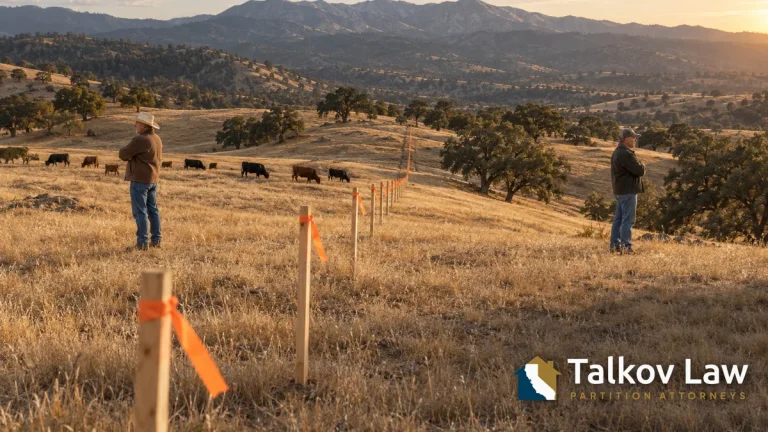
When a California court divides co-owned land into separate pieces, it must value every piece so it can order owelty, a payment from the owner who got more to the owner who got less. In Jamison v. Jamison (2008) 164 Cal.App.4th 714, the Court of Appeal put it plainly: “to make the owelty award, the trial court was required to determine the property values of the various parcels.” (Jamison, at p. 721.) The case shows how that valuation works, and why a co-owner who disagrees with the number has to say so in the trial court.
Why Jamison v. Jamison Matters
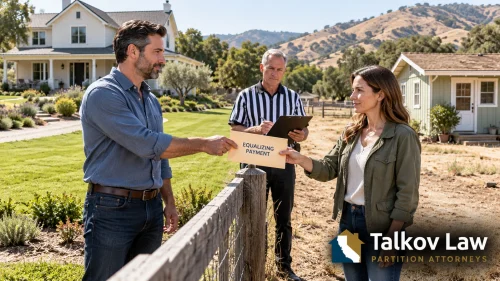
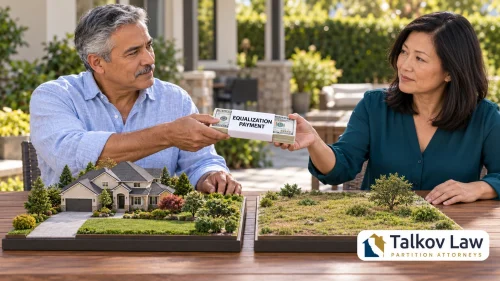
Families that own several parcels together often want to split them up rather than sell. A court can do that through a partition in kind, giving each owner their own parcels. But the pieces are rarely worth exactly the same, so Code of Civil Procedure section 873.250 lets the court even things out with owelty. Jamison is the published case showing what that takes:
- The court values each parcel at its highest and best use, meaning its most valuable realistic use.
- The values can be fixed as of the date the court ordered the division, even if the valuation trial comes years later.
- A co-owner who thinks the owelty is wrong must timely ask the trial court for a new trial, and owelty based on disputed values earns no interest before judgment.
The Facts: A Family Ranch Split North and South
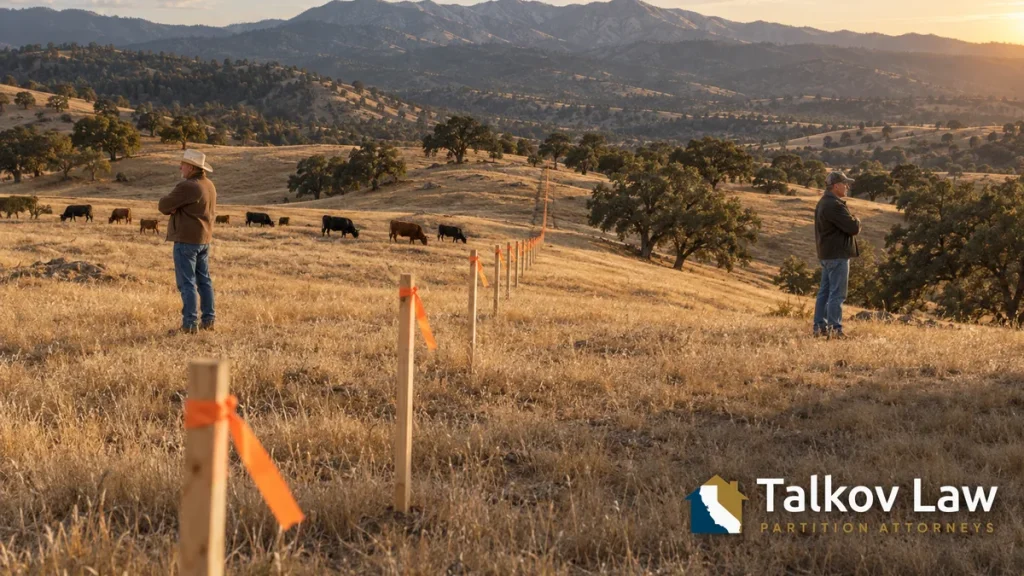
Brothers William and John Jamison and John’s two sons owned several thousand acres of Madera County grazing land as tenants in common. Because they share a last name, this article uses first names, as the court did. In 1999, John and his sons filed a partition action. (Jamison, at p. 717.)
Twelve parcels were at issue: eight north of State Route 145 and four south of it. In 2003, the court entered an interlocutory judgment of partition giving William the four southern parcels and John’s side the northern ones, and left the owelty for later. To set it, the court had to determine the acreage and value of all twelve parcels. Trial began in June 2005, but the land was valued as of April 8, 2003, the date of the interlocutory judgment. (Jamison, at p. 717.)
How the Court Valued the Land
All twelve parcels were zoned for 40-acre lots with one home on each, and all were under Williamson Act contracts, which limit farmland to agricultural uses. The southern parcels were also in a planned growth area. (Jamison, at p. 717.) The question was whether to value the land as cattle grazing or as 40-acre “ranchettes.” (Jamison, at pp. 717–718.)
- William’s appraiser valued the southern parcels as grazing land at $1,000 or $1,500 per acre, while admitting they could legally be split into 40-acre lots.
- John’s appraiser also used grazing values for most of the land, but $32,600 per acre for about 130 acres planned for industrial or residential use.
- John testified that ranchettes were the highest and best use, at $2,100 per acre.
- William had split nearby land into 40-acre parcels himself, and one sold for a little less than $4,000 per acre.
The trial court valued the northern parcels as grazing land. For William’s southern parcels, it found ranchettes were the highest and best use and valued them at $4,000 per acre. (Jamison, at p. 718.) The higher value of William’s parcels set the owelty he had to pay.
How the Court of Appeal Reached Its Decision
Both brothers appealed. William’s challenge to the ranchette finding was rejected in a part of the opinion that was not published. The published part decided John’s claim that the owelty was too low.
A Late New Trial Motion Ended John’s Challenge
William filed his notice of intent to move for a new trial on November 16, 2005, which gave John until November 30, 2005, to file his own. John filed on January 20, 2006, so his motion was late. (Jamison, at p. 719.) When the amount of an award turns on conflicting evidence or the credibility of witnesses, a party who did not timely move for a new trial cannot attack the amount for the first time on appeal. (Jamison, at pp. 719–720.)
Owelty Is Treated Like Damages for This Rule
John argued that owelty is not damages, because no one does anything wrong to owe it. The court agreed with the premise but not the result:
“However, in this context, owelty versus damages is a distinction without a difference. Whether the award is termed owelty or damages, it still requires an evaluation of the amount awarded in light of the evidence presented at trial, an issue that can and should be resolved at the trial court level.”
Jamison, at p. 720
No Interest on Disputed Land Values
John’s claim for prejudgment interest under Civil Code section 3287 was a legal question, so the late motion did not bar it. It failed anyway. That interest is owed only on amounts that are certain or can be calculated, and the owelty here depended on disputed land values the court had to decide. (Jamison, at p. 721.) John’s request to revalue the land at a later date, to capture two years of rising values, was just another challenge to the owelty amount and was barred for the same reason. (Jamison, at pp. 721–722.)
The Result: The Owelty Award Stood
The Court of Appeal affirmed the judgment setting the owelty, and each side paid its own costs. (Jamison, at p. 722.) William kept the southern parcels at $4,000 per acre, and John’s side received the owelty without interest.
What Jamison v. Jamison Means for California Co-Owners
- If several properties are split among co-owners, expect the court to value each one. See whether you can keep one property and sell the other.
- Value follows highest and best use, not just current use. Grazing land zoned for smaller lots may be valued as homesites. See our page on farmland partition actions.
- Build the valuation record at trial, and if the owelty is wrong, move for a new trial on time. The deadline can run from the other side’s notice, not just the judgment.
- Division in kind is the starting point under section 872.810, but a partition by sale under section 872.820 often avoids an owelty fight altogether.
Dividing Family Land? Start Your California Partition Action
Whether family land is divided or sold, the result depends on a strong valuation record. When the family cannot agree, you can file a partition lawsuit.
Talkov Law can help. With 12 full-time partition attorneys and experience in over 650 partition actions throughout California, our team handles every step of the process, from the valuation trial through the partition referee‘s work and the final judgment. Call (877) PARTITION (727-8484) today or contact us online to get started.