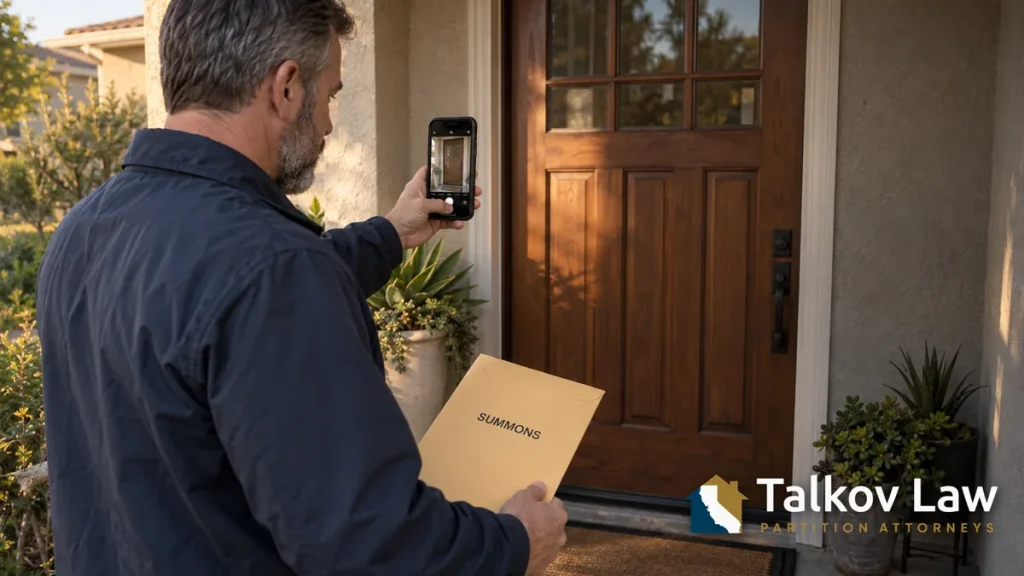

Beginning January 1, 2027, California’s Assembly Bill 747 requires a process server to take a photograph at every attempt to serve a summons and complaint by personal service, substituted service, or eviction posting. Each photo must carry an automatic stamp of the date, time, and location, and at a home it must show the front door. The rule is in the new version of California Code of Civil Procedure section 417.10. It does not apply to service by publication, which matters in a partition action where a co-owner cannot be found.
What the AB 747 Photo Requirement Says
Governor Newsom signed Assembly Bill 747, the Service of Process Accountability, Reform and Equity Act (SPARE Act), on October 10, 2025, as Statutes 2025, chapter 563. The Legislature aimed it at “sewer service,” where a server never delivers the papers but signs a proof of service saying they did.
The new section 417.10 provides that the proof of service “shall include one or more photographs of the site of each effected or attempted service of the summons and complaint.” The word “attempted” is the key: a failed knock needs a photo just as much as a successful handoff.
Which Types of Service Require a Photo
| Method of service | Statute | Photo required? |
|---|---|---|
| Personal service (handing the papers to the person) | Code of Civil Procedure section 415.10 | Yes |
| Substituted service (leaving the papers with an adult at the home or office, then mailing) | Code of Civil Procedure section 415.20 | Yes |
| Posting in an eviction case | Code of Civil Procedure section 415.45 | Yes |
| Service by mail with a signed acknowledgment of receipt | Code of Civil Procedure section 415.30 | No |
| Service by publication in a newspaper | Code of Civil Procedure section 415.50 | No |
| Posting the summons on the property after a partition publication order | Code of Civil Procedure section 872.320 | No |
| Sign on the property under the Partition of Real Property Act | Code of Civil Procedure section 874.314 | No |
What Each Photo Must Show
- An automatic stamp. Each photo must carry a readable stamp that automatically records the date, time, and GPS (global positioning system) or equivalent coordinates of the attempt.
- The door of a home. When service is attempted at a house, apartment, or other dwelling, at least one photo for each attempt must show the door of the person’s home.
- The door of a business. At a place of business, at least one photo must show the door of the specific office or business of the person being served, not just the building.
- Taken at the time, by the server. The process server must take the photo as close as practicable to the time of the attempt.
The Three Exceptions
- The door is not reasonably accessible. The server may photograph the entrance instead, but must explain with specificity, on or with the proof of service, why the door could not be reached.
- There is no signal. If no GPS, cellular, or equivalent signal is available, the photo is still required, but the server must give a detailed statement explaining why the location stamp is missing.
- A photo would be unsafe. If, in the server’s reasonable judgment, taking a photo would compromise their safety, no photo is required. The server must still document the attempt on the proof of service and explain in detail why a photo would have been unsafe.
The Exact Text of California Code of Civil Procedure Section 417.10
These are the parts of the new section 417.10(a) that set the photo requirement, as enacted by Assembly Bill 747:
(1) If served under Section 415.10, 415.20, or 415.45, the proof of service shall include one or more photographs of the site of each effected or attempted service of the summons and complaint.
(A) Each photograph shall contain a readable stamp that establishes and automatically records the date, time, and global positioning system (GPS) or equivalent coordinates of the effected or attempted service.
(B) If no GPS, cellular, or equivalent signal is available at the time and place of an effected or attempted service, the process server shall provide a detailed statement on or with the proof of service explaining the reason for the lack of a readable GPS or equivalent stamp on the photograph.
(2) (A) If the site of the effected or attempted service is a dwelling place or abode, for each effected or attempted service of the summons and complaint, at least one of the photographs required by paragraph (1) shall show the door, or, if the door is not reasonably accessible, the entrance of the house, apartment, or other dwelling place of the person to be served.
(B) If the site of the effected or attempted service is a place of business, for each effected or attempted service of the summons and complaint, at least one of the photographs required by paragraph (1) shall show the door, or, if the door is not reasonably accessible, the entrance of the specific office or other place of business of the person being served.
(C) For purposes of subparagraphs (A) and (B), if the door is not reasonably accessible and the process server takes a photograph of the entrance instead, the process server shall explain with specificity on or with the proof of service why the door was not accessible.
. . .
(4) Notwithstanding paragraph (1), a photograph is not required if, in the reasonable judgment of the process server, taking a photograph would compromise the process server’s safety. In such circumstances, the process server shall document the effected or attempted service on the proof of service and provide a detailed statement explaining why taking a photograph would have compromised their safety.
(5) The photograph required by paragraph (1) shall be taken by the process server as closely as practicable to the time of effecting or attempting service.
California Code of Civil Procedure section 417.10, subdivision (a), operative January 1, 2027
The definition of reasonable diligence for substituted service is in the new section 415.20(b)(2):
For purposes of this subdivision, a party shows reasonable diligence by attempting personal delivery of the summons and complaint, in good faith, on at least three occasions on three different days at three different times.
California Code of Civil Procedure section 415.20, subdivision (b)(2), operative January 1, 2027
Common Questions About the Photo Requirement
Does Every Attempt Before Substituted Service Need a Photo?
Yes. The same law adds a new definition of reasonable diligence for substituted service: good-faith attempts at personal delivery “on at least three occasions on three different days at three different times.” Because the photo rule covers “each effected or attempted service,” each of those attempts, and the substituted service itself, needs its own stamped photo.
What About a Gated Community?
California Code of Civil Procedure section 415.21 already requires a gated community with a guard or other security staff on duty to let in a registered process server who shows identification. If the door still is not reasonably accessible, the entrance exception applies, along with the required explanation.
What About an Apartment Building?
The statute lists the door of the “house, apartment, or other dwelling place.” The photo must show the door of the dwelling, or its entrance if the door is not reasonably accessible.
Does the Law Require Video or Body Cameras?
No. The statute requires photographs and does not mention video or body cameras.
How the Photo Requirement Applies in a Partition Action
The general rules of civil procedure apply in a partition action unless a partition statute says otherwise, under California Code of Civil Procedure section 872.030. So from 2027, every co-owner served personally or by substituted service must be served with photos, and every co-owner must be served before the court can enter an interlocutory judgment of partition.
Defaults are common in partition cases, especially among heirs who ignore the papers. A default judgment in a partition action leads to a court-ordered sale of real estate, and the buyer and title company need a judgment that will hold up.
Service by Publication and Posting in a Partition Action
If a co-owner cannot be reached, service by publication remains available, and the partition statutes add their own requirements:
- California Code of Civil Procedure section 872.310 provides that known co-owners are served as in any civil case, while unknown defendants may be served by publication.
- California Code of Civil Procedure section 872.320 requires the plaintiff, when the court orders publication, to post a copy of the summons and complaint on the property within 10 days after the order, record a notice of pending action if one is not already recorded, and describe the property in the publication.
- California Code of Civil Procedure section 872.330 lets the publication name only the defendants being served that way, and limits any default judgment to what was published.
- California Code of Civil Procedure section 874.314 applies when the Partition of Real Property Act governs the case. Within 10 days after the court allows notice by publication, the plaintiff must post and keep up a conspicuous sign on the property stating that the case has begun and identifying the court and the property.
The photo requirement does not apply to publication, or to the posting that California Code of Civil Procedure section 872.320 and California Code of Civil Procedure section 874.314 require once publication is ordered. Those postings are conditions of a publication order, not service by posting under section 415.45, which applies only in eviction cases. Still, a dated photo of the posted papers or sign is inexpensive proof that the plaintiff met the deadline.
The Other AB 747 Changes at a Glance
- Three attempts before substituted service. Reasonable diligence now means at least three good-faith attempts on three different days at three different times.
- More mailing options. The mailing after substituted service may go by first-class mail, Priority Mail with tracking, or certified mail with a return receipt.
- A public register. Each county clerk must keep its register of process servers publicly available, and a proof of service signed by a registered server must show the server’s registration number.
Serve Your Co-Owner Correctly and Keep the Partition Moving
The photo requirement rewards plaintiffs who serve carefully. Whether to tell your co-owner you are suing for partition is a separate question; clean, documented service keeps the partition action timeline on schedule.
Talkov Law can help. With 12 full-time partition attorneys and experience in over 650 partition actions throughout California, our team handles every step of the process, from serving your co-owner through the referee’s sale and the final distribution of proceeds. Call (877) PARTITION (727-8484) today or contact us online to get started.