

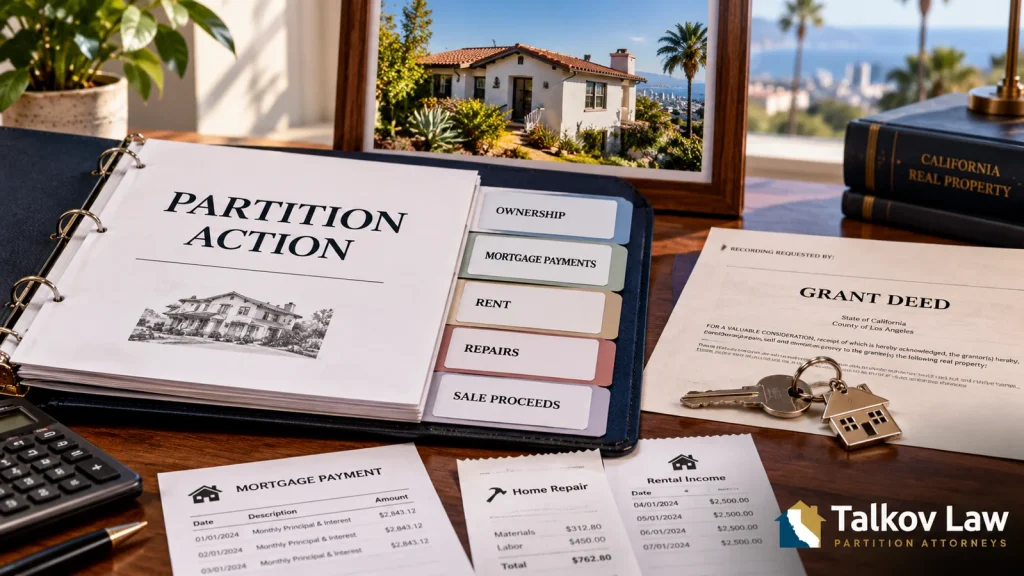

The scope of a California partition action extends beyond forcing a property sale. In Demetris v. Demetris, the Court of Appeal applied the rule that “all equities and conflicting claims … arising out of their relation to the property to be partitioned may be adjusted.”[1] In the same lawsuit, the court can determine ownership interests, resolve title disputes, account for mortgage payments and other property expenses, address rent and occupancy claims, determine lien priorities, and allocate qualifying attorney’s fees and costs. The point is to end the co-ownership and resolve the property-related financial disputes that stand between you and your share of the proceeds.
That matters when your co-owner says, “We cannot sell until you pay me back,” or “The deed is wrong, so you cannot file.” Those issues may belong in the partition case itself. A disagreement over who owns what or who paid more can often be resolved through partition’s broader remedies. The available relief still depends on the ownership, claims, parties, and evidence in your case.
What Can a Partition Action Resolve?
| Issue | What the court can decide |
|---|---|
| Ownership and title | Who owns the property, each owner’s percentage, and properly raised claims that the deed does not reflect the parties’ rights. |
| Sale, division, or buyout | How to end the co-ownership under the applicable partition procedures. |
| Mortgage payments and other expenses | Which payments support reimbursement and how to account for them. |
| Rental income and exclusive occupancy | Whether an owner must account for rent collected or an occupancy-related charge or offset. |
| Mortgages and other liens | Their status and priority, and their treatment in distributing the proceeds. |
| Attorney’s fees and partition costs | Which expenses qualify and how they should be allocated among the owners. |
| Protection of the property | Appropriate orders preventing waste, protecting title, or restraining unlawful interference with an ordered partition. |
| Remaining sale proceeds | What each owner receives after the court addresses the relevant charges and credits. |
Why the Scope of a Partition Action Is Broader Than a Sale
Code of Civil Procedure section 872.610 expressly provides: “The interests of the parties, plaintiff as well as defendant, may be put in issue, tried, and determined in the action.”[2] Code of Civil Procedure section 872.620 also directs the court, upon adequate proof, to ascertain the state of the title to the extent necessary to grant appropriate relief.[3]
These provisions work together with Code of Civil Procedure section 872.140, which authorizes accounting, contribution, and other financial adjustments according to equity.[4] A partition court therefore does more than find a buyer and divide a check. It can address the competing interests in the property and the accounting needed to distribute its value properly.
In Demetris, the court addressed reformation of a mistaken joint tenancy deed, repayment of an extra purchase contribution, improvements, taxes, and a mortgage lien in the same lawsuit. Likewise, in Bacon v. Wahrhaftig, the Court of Appeal held that a co-owner’s fraud, damages, and accounting claims were all part of one partition case, because the partition court can decide every issue needed to do complete justice.
The broader authority serves partition’s purpose: ending shared possession and the disputes that come with it. As Cummings v. Dessel explains, partition is an equitable proceeding even though the remedy is governed by statute.[5]
The Court Can Determine Ownership and Resolve Title Disputes
A co-owner does not necessarily have to win a separate lawsuit before asking the partition court to decide a dispute about ownership. Sections 872.610 and 872.620 allow title and ownership issues to be resolved within the partition proceeding. Depending on the facts, the complaint may combine partition with quiet title or other related claims.
- Whether the deed identifies the correct owners and ownership percentages.
- Whether a deed should be corrected because of a legally sufficient claim of mistake or another ground for reformation.
- Whether a claimed beneficial interest, agreement, or transfer affects the parties’ rights.
- Whether a payment was a gift, an advance to another owner, or a contribution supporting reimbursement.
Paying more does not automatically mean owning more. Evidence Code section 662 generally presumes that the holder of legal title also holds the full beneficial title; where that presumption applies, overcoming it requires clear and convincing proof.[6] A claim to change ownership must be distinguished from a claim to recover money in the accounting. You may retain the same ownership percentage yet receive a larger distribution because another owner owes you reimbursement.
That is why your attorney should review both the deed and the records of how the property was acquired. In Demetris, the court could consider a deed-reformation claim and the parties’ financial contributions together; the deed dispute did not put those subjects beyond partition’s reach.
The Court Can Resolve Offsets and Accounting Between Co-Owners
If you paid more than your share of the property’s expenses, the partition can include a request for offsets and accounting. In Wallace v. Daley, the court explained that partition includes a final accounting of charges and credits and identified several categories of qualifying expenditures.[7]
Mortgage Payments, Taxes, Insurance, Repairs, and Improvements
Potential claims include unequal purchase contributions, mortgage principal and interest, property taxes, insurance for the common benefit, necessary repairs, value-enhancing improvements, and expenses protecting the property or its title. Whether a particular expenditure is recoverable—and how much—depends on the facts, the owners’ agreements, and the applicable rules.
Receipts prove that money was spent; they do not automatically establish that every dollar must be charged to the other owner. The timing and purpose of the expenditure, its benefit to the property, and any opposing accounting claims matter. Claims for improvements may require evidence beyond the contractor’s bill.
Rent Collected From Tenants
An owner who collects rent cannot assume that the income belongs entirely to them simply because they manage the property. The accounting can examine rental receipts, legitimate rental expenses, and the amounts owed between the owners. For an income-producing property with tenants, obtain leases, rent ledgers, bank statements, and management records so the court can work from an actual accounting instead of competing estimates.
An Owner’s Exclusive Use of the Property
Rent collected from a tenant is different from the rental value of a co-owner’s own occupancy. Living in the house does not automatically make a co-owner a rent-paying tenant. An agreement, exclusion of another owner, or an accounting offset may change the analysis.
In Hunter v. Schultz, the court upheld use of occupancy value as an offset against the occupying owners’ claims for mortgage interest, taxes, and insurance. It distinguished that defensive accounting adjustment from an automatic right to collect rent from a co-owner merely because that person lives there.[8] The scope of partition includes evaluating these competing claims together.
The Court Can Determine Liens and Distribute Sale Proceeds
Code of Civil Procedure section 872.630 directs the court to determine the status and priority of liens as necessary to grant relief. The court may use a referee to help ascertain the relevant facts.[9] The analysis may involve a mortgage affecting the whole property, a lien against one owner’s interest, or competing claims to the sale money. These should not be treated as interchangeable.
Code of Civil Procedure section 873.820 specifies the order for applying sale proceeds: expenses of sale, other partition costs or security for costs later allowed, liens in their priority except those remaining under the sale terms, and distribution of the residue according to the shares determined by the court.[10] The owners’ accounting must fit with that distribution and the rights of lienholders.
The distinction can make a substantial difference. An agreement between co-owners about who should bear a debt does not necessarily change a creditor’s security rights. Demetris required correction of the distribution to protect the mortgage lien while separately accounting for which owners ultimately bore that debt. Our guide to how partition sale proceeds are divided explains the distribution process further.
The Court Can Order the Appropriate Sale, Division, or Buyout Procedure
The court decides how the co-ownership will end. Under Code of Civil Procedure section 872.820, a sale may be ordered when the parties agree or when sale and division of the proceeds would be more equitable than physical division.[11] Cases governed by the Partition of Real Property Act have additional requirements; the general sale rule is not the complete analysis for every property.
The Partition of Real Property Act applies to qualifying tenancy-in-common property in actions filed on or after January 1, 2023, where no agreement in a record binding all co-owners governs partition.[12] When an owner requests a sale, section 874.317 provides eligible owners who did not request a sale an opportunity to buy the sale-requesting owners’ interests after the court determines value.[13] If that process does not resolve the case, section 874.318 governs the next decision between physical division and sale.[14]
That statutory buyout is different from an agreed partition by appraisal. Sections 873.910 and 873.920 require the latter procedure to rest on a written agreement after the parties’ interests are undisputed or adjudicated.[15] A court’s broad equitable authority does not allow it to replace those requirements with whatever buyout arrangement one owner prefers.
The Court Can Allocate Attorney’s Fees and Other Partition Costs
A partition can also resolve who bears the qualifying costs of ending the co-ownership. Code of Civil Procedure section 874.010 includes reasonable attorney’s fees incurred or paid for the common benefit, referee fees and expenses, and other specified costs. Section 874.040 generally allocates partition costs by ownership interests or another equitable allocation.[16]
Your co-owner’s opposition does not automatically make the legal work ineligible for allocation. In Orien v. Lutz, the Court of Appeal explained that reasonable common-benefit fees can be allocated even in a contested partition; the trial court decides which fees qualify and how to allocate them.[17] This supports pursuing a properly documented partition attorney’s fee request. It does not guarantee recovery of every fee.
The Court Can Protect the Property While the Case Is Pending
The scope of partition includes appropriate orders needed to carry out the proceeding. Section 872.120 authorizes orders necessary or incidental to the partition statutes and enforcement of the court’s orders.[18] Under Code of Civil Procedure section 872.130, the court may issue temporary restraining orders or injunctions to prevent waste, protect the property or title, and restrain unlawful interference with an ordered partition.[19]
For example, documented threats to damage the property or interfere unlawfully with a court-ordered sale may call for specific relief. Filing the partition complaint does not itself freeze the property, transfer management, or remove an occupant. Your attorney must identify the problem, establish the grounds for relief, and request an appropriate order.
What Falls Outside the Ordinary Scope of Partition?
Broad authority over co-owned property is not unlimited authority over the owners’ lives. The issue must be properly before the court, the affected parties must be brought into the case, and the requested remedy must have a legal and factual basis.
| Situation | What to distinguish |
|---|---|
| A dispute between spouses over community property | Section 872.210(b) excludes partition actions between spouses or putative spouses concerning their community, quasi-community, or quasi-marital interests. A partition is not a substitute for the applicable family-law process. |
| Property held through an estate or trust | Determine who owns the property and who has authority to act. Section 872.840 permits sale of property subject to an express trust in appropriate circumstances, but property or proceeds allotted to the trustee remain subject to the trust. |
| A personal grievance unrelated to the property | A family disagreement or unrelated personal debt does not automatically become a partition accounting claim. Whether another civil claim can be joined requires its own analysis. |
| A proposed physical division of land | Partition does not excuse compliance with applicable subdivision, land-use, transfer, or other governing laws. |
| An unsupported demand for damages | The court’s equitable powers do not eliminate the need to plead and prove the basis for additional relief. |
The statutory limits include Code of Civil Procedure section 872.210, Code of Civil Procedure section 872.840, and Code of Civil Procedure section 872.040.[20] If your dispute involves divorce, trust administration, or probate as well as co-ownership, the task is to identify the proper parties and proceedings rather than assume one partition complaint replaces every other process.
Can a Partition Include Real and Personal Property?
Yes. Code of Civil Procedure section 872.240 permits real and personal property to be partitioned in one action.[21] That provision concerns property subject to partition; it does not automatically bring every financial disagreement between its owners into the accounting. Talkov Law focuses on partition actions involving California real estate.
Must Every Financial Dispute Be Resolved Before the Property Is Sold?
Ownership interests and final accounting are different questions. Under Code of Civil Procedure section 872.720, the interlocutory judgment determines the parties’ interests and orders partition. In Summers v. Superior Court, the Court of Appeal held that the manner of partition cannot be ordered before the parties’ disputed ownership interests are determined.[22]
That does not mean every reimbursement claim must necessarily be tried before a sale. Code of Civil Procedure section 873.850 allows the action to continue after a sale to determine the parties’ claims to unallocated proceeds, with further testimony taken in court or by a referee as directed by the court.[23] Once the required ownership determinations and sale procedures are satisfied, a dispute over expenses may be addressed through a reserve of proceeds and a later accounting rather than leaving the owners tied to the property.
The referee’s report on offsets and accounting can assist that process, but the referee’s role depends on the court’s order. Section 873.850 places adjudication of the parties’ claims with the court; appointment of a referee is not a substitute for obtaining the necessary ruling.
Do Related Claims Require a Separate Lawsuit or Cross-Complaint?
Not necessarily. A partition complaint can present related ownership and accounting issues, and Code of Civil Procedure section 872.430 expressly allows an answer to set forth a defendant’s claim for contribution or another compensatory adjustment.[24] The Legislative Committee Comment to CCP 872.430 states that the statute “avoids the need of the defendant to file a cross-complaint for affirmative relief.”[25] That is why many cross-complaints are not needed in partition actions. An owner does not necessarily need a separate lawsuit merely to request qualifying credits.
The plaintiff’s side works the same way. In Bacon v. Wahrhaftig, a Kern County co-owner’s partition complaint also accused co-owners and oil companies of fraud, sought damages, asked to undo leases, and requested an accounting. The defendants argued these were separate claims improperly combined. The Court of Appeal disagreed: the primary right was partition, and “This is an equitable action and the court has jurisdiction to hear and determine all issues necessary to do complete justice.” It added that a court of equity can order an accounting even when the complaint did not ask for one.[26]
But the breadth of partition does not make pleading irrelevant. A deed-reformation claim, quiet-title claim, or request for additional damages may require specific allegations and relief beyond a routine request for sale. In Demetris, the alleged facts about the father’s excess purchase payment allowed the court to consider reimbursement. The lesson is to bring the supporting facts into the case—not to assume the court will discover every claim on its own.
The proper parties matter too. Code of Civil Procedure section 872.510 requires joinder of people with interests in the estate being partitioned that are of record, actually known to the plaintiff, or reasonably apparent from inspection.[27] Identifying owners, trustees, and lienholders early helps the court resolve the property interests that are actually at stake.
Example: Equal Ownership Can Produce Unequal Payouts
Consider this hypothetical. Two siblings each own half of a house. After the sale and payment or reservation of the applicable sale expenses, partition costs, and liens, $400,000 remains for distribution. One sibling paid $40,000 in qualifying common property expenses alone. Assume the court finds that each sibling should bear half of those expenses, with no contrary agreement or other offset.
| Accounting step | Sibling who paid | Other sibling |
|---|---|---|
| Initial 50% share of the $400,000 | $200,000 | $200,000 |
| Adjustment for the other sibling’s half of the $40,000 expense | +$20,000 | −$20,000 |
| Final distribution | $220,000 | $180,000 |
The ownership remains 50/50. The distributions differ because of reimbursement. Charging the other sibling the entire $40,000 would make that sibling bear both owners’ shares of the expense. This is why determining title and completing the accounting are separate tasks within the same partition action. Actual cases may include competing expenses, rent, occupancy claims, or liens that change the calculation.
What Records Help Establish the Full Scope of Your Case?
Before a consultation, collect the records that show who owns the property, who paid for it, and who received its benefits:
- Recorded deeds, acquisition documents, and any relevant trust, probate, or ownership orders.
- Written co-ownership agreements, buyout proposals, and communications about gifts or purchase contributions.
- Mortgage statements, payment histories, and current information about liens.
- Property tax bills, insurance statements, receipts, invoices, and proof of payment.
- Leases, rent ledgers, bank records, and records of income and rental expenses.
- Communications concerning access, occupancy, damage, or cooperation with a sale.
Separate payments you can document from estimates, and identify any missing records. A useful accounting states the amount claimed, its purpose, who paid it, and the supporting evidence. That lets your attorney evaluate which disputes affect ownership, which affect the distribution, and which require separate relief.
Resolve the Property Dispute in One Coordinated Partition Case
You do not have to accept an indefinite stalemate because your co-owner disputes the deed, claims you owe money, or refuses to discuss a sale. Talkov Law’s California partition attorneys can evaluate the ownership issues, reimbursement claims, income, liens, and court orders needed to bring the co-ownership to an end.
Our practice focuses exclusively on California partition actions. With 12 full-time partition attorneys and experience in over 650 partition actions, we help co-owners pursue a sale or buyout and a supported accounting of what they should receive. Call (877) PARTITION (727-8484) or contact Talkov Law for a free consultation about the full scope of your property dispute.
References







