

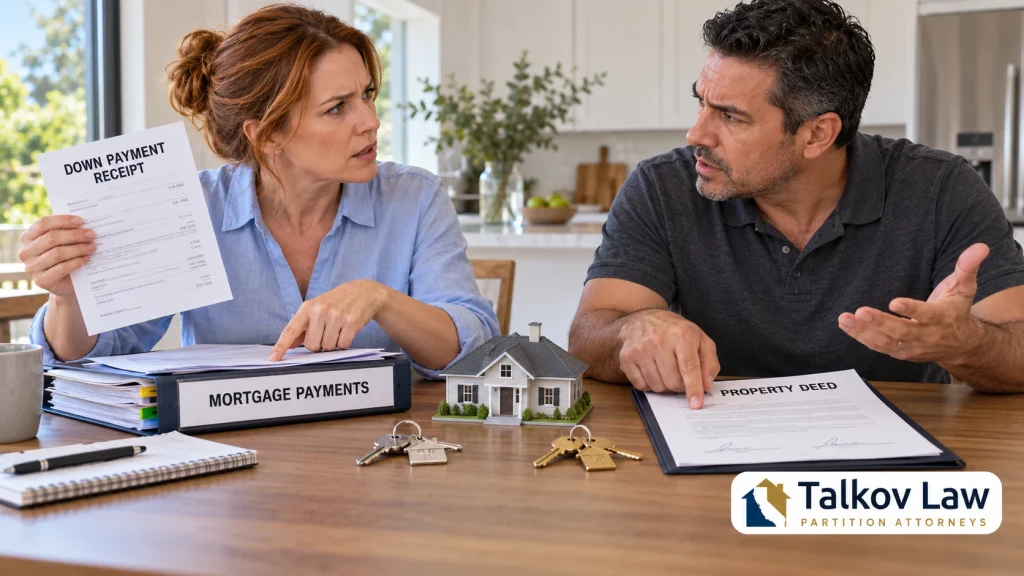
No. If you paid the down payment and the mortgage and put your girlfriend on title, she does not automatically walk away with half the equity when the relationship ends. In a California partition action, the court generally repays the co-owner who put in more before the rest of the money is split. The major exception is a “true joint tenancy,” where the owners hold equal shares and the court may not repay an unequal down payment, or where the court finds you both agreed to own the house equally no matter who paid. Even a joint tenancy deed can be corrected when it does not match what the co-owners agreed, as in Demetris v. Demetris (1954) 125 Cal.App.2d 440.
This comes up most often with former romantic partners who bought together. The story is usually the same. You earned more and bought the house. You put your girlfriend on the deed because the lender wanted both names, escrow suggested it, or you wanted to show you were serious. You paid the down payment and most of the bills. Now the relationship is over, she will not move out or sign anything, and she points to the deed and says half the house is hers.
The same rules apply when the co-owners are siblings, a parent and child, or friends who bought a house together. Our posts on getting your mortgage payments back in a partition and helping fund your child’s house while on title cover those situations.
She Won’t Sign a Quitclaim Deed. Can I Take Her Off Title Myself?
No. Once her name is on the deed, she owns a share, and only she can sign it away. You cannot remove her by recording a deed of your own, and the lender, the title company, and the escrow officer cannot do it for you. If she refuses to sign a quitclaim deed, the way out is a partition action. The court can force the sale of the house or let you buy out her share, and either way it decides who gets paid back before the money is split.
Changing the locks or trying to evict her is not the shortcut it seems. A co-owner generally cannot evict another co-owner, and in Zaslow v. Kroenert the California Supreme Court held that a co-owner who changes the locks and refuses entry commits an ouster and can owe the locked-out owner rental value.
Is My Ex Entitled to Half Because Her Name Is on the Deed?
The deed tells the court who owns the house and in what shares, and changing those percentages is hard. Under California Evidence Code section 662, “The owner of the legal title to property is presumed to be the owner of the full beneficial title. This presumption may be rebutted only by clear and convincing proof.”
But ownership percentages are only half the math. Even when the deed reads 50/50, the court decides who gets paid back for what through the partition offsets and accounting, under California Code of Civil Procedure section 872.140:
“The court may, in all cases, order allowance, accounting, contribution, or other compensatory adjustment among the parties according to the principles of equity.”
California Code of Civil Procedure section 872.140
How that accounting treats your payments depends on how you and your ex took title: as tenants in common or as joint tenants.
Tenants in Common Usually Get Their Down Payment and Mortgage Payments Back
Tenancy in common is California’s default form of co-ownership, and between tenants in common the co-owner who paid more is generally repaid before the rest is divided. In Milian v. De Leon (1986) 181 Cal.App.3d 1185, 1194, the Court of Appeal explained that a co-owner who pays the taxes, the loan payments, or other charges against the property “on partition by sale is entitled to reimbursement for those expenditures before division of the proceeds among the property owners.”
For a tenant in common who paid more than their share, that can include:
- The unequal down payment, which the court may repay or, in some cases, use to give you a larger ownership share
- Mortgage payments you carried beyond your share, with principal often easier to recover than interest
- Property taxes and homeowner’s insurance you paid alone
- Repairs and improvements that added value to the house
Here is how the math can work. Say you and your ex own the house 50/50 as tenants in common, you paid the entire $150,000 down payment and $60,000 of loan principal, your ex paid nothing, and the sale leaves $500,000 after the loan and the costs of sale are paid. You are repaid $210,000 first, and the remaining $290,000 is split evenly, so you receive $355,000 and your ex receives $145,000, not $250,000. Our post on two ways to calculate co-owner reimbursements explains the methods courts use.
We Took Title as Joint Tenants. Do I Still Get My Down Payment Back?
Joint tenants own equal shares by definition, so the rule for an unequal down payment may be different. Once a court finds a true joint tenancy, it generally may not order repayment of the difference in what each owner paid toward the purchase. The Court of Appeal said so in Milian, 181 Cal.App.3d at 1195, and added that an agreement between the owners to repay one of them on a sale can still be enforced.
That limit concerns the purchase price. The same opinion confirms that a co-owner who pays property taxes, loan payments, or other charges against the property is entitled, on a partition sale, to reimbursement before the proceeds are divided (Milian, 181 Cal.App.3d at 1194).
The words on the deed do not end the question. In a partition action, Code of Civil Procedure section 872.610 lets the court decide what each person’s interest really is, whatever the record title says, and a large gap in who paid is evidence the court can weigh in deciding whether you both intended a true joint tenancy (Milian, 181 Cal.App.3d at 1196). In Cosler v. Norwood (1950) 97 Cal.App.2d 665, 666, for example, two co-owners took title as joint tenants, but one paid three-fourths of the price, and the Court of Appeal upheld a three-fourths to one-fourth split (see our summary of Cosler v. Norwood and our summary of Kershman v. Kershman, which followed it).
An agreement can also decide the outcome. In Milian, an unmarried couple took title as joint tenants, and one partner made the down payment and wrote the mortgage checks, although the other contributed money too. The trial court found an implied agreement to own and divide the house equally no matter what each contributed, and the Court of Appeal affirmed an equal division with no accounting (Milian, 181 Cal.App.3d at 1194, 1196–1198). That is why texts, emails, and a signed gift letter about the down payment matter.
Will I Get Back the Mortgage, Taxes, and Insurance I Paid?
Often, yes, but expect a fight over the details. Your ex may argue that the mortgage payments you made while you lived together were your way of paying for a shared household, not money she owes back. The strongest claim is usually for loan principal, which built equity in the house, rather than interest, which works more like rent. Property taxes and insurance you paid alone can also be credited. The payments most likely to be offset are the ones you make after the breakup while you live in the house alone, because the court can charge you for the value of that exclusive use:
Generally, “when, in a suit for partition or a sale for division, or other proceeding between cotenants in equity or in which equitable powers may be exerted, a cotenant who has been in possession or use of the premises seeks to obtain contribution respecting improvements made, or amounts expended in protection or preservation of the property, the court, as incidental to the granting of such relief and by way of adjusting the rights of the parties, may charge the claimant, defensively, with at least a part of the reasonable value of his occupancy or use….”[1]
She Says the Down Payment Was a Gift. Is She Right?
Even between tenants in common, the partner who paid less will often argue that your payments were gifts made during a loving relationship. That argument is strongest when one partner earned far more and paid the household bills without any talk of repayment. Money from your parents raises its own question of whether the gift was meant for you alone or for both of you, which our post on down payment gifts explains. She may also say you promised to share everything with her, which is called a Marvin claim after Marvin v. Marvin (1976) 18 Cal.3d 660. Living together does not by itself give an unmarried partner rights to the other partner’s property; she has to prove an express or implied agreement.
Your ex can also push back if you stayed in the house after the breakup. The court can weigh the rental value of your exclusive use against your claim for mortgage payments made after you split. The trial court in Milian, for example, denied credit for payments made after the couple separated because those payments roughly equaled the fair rental value of the house, but the Court of Appeal affirmed on a different ground: it held that no rental-value balancing was required because the couple had an implied agreement to own the house equally, and their separation did not end that agreement (Milian, 181 Cal.App.3d at 1192, 1199).
Evidence That Protects the Co-Owner Who Paid
The partition referee and the court decide these claims on records, not memories, and people in a breakup routinely overestimate what they contributed. Gather:
- The escrow closing statement and the wire or cashier’s check for the down payment
- The escrow vesting worksheet showing how the two of you chose to take title
- Bank statements showing each mortgage payment and the account it came from
- Any gift letter either of you signed for the lender
- Texts or emails about who would get the down payment back if you split, or about why she was put on title
Our guide to the evidence a partition referee needs for offsets goes further.
Get Your Down Payment Back and Your Ex Off Title
You do not need your ex’s agreement to end the co-ownership. Any co-owner can force the sale of jointly owned property, and either of you may be able to buy the property in the partition action instead. The accounting then decides how the proceeds are divided. Sharing a deed is not the same as sharing a down payment.
Talkov Law can help. With 12 full-time partition attorneys and experience in over 650 partition actions throughout California, our team handles every step of the process, from filing through the final accounting of who paid what. We handle these cases throughout California, including Los Angeles, Orange County, San Diego, Riverside, Sacramento, San Francisco, and San Jose. Call (877) PARTITION (727-8484) today or contact us online to get started.
References
| ↑1 | Hunter v. Schultz (1966) 240 Cal.App. 2d 24, 30–31. |
|---|







