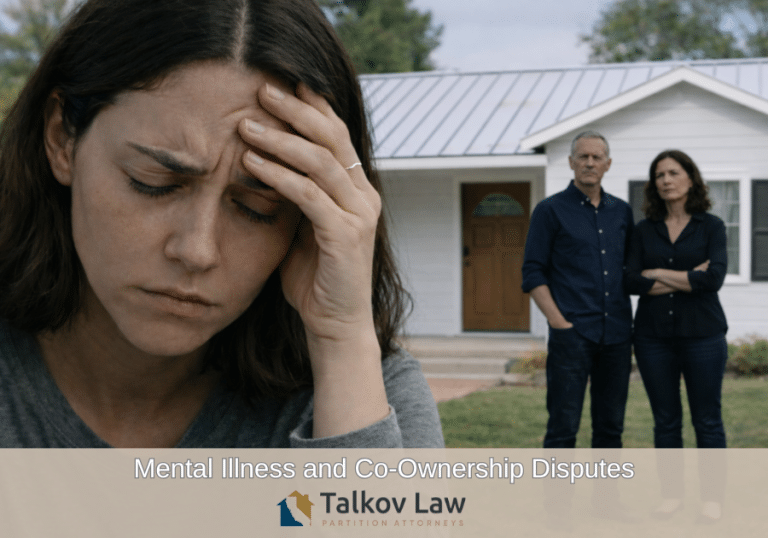
Mental illness can create challenges, with property co-ownership being particularly challenging under California law. From refusal to sell to unpaid expenses, behavioral health concerns can complicate co-ownership and often lead to property disputes. Conditions like anxiety, depression, or substance use disorders may cause communication breakdowns, financial mismanagement, or outright refusal to cooperate.
These issues often push co-owners toward a partition action, which allows a judge to resolve disputes by dividing or selling the property.
At Talkov Law Partition Attorneys, we understand the sensitive nature of these cases and provide compassionate, experienced guidance when mental illness impacts co-ownership. Call (877) PARTITION (727-8484) today to speak with a partition attorney.
Common Behavioral Health Concerns and Their Impact on Co-Ownership
When mental illness affects one or more co-owners, the challenges of managing shared property often go far beyond ordinary disagreements. Behavioral health conditions can influence decision-making, financial responsibility, and the ability to cooperate, creating unique obstacles in co-ownership arrangements. Below are some of the most common behavioral health concerns and how they can impact both co-ownership and the partition process.
Dementia or Cognitive Decline
In cases involving older co-owners including parents or relatives, diminished capacity can lead to confusion about rights and obligations. Family members may need to intervene through partition when one owner can no longer manage their share.
These issues are sometimes addressed through estate planning tools like powers of attorney or revocable living trusts. A power of attorney may allow a trusted family member to act on behalf of the person with dementia, but this authority can be limited and may not resolve co-ownership disputes. Similarly, if the property is held in a revocable living trust, a diagnosis of dementia may trigger changes to the trustee or beneficiaries, which can further complicate ownership.
When these measures fail to provide clarity, a partition action may become necessary to ensure the property is fairly managed or sold, protecting the interests of all co-owners while respecting the rights of the individual with diminished capacity.
Hoarding Disorder
Hoarding behavior in co-owned property can significantly reduce a home’s marketability, obscure its true condition, and ultimately diminish its fair market value. Hoarding can make a property unsafe, unsellable, or uninhabitable. Co-owners may be forced to seek partition just to regain control of the property’s value.
Psychotic & Personality Disorders
Periods of mania may lead to impulsive financial decisions, such as unauthorized repairs or refusing a fair market offer. During depressive phases, the same co-owner may neglect responsibilities, causing instability for everyone involved.
A co-owner experiencing delusions or paranoia may distrust other co-owners and refuse to cooperate with property management or sale, even when it is in everyone’s best interest.
Substance Use Disorders
Addiction issues often lead to financial mismanagement. A co-owner may live rent-free on the property without paying their share or resist selling because the property is their only source of stability. Addiction can even lead to a co-owner in prison.
Personality Disorders (e.g., Borderline, Narcissistic, Paranoid)
Personality disorders can fuel conflict, with co-owners making decisions based on emotion rather than fairness. They may refuse settlement offers, lash out at others, or create toxic dynamics that make co-ownership impossible. Some co-owners may feel that their co-owners are out to get them when ordinary settlement terms are proposed.
In some cases, they may even attempt to negotiate informal “DIY” settlements that constantly change or fail to hold up legally, creating further instability and disputes.
Obsessive-Compulsive Disorder (OCD)
A co-owner with OCD tendencies may insist on unrealistic standards for property upkeep or sale conditions, creating unnecessary delays and disputes.
Depression
A co-owner struggling with depression may withdraw from responsibilities, fail to maintain the property, or avoid paying expenses. Their lack of participation can place an unfair burden on the other co-owners.
Partition Actions as a Legal Remedy
Mental illness can make it impossible to manage co-owned property fairly. California law protects co-owners from being trapped in these situations.
Under California Code of Civil Procedure § 872.210 and § 872.710, any co-owner has the right to seek a partition, and the court must grant it as a matter of right. When physically dividing the property is impractical, § 872.820 authorizes the court to order a sale and fairly divide the proceeds among the owners, while also accounting for expenses and contributions.
This ensures that no single co-owner — regardless of behavioral health struggles — can hold the others hostage in an unworkable co-ownership arrangement.
Talkov Law’s Experience with Sensitive Partition Disputes
When mental illness affects co-ownership, legal disputes can become deeply emotional. At Talkov Law Partition Attorneys, we combine knowledge of partition law with compassion for families navigating these difficult circumstances. Our attorneys handle the legal process so that you can focus on moving forward. Courts are aware that the mental condition of the co-owners is not a defense to partition given California’s absolute right to partition.
If you are facing co-ownership disputes complicated by mental health issues, call Talkov Law at (877) PARTITION (727-8484) today.