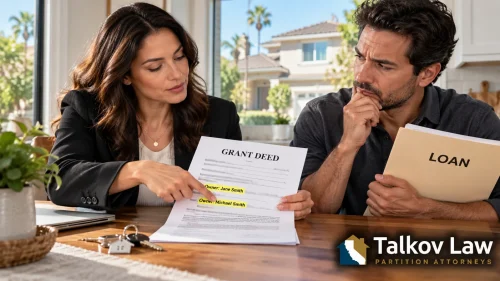

Clear and convincing evidence in California law is proof that makes a fact highly probable, not just more likely true than not. In a California partition action, it is the standard a co-owner must meet before a court will rule that the deed is wrong about who owns the property. For a co-owner whose name is on title, it is one of the strongest protections California law offers.
What Does Clear and Convincing Evidence Mean in California Law?
California law uses three levels of proof. Under Evidence Code section 115, the burden of proof may require a party to establish a fact “by a preponderance of the evidence, by clear and convincing proof, or by proof beyond a reasonable doubt.”
- Preponderance of the evidence: the fact is more likely true than not. This is the default in civil cases.
- Clear and convincing evidence: the fact is highly probable.
- Beyond a reasonable doubt: the standard for criminal convictions.
The California Supreme Court describes clear and convincing evidence as “proof making the existence of a fact highly probable,” a standard that sits between the other two. (Conservatorship of O.B. (2020) 9 Cal.5th 989, 995.) California’s civil jury instruction on the subject, California Civil Jury Instructions No. 201, tells jurors the party “must persuade you that it is highly probable that the fact is true.”
Older Supreme Court decisions describe the standard more forcefully, as evidence “so clear as to leave no substantial doubt.” (In re Angelia P. (1981) 28 Cal.3d 908, 919.) In practical terms, a judge who believes a claim is probably true must still reject it if the evidence does not make it highly probable.
Why California Law Requires Clear and Convincing Evidence to Overcome a Deed
Evidence Code section 662 sets the rule for property titles:
“The owner of the legal title to property is presumed to be the owner of the full beneficial title. This presumption may be rebutted only by clear and convincing proof.”
California Evidence Code section 662
The person named on the deed holds legal title, and the law presumes that person also holds the economic benefit of ownership, called equitable title. Anyone who says otherwise carries the heavier burden, whether the deed names the owners as tenants in common or as joint tenants.
The reason is practical. In O.B., the Supreme Court explained, quoting a 1946 law review note, that courts first demanded more than ordinary proof for claims that experience showed were “inherently subject to fabrication, lapse of memory, or the flexibility of conscience.” (Conservatorship of O.B., supra, 9 Cal.5th at p. 999.)
Deeds were a leading example. More than a century ago, the Court held that testimony offered to show a deed meant something other than what it says “must be clear, convincing, and conclusive,” because the matter is as serious as “the overthrow of a clearly expressed deed, solemnly executed and delivered.” (Sheehan v. Sullivan (1899) 126 Cal. 189, 193.)
When the Standard Comes Up in a Partition Action
A partition court decides each co-owner’s share before the property is sold and the proceeds are divided, because the rights determinable in a partition action include ownership disputes. The clear and convincing standard often appears when a co-owner claims:
- The other co-owner was only a cosigner added to the deed to help qualify for the loan
- A spoken agreement gave one owner a larger share than the deed shows, a claim that also runs into the statute of frauds in California real estate
- The owners’ shares differ from the presumption of equal shares that applies when a deed is silent
- Title should be changed through a quiet title claim decided within the partition
Requests for reimbursement work differently. A co-owner who paid more toward the mortgage, property taxes, or repairs usually seeks repayment through the partition offsets and accounting, which generally uses the ordinary standard.
That is why paying more usually gets a co-owner repaid, not a bigger ownership share. Our articles on unequal down payments and whether an ex gets half after you paid the down payment and mortgage explain that path, and Clear and Convincing Evidence vs. Preponderance of the Evidence compares the two standards side by side.
The Standard Also Applies on Appeal
For years, some California appellate courts said the clear and convincing standard “disappears” on appeal, so a trial court’s finding would stand if any credible evidence supported it. In 2020, the Supreme Court rejected that view and disapproved those decisions.
Now the question on appeal is “whether the record as a whole contains substantial evidence from which a reasonable factfinder could have found it highly probable that the fact was true.” (Conservatorship of O.B., supra, 9 Cal.5th at p. 1011.) The appellate court still defers to the trial judge on credibility and conflicting evidence, but it asks whether the evidence could reasonably reach the certainty the law requires.
For a co-owner on title, that means a ruling that overrides a deed on thin evidence is open to reversal.
A Note for Married Co-Owners
Spouses are governed by separate presumptions under the California Family Code, which can change how title is treated between them. This article addresses co-owners who are not married to each other, such as siblings who inherited property or former partners who bought together.
Protect Your Ownership Interest in a Partition Action
The deed is the starting point in every California ownership dispute, and a co-owner who wants a court to disregard it must prove the claim is highly probable, not merely plausible. Knowing where that burden falls helps co-owners decide which claims are worth fighting and how to force the sale of jointly owned property.
Talkov Law can help. With 12 full-time partition attorneys and experience in over 650 partition actions throughout California, our team handles every step of the process, from filing through the referee’s sale and the final distribution of proceeds. Call (877) PARTITION (727-8484) today or contact us online to get started.