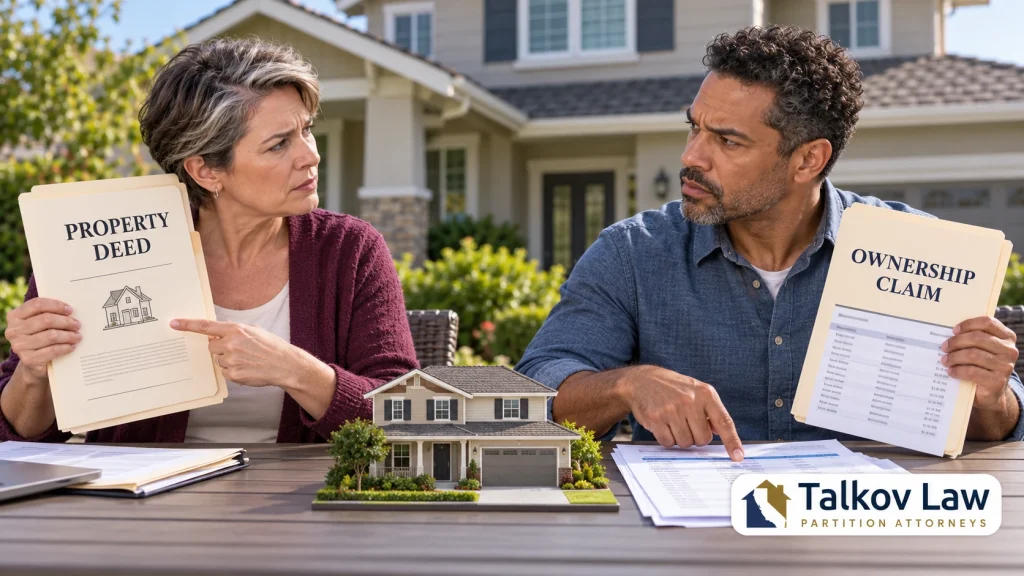
A quiet title action asks a court to decide who owns property. In co-ownership disputes, it is often paired with a partition action, which ends the co-ownership.
What is a Quiet Title Action Alleging Co-Ownership?
Quiet Title in California is under the authority of the California Code of Civil Procedure §760.010 – §764.010. Quiet title actions are one of the most common types of real estate litigation. A quiet title action (also known as action of quiet title) is a lawsuit filed to establish or find resolution of title to real property between adverse parties. Quiet title causes of action arise when multiple parties claim ownership of or title to a property, and an owner seeks a declaratory judgment from the court “quieting title.” Indeed: “A bona fide purchaser without notice may seek a legal determination through a quiet title action that the title it obtained remains free and clear of any adverse interest in the property.” Vasquez v. LBS Financial Credit Union (2020) 52 Cal.App.5th 97, 107. Quiet title actions are used to establish a clear title, remove unknown parties, or challenge anything clouding the title on property ranging from commercial to residential and even vacant land. As explained in our blog post on title vs. deed, a party in a quiet title action can be added to title regardless of whether the record owner executed a deed. Ownership and title disputes can thus be resolved through a quiet title action.
Our attorneys bring great expertise to partition actions in California alleging co-ownership. This includes actions where one party is on the deed, but another party alleges that two or more owners should be on title.
When to File a Quiet Title Action Alleging Co-Ownership
There are many reasons why quiet title actions may arise when there are allegations of co-ownerships. Some common reasons include:
- Constructive Trust
- Resulting Trust
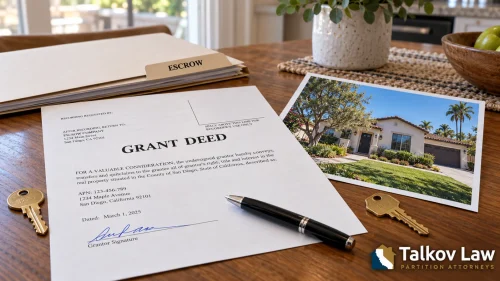
- Mistakes in Escrow
- Tenant-in-Common Agreement that is Unrecorded
When a quiet title action is filed successfully, they typically result in a court order that establishes exactly which parties have a valid co-ownership interest in the property in question. If you are involved in a conflict over ownership of a property or who has a legitimate claim to it, a quiet title action may be appropriate.
The Process of a Quiet Title Action
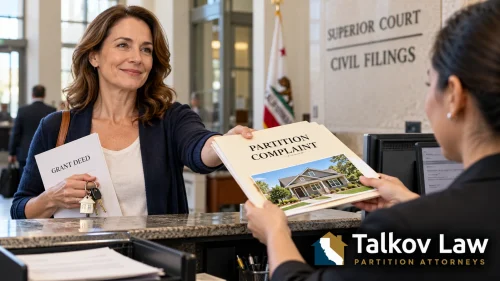
Quiet title actions must be filed in local Superior Court where the real property, or any part of it, is located. To begin the lawsuit, the plaintiff (usually the lender or homeowner) files a complaint with the court followed by a Notice of Pendency of Action (Lis Pendens), meaning “notice of pending action,” that is recorded with the county recorder and filed with the court. The complaint must be verified and the complaint must cover several requirements:
- A description of the property subject of the quiet title action
- The plaintiff must name as defendants all persons known or unknown claiming an interest in the property
- The title of the plaintiff as to which a determination of quiet title is sought. If the complaint is based on adverse possession, the complaint must allege the specific facts constituting the adverse possession
- The adverse claims to the plaintiff’s title
- Whether the title is being determined as of the date of the complaint or another date
- A prayer for the determination of the plaintiff’s title against adverse claims
In response to the complaint, the defendant files an answer, which also must include certain necessary information, such as:
- Defendant’s claim to the title
- Facts in dispute
- Statement of any new information creating a defense to the action
Once both sides have presented their information and claims, the court makes a resolution and issues a judgment that binds all of the parties involved. The title company must receive the judge’s order and all related documents in order to issue the title policy for the property.
When to Consult a Quiet Title Lawyer for Co-Ownership Disputes
The main objective of a quiet title action is to attain clear ownership of the property, and to settle any flaws found in a property title search. Filing an action for a quiet title is not always easy and straightforward. A skilled attorney who specializes in real estate examine your title, can review title search results and is able to assist in obtaining a title insurance policy. This will ensure that you are protected against possible clouds on title and will know exactly what needs to be done to clear any title defects. Because conflicts in property ownership may possibly lead to litigation, it is wise to consult a partition attorney regarding your case.
Partition of Equitable Co-Ownership Interests
The partition statutes make clear that: “The interests of the parties, plaintiff as well as defendant, may be put in issue, tried, and determined in the action.” Code of Civil Procedure section 872.610;.
“An equitable interest is sufficient to support a partition action.” Powers v. Powers (1963) 221 Cal.App.2d 746, 750; see Capuccio v. Caire (1922) 189 Cal. 514, 525–26 (“the legal or equitable owners of their respective interests in said real property,…were, therefore, entitled to institute and maintain this action for the partition of said real property”); Demetris v. Demetris (1954) 125 Cal.App.2d 440, 445 (“In such action the parties may assert any title they have, legal or equitable, and the court will decree what is equitable and proper”); Murphy v. Crowley (1903) 140 Cal. 141, 145 (“The owner of an equitable title is the owner of real property, and may maintain an action to establish his equitable right, and in the same action obtain a partition of the real property to which he claims a complete title in equity.”); Luco v. De Toro (1891) 91 Cal. 405 (“in this action for a partition there can be no doubt that the parties may assert any title which they have, legal or equitable”).
Indeed, to avoid “litigation by piecemeal,” there is “no reason why the owner of the equitable title may not sue to establish his right, and when so established, if he is a tenant in common, ask for and have a partition of the common estate….” Watson v. Sutro (1890) 86 Cal. 500, 528–29.
Resulting Trusts: Co-Ownership When You Paid but Are Not on the Deed
One of the most common co-ownership claims comes from a person who helped pay for a house but was left off the deed. California law can still treat that person as an owner through a resulting trust. Nobody signs a resulting trust. The law creates it from what the parties did: the person on the deed holds title for the person who paid. In the words of the Court of Appeal, “A resulting trust arises by operation of law from a transfer of property under circumstances showing that the transferee was not intended to take the beneficial interest.” Estate of Yool (2007) 151 Cal.App.4th 867, 874 (quoting Lloyds Bank California v. Wells Fargo Bank (1986) 187 Cal.App.3d 1038, 1042–1043).
The classic example is a purchase: “Ordinarily a resulting trust arises in favor of the payor of the purchase price of the property where the purchase price, or a part thereof, is paid by one person and the title is taken in the name of another.” Martin v. Kehl (1983) 145 Cal.App.3d 228, 238. Paying only part of the price can still earn a share, because “a resulting trust may be established in a fractional interest in property where the one urging the trust pays only a portion of the purchase price.” Watson v. Poore (1941) 18 Cal.2d 302, 317.
No written agreement is required. “A resulting trust is implied from the facts, and neither written evidence of an agreement nor a fraud on the part of the alleged trustee is essential to its existence.” Rowland v. Clark (1949) 91 Cal.App.2d 880, 883 (quoting Bradley v. Duty (1946) 73 Cal.App.2d 522, 526). The same rule applies when the person on the deed paid the seller with someone else’s money, with that person’s consent. Majewsky v. Empire Construction Co. (1970) 2 Cal.3d 478, 485.
Here is how the share works out. Two siblings buy a $500,000 house with cash. One pays $200,000 and the other pays $300,000, but only the second sibling goes on the deed. The first sibling can claim a 40 percent share through a resulting trust ($200,000 ÷ $500,000 = 40 percent), and then ask the court to partition the property.
The Proof Must Be Clear and Convincing
The deed still starts out ahead. Under Evidence Code section 662, the person on title is presumed to own the full beneficial title, and that presumption can be overcome only by clear and convincing evidence. For a resulting trust, that means proving exactly how much you paid: “One who claims a resulting trust in land must establish clearly, convincingly and unambiguously, the precise amount or proportion of the consideration furnished by him.” Laing v. Laubach (1965) 233 Cal.App.2d 511, 517.
Escrow statements, bank records, wire confirmations, and canceled checks showing who paid what are usually the heart of the case. Once the share is proven, the court can decide it and order the partition in the same lawsuit, because under Code of Civil Procedure section 872.610 the interests of every party may be “put in issue, tried, and determined in the action.” To learn more about how courts treat ownership that differs from the deed, see our article on equitable title vs. legal title.
Contact a Quiet Title Co-Ownership and Partition Attorney in California Today
No one should be fighting a quiet title battle on their own. Our real estate partition action attorneys have vast experience in quiet title co-ownership actions with cases throughout the State of California, including Los Angeles, Orange County, San Francisco, Riverside, San Diego, San Jose, Sacramento, and Surrounding Areas in California. Call the experienced partition attorneys at Talkov Law at (877) PARTITION (727-8484) or contact us online for a free consultation about your case!
Talkov Law's Partition Attorneys Can Help
If you want to end your co-ownership relationship, but your co-owner won’t agree, a partition action is your only option. With 12 full time partition lawyers, Talkov Law is the #1 partition law firm in California and has handled over 650 partition actions throughout California. Every case has resulted in a sale to either a third party or one of the co-owners. Not a single court has denied our clients the right to partition or declared our client to be a non-owner. Plus, for qualified cases, there is no fee until we settle or win your case!
If you're looking to end your co-ownership dispute, contact California's premier partition action law firm by calling Talkov Law at (877) PARTITION (727-8484) or sending us a message today.