No. If you paid the down payment and the mortgage, your ex does not automatically walk away with half the equity just because both names are on the deed. In a California partition action, the court generally repays the co-owner who put in more before the rest of the money is split. The major exception is a “true joint tenancy,” where the court finds you both meant to own the house equally no matter who paid.
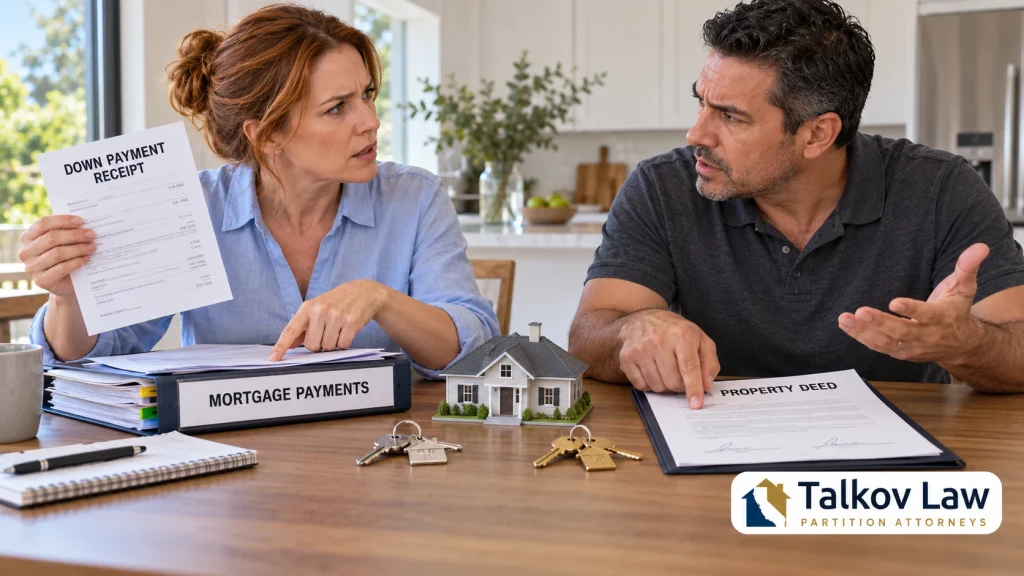
This comes up most often with former romantic partners who bought together. One partner, usually the higher earner, paid most or all of the costs while the relationship was going well. Now that it has ended, the other partner points to the deed and asks for half.
Your Ex’s Name on the Deed Is Only the Starting Point
The deed tells the court who owns the house and in what shares, and changing those percentages is hard. Under California Evidence Code section 662, “The owner of the legal title to property is presumed to be the owner of the full beneficial title. This presumption may be rebutted only by clear and convincing proof.”
But ownership percentages are only half the math. Even when the deed reads 50/50, the court decides who gets paid back for what through the partition offsets and accounting, under California Code of Civil Procedure section 872.140:
“The court may, in all cases, order allowance, accounting, contribution, or other compensatory adjustment among the parties according to the principles of equity.”
California Code of Civil Procedure section 872.140
How that accounting treats your payments depends on how you and your ex took title: as tenants in common or as joint tenants.
Tenants in Common Usually Get Their Down Payment and Mortgage Payments Back
Tenancy in common is California’s default form of co-ownership, and between tenants in common the co-owner who paid more is generally repaid before the rest is divided. In Milian v. De Leon (1986) 181 Cal.App.3d 1185, 1194, the Court of Appeal explained that a co-owner who pays the taxes, the loan payments, or other charges against the property “on partition by sale is entitled to reimbursement for those expenditures before division of the proceeds among the property owners.”
For a tenant in common who paid more than their share, that can include:
- The unequal down payment, which the court may repay or, in some cases, use to give you a larger ownership share
- Mortgage payments you carried beyond your share, with principal often easier to recover than interest
- Property taxes and homeowner’s insurance you paid alone
- Repairs and improvements that added value to the house
Here is how the math can work. Say you and your ex own the house 50/50 as tenants in common, you paid the entire $150,000 down payment and $60,000 of loan principal, your ex paid nothing, and the sale leaves $500,000 after the loan and the costs of sale are paid. You are repaid $210,000 first, and the remaining $290,000 is split evenly, so you receive $355,000 and your ex receives $145,000, not $250,000. Our post on two ways to calculate co-owner reimbursements explains the methods courts use.
Which Offsets are Sometimes Awarded?
When property is owned by partners who have earning capacities, offsets for mortgage payments may be interpreted as a gift from the higher-earning co-owner to their former partner. A seasoned partition attorney may argue a compelling case by distinguishing the principal payments of the mortgage, which is more likely to be reimbursed, from the interest. Furthermore, payments for taxes and insurance might also be eligible for reimbursement. The likelihood of recouping these costs decreases significantly after one party has vacated the property.
Generally, “when, in a suit for partition or a sale for division, or other proceeding between cotenants in equity or in which equitable powers may be exerted, a cotenant who has been in possession or use of the premises seeks to obtain contribution respecting improvements made, or amounts expended in protection or preservation of the property, the court, as incidental to the granting of such relief and by way of adjusting the rights of the parties, may charge the claimant, defensively, with at least a part of the reasonable value of his occupancy or use….”[1]
Expect Your Ex to Argue the Payments Were Gifts
Even between tenants in common, the partner who paid less will often argue that your payments were gifts made during a loving relationship. That argument is strongest when one partner earned far more and paid the household bills without any talk of repayment. Money from your parents raises its own question of whether the gift was meant for you alone or for both of you, which our post on down payment gifts explains.
Your ex can also push back if you stayed in the house after the breakup. The court can weigh the rental value of your exclusive use against your claim for mortgage payments made after you split. The trial court in Milian, for example, denied credit for payments made after the couple separated because those payments roughly equaled the fair rental value of the house.
Evidence That Protects the Co-Owner Who Paid
The partition referee and the court decide these claims on records, not memories, and people in a breakup routinely overestimate what they contributed. Gather:
- The escrow closing statement and the wire or cashier’s check for the down payment
- Bank statements showing each mortgage payment and the account it came from
- Any gift letter either of you signed for the lender
- Texts or emails about who would get the down payment back if you split
Our guide to the evidence a partition referee needs for offsets goes further.
Get Your Down Payment Back With a California Partition Action
You do not need your ex’s agreement to end the co-ownership. Any co-owner can force the sale of jointly owned property, and either of you may be able to buy the property in the partition action instead. The accounting then decides how the proceeds are divided. Sharing a deed is not the same as sharing a down payment.
Talkov Law can help. With 12 full-time partition attorneys and experience in over 650 partition actions throughout California, our team handles every step of the process, from filing through the final accounting of who paid what. Call (877) PARTITION (727-8484) today or contact us online to get started.
References
| ↑1 | Hunter v. Schultz (1966) 240 Cal.App. 2d 24, 30–31. |
|---|