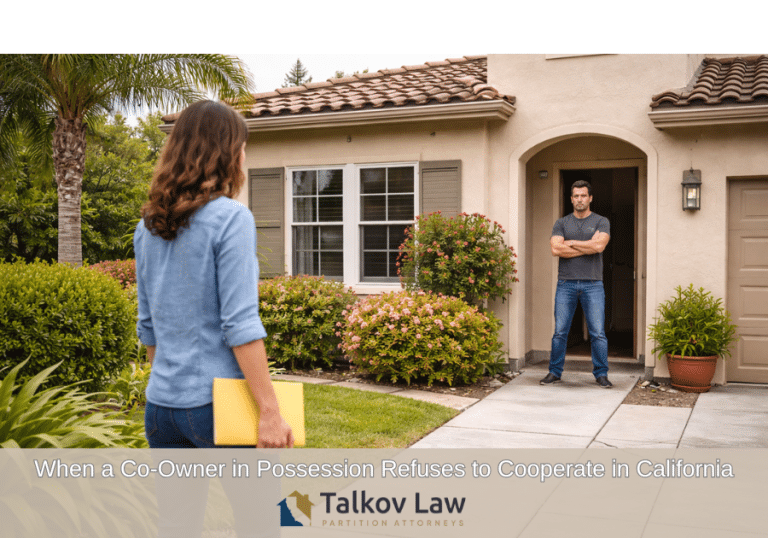
One of the most common reasons a co-owner refuses to cooperate with a sale is simple: they are already getting what they want.
If your co-owner is living in the property, they may have little incentive to sell or buy you out. In fact, they may actively delay, obstruct, or ignore your requests in hopes that you will give up or accept a cheap buyout.
Understanding the concept of a co-owner in possession is critical to knowing your rights and your leverage under California law.
What Is a Co-Owner in Possession?
A co-owner in possession is a joint tenant or tenant in common who occupies the property while another co-owner does not.
Under California law, each co-owner has an equal right to possess the entire property, regardless of their percentage interest. That means one co-owner generally cannot exclude another through an unlawful detainer (eviction). However, in practice, one person often ends up living at the co-owned property while the other does not.
This creates a significant imbalance.
Why the Co-Owner in Possession Refuses to Sell
If someone is living in the property rent-free (or effectively rent-free), they may:
• Delay responding to requests to sell
• Refuse to list the property
• Ignore offers
• Create conflict to frustrate you
• Demand a below-market buyout
From their perspective, time is on their side. They are already enjoying the full benefit of the property while you receive nothing.
In some cases, they may hope that financial pressure, frustration, or emotional fatigue will push you into accepting a discounted buyout just to “be done with it.”
Ouster and Occupancy Value in California
California law does not allow one co-owner to profit unfairly at the expense of another.
If a co-owner in possession excludes another co-owner from the property (known as “ouster”), the occupying co-owner may be required to pay the fair rental value of the property. Even without formal ouster, courts in partition actions can account for occupancy and award credits or offsets.
In a partition action, the court can:
• Order the property sold (partition by sale)
• Account for rental value owed to the non-occupying co-owner
• Adjust the division of proceeds based on equitable factors
This removes the incentive to delay.
How Delay Tactics Backfire
Many co-owners in possession believe they can stall indefinitely. However, under California Code of Civil Procedure § 872.210, a co-owner has an absolute right to partition. The court will not force you to remain in co-ownership.
Once a partition action is filed:
• The court can appoint a partition referee
• The property can be listed and sold
• Credits and reimbursements can be calculated
• Attorney’s fees may be recoverable under Code of Civil Procedure § 874.010
The longer the occupying co-owner delays, the greater the potential financial exposure.
Why You Should Not Accept a Cheap Buyout
It is common for a co-owner in possession to offer a buyout below market value, arguing:
• “The house needs repairs.”
• “The market is bad.”
• “You won’t get more than this anyway.”
• “If you sue, you’ll just waste money.”
In reality, a properly handled partition action often results in:
• A fair open market sale
• Competitive bidding
• Court-supervised accounting
• A fair distribution of proceeds
The pressure they are applying is often strategic.
Partition Is Leverage
Filing a partition action changes the power dynamic. Instead of you waiting for cooperation, the court controls the process.
Once that happens, the co-owner in possession can no longer:
• Unilaterally block the sale
• Use occupancy as leverage
• Stretch the situation indefinitely
The law is designed to prevent exactly this kind of deadlock.
Ending the Stalemate with a Co-owner in Possession
If your co-owner is living in the property and refusing to cooperate, the situation will not improve on its own. The longer you wait, the longer they continue benefiting from the property while you remain locked out of your equity.
A partition action forces movement. It replaces emotion and gamesmanship with a court-supervised process.
Talkov Law has twelve full-time partition attorneys who have handled 575 partition actions throughout California.
If you are dealing with a co-owner in possession who refuses to cooperate or is pressuring you to accept a cheap buyout, call (877) PARTITION (727-8484) or contact us online today to protect your rights and force a fair resolution.