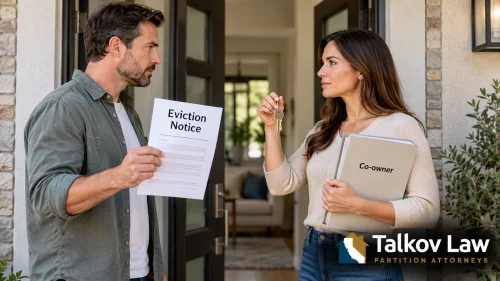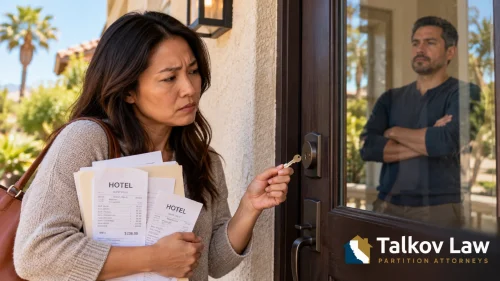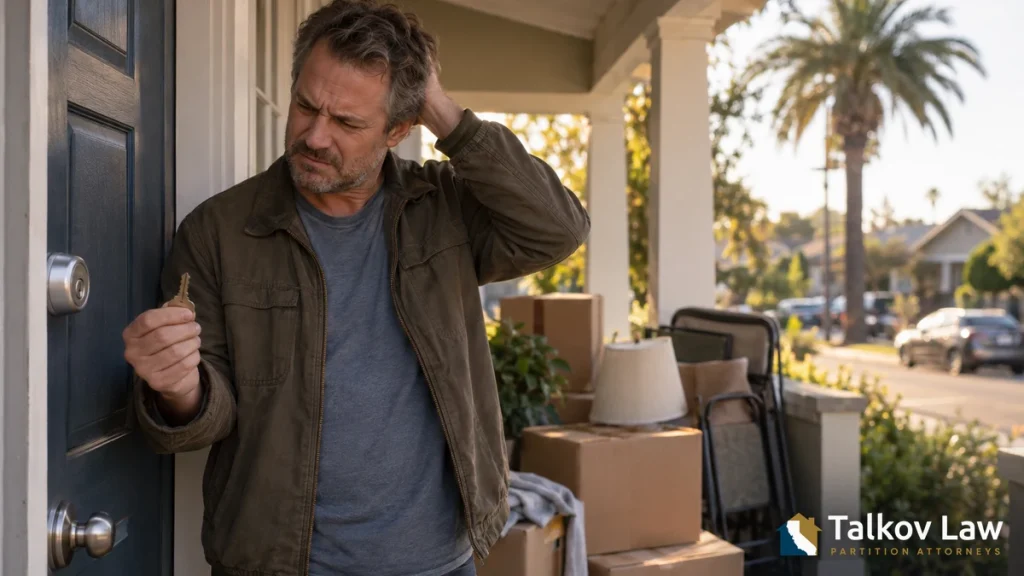
A co-owner who changes the locks, posts “No Trespassing” signs, and refuses to let the other owner back in has committed an ouster, and the owner who was locked out can recover possession and damages for the lost use of the property. The California Supreme Court said so in Zaslow v. Kroenert (1946) 29 Cal.2d 541, 548. The same case also holds that the locked-out owner cannot use a damages lawsuit to force the other owner to buy them out, and that boxing up an owner’s belongings and putting them in storage is not, by itself, stealing them.
Why Zaslow v. Kroenert Matters
Lockouts are one of the most common ways co-ownership falls apart. One owner moves in, changes the locks, and tells the other to stay away. Zaslow is the California Supreme Court decision that sets the basic rules for that situation:
- Every co-owner can use the whole property. No co-owner may shut another out of any part of it.
- A lockout is an ouster. Changing the locks, denying the other owner’s title, and refusing entry is enough.
- The locked-out owner is owed money. The usual measure is their share of the rental value from the date of the ouster.
- A damages lawsuit is not a buyout. The way to turn your share into cash is a partition action.
The case is cited for its definition of ouster, which later courts, including the Court of Appeal in Hacienda Ranch Homes, still apply.
The Facts: Two Tax Buyers and a Changed Lock
The property was a house with a hamburger stand in Los Angeles County. Marcus Zaslow had been in possession since 1935, after foreclosing a street assessment bond on the land. Meanwhile, the property had been deeded to the state years earlier for unpaid taxes, and in 1943 Helene Kroenert bought it at a tax sale for $4,700, outbidding Zaslow’s $4,600. (Zaslow, at pp. 544–545.)
On May 15, 1944, Zaslow’s subtenant moved out and left the doors unlocked. That same day, Kroenert’s agent walked in, posted “No Trespassing” signs, and changed the locks. When Zaslow came back that evening, he could not get in. When he and his attorney later asked to enter, the agent refused. Zaslow’s belongings were later moved into storage. (Zaslow, at pp. 545–546.)
Zaslow sued for trespass and conversion (the legal term for wrongfully taking someone’s personal property). The trial court awarded him $1,400 for the lockout, $1,200 for his belongings, and $300 in punitive damages. (Zaslow, at p. 546.)
How the Supreme Court Decided the Case
Both Buyers Were Co-Owners
The court first held that Kroenert’s tax deed was valid. Because Zaslow and Kroenert had each bought the whole parcel at a tax sale from different taxing agencies, they became tenants in common. (Zaslow, at pp. 547–548.) That meant Zaslow could not treat Kroenert as a trespasser. The question became what one co-owner owes another after a lockout.
No Co-Owner May Exclude Another
The court started with the rule every co-owner should know:
“Each tenant in common equally is entitled to share in the possession of the entire property and neither may exclude the other from any part of it.”
Zaslow, at p. 548
It then defined ouster as “the wrongful dispossession or exclusion by one tenant of his cotenant or cotenants from the common property of which they are entitled to possession,” proved by acts “such as claiming the whole for himself, denying the title of his companion, or refusing to permit him to enter.” (Zaslow, at p. 548.)
Changing the Locks Was an Ouster
Kroenert denied Zaslow’s title, her agent changed the locks and posted signs, and Zaslow was refused entry when he asked. That was enough. It did not matter whether the departing subtenant had told the agent he could move in:
“The wrong or ouster took place when Mrs. Kroenert denied Zaslow’s title and refused him common possession.”
Zaslow, at p. 548
Zaslow was entitled to get back into the property and to recover damages for loss of use, which ordinarily equal the ousted owner’s share of the value of the use and occupation of the land from the time of the ouster. (Zaslow, at p. 548.)
The Damages Had to Match the Rental Value
The $1,400 award did not hold up. The house and hamburger stand together rented for $75 a month, and only about four months passed between the lockout and the judgment, so the rental value for that period was about $325. The trial court had also tried the case as if Kroenert owned nothing at all. (Zaslow, at p. 549.)
A Damages Lawsuit Cannot Force a Buyout
Zaslow argued that he could treat the lockout as permanent, give up his interest, and collect its value from Kroenert. The court rejected that:
“But this rule will not permit Zaslow to waive all of his interest in real property, in effect abandon his property to the cotenant, and force a sale on Mrs. Kroenert.”
Zaslow, at p. 549
Where nothing showed that the ouster was permanent, damages for loss of use were adequate relief. (Zaslow, at p. 549.) In other words, an ouster lawsuit gets you rent, not your equity. A co-owner who wants out and wants their share in cash files for partition.
Moving Belongings to Storage Was Not Conversion
The court also reversed the $1,200 award for Zaslow’s belongings. It held that “the act of taking possession of a building and locking it does not, of itself, constitute a conversion of the personal property therein.” (Zaslow, at p. 550.) Kroenert’s side stored the goods, did not use them, and offered them back by letter, and Zaslow never demanded their return. (Zaslow, at p. 551.)
That did not leave Zaslow empty-handed. As a co-owner, he had the right to keep his belongings in the house, so moving them was a wrongful interference that entitled him to his actual losses. And the court noted that refusing to let an owner retrieve belongings after a demand can be evidence of conversion. (Zaslow, at pp. 550–551.)
The Result
The Supreme Court reversed the judgment and sent the case back for the trial court to recalculate the damages for the ouster and for the interference with Zaslow’s belongings. (Zaslow, at p. 552.) Zaslow won on liability. He lost the inflated numbers.
What Zaslow v. Kroenert Means for California Co-Owners
- If your co-owner changed the locks and refused to let you in, that is very likely an ouster.
- Ask in writing to be let back in. Today, Civil Code section 843 sets out how to make that demand; see our article on the notice of ouster.
- You may be owed your share of the rental value from the date of the ouster. See damages for ouster and whether you can collect rental value from a co-owner in possession.
- If your belongings are still inside, ask for them back in writing. A refusal after a demand strengthens your claim.
- Rent and other credits are settled in the partition through partition offsets, before the sale money is divided.
Zaslow shows the limits of fighting a lockout one month of rent at a time. A partition action ends the standoff. Any co-owner can file under Code of Civil Procedure section 872.210, whether or not they are living in the property, and the court orders the property sold or divided and credits each owner for what they are owed. When you are ready, you can file a partition lawsuit.
Talkov Law can help. With 12 full-time partition attorneys and experience in over 650 partition actions throughout California, our team handles every step of the process, from proving the ouster through the referee’s sale and the final distribution of proceeds. Call (877) PARTITION (727-8484) today or contact us online to get started.