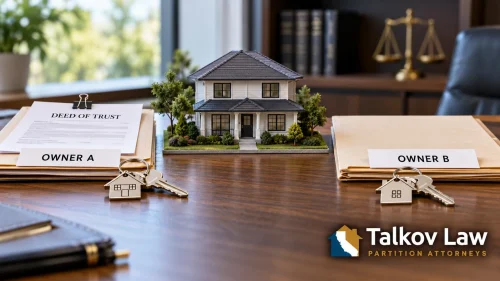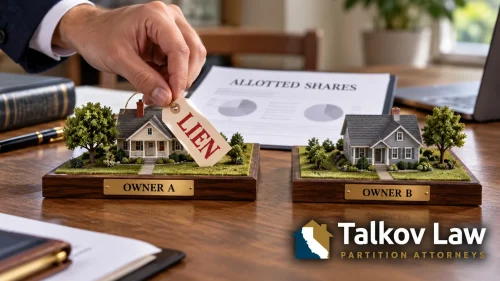
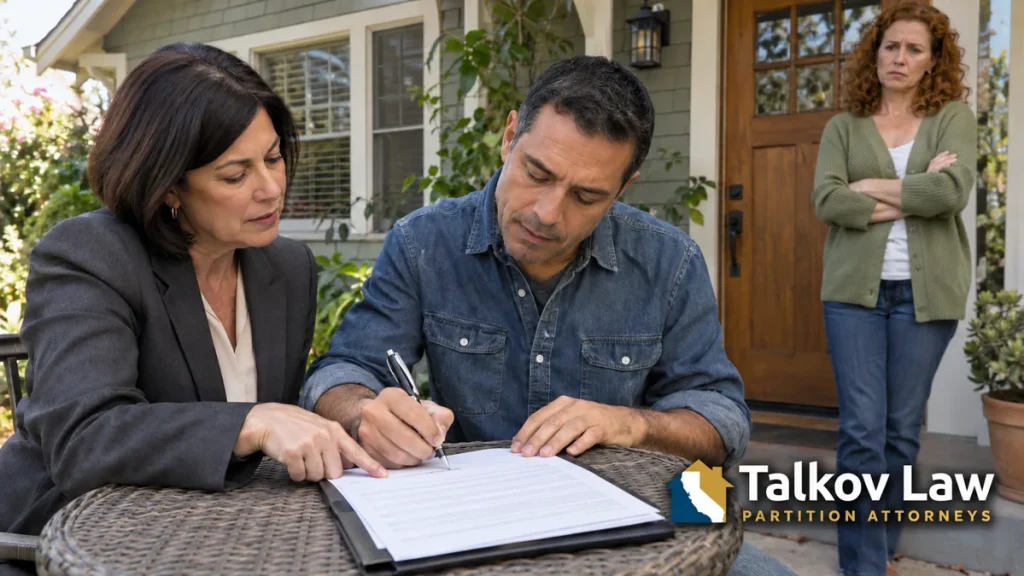
A California co-owner can borrow against their own share without asking the other owners, but that loan reaches only the borrower’s share. In Zieve, Brodnax & Steele, LLP v. Dhindsa (2020) 49 Cal.App.5th 27, the Court of Appeal applied that rule even after a foreclosure. A bank holding a second loan signed for a 75 percent interest got only 75 percent of the leftover sale money, and the co-owner whose 25 percent was never borrowed against got the rest.
Why Zieve v. Dhindsa Matters
Co-owners often discover that another owner took out a loan against the property without telling them. Zieve is the published case that answers their three most common questions:
- Can a co-owner borrow without my consent? Yes. “Each cotenant can sell or encumber his or her interest in the common property without the knowledge, approval, or consent of the other cotenants.” (Zieve, at p. 35, quoting a leading real estate treatise.)
- Does that loan reach my share? No. A deed of trust “given by only one cotenant affects only his or her interest in the property.” (Zieve, at pp. 35–36.)
- What if the lender forecloses? The lender can foreclose only on the borrower’s share. The buyer at that sale “becomes a tenant in common with the other cotenants” and can file a partition action. (Zieve, at p. 36.)
The case then adds a fourth answer: when the whole property is sold to pay a loan everyone owes, the leftover money is split by ownership share first, and a loan signed by one owner is paid only from that owner’s part.
The Facts: A Turlock Home and a Second Loan
The home was in Turlock, in Stanislaus County. Because the owners share a last name, this article uses first names. By 2001, Ashraj Dhindsa owned 25 percent, which he received from his uncle Malkit as a two-year-old. That year, Ashraj, then 10, and his father signed a quitclaim deed to Malkit, but Ashraj’s part was void because he was a minor. So Malkit ended up with 75 percent and Ashraj kept 25 percent.
The whole property already secured a first loan. In 2007, Malkit alone took out a $225,000 home equity line of credit, secured by a second deed of trust. A 2009 court judgment confirmed that Ashraj owned 25 percent, that the first loan was a lien on the whole property, and that the second loan encumbered only Malkit’s 75 percent.
In 2018, the first loan was foreclosed through a trustee’s sale, without a lawsuit. Wells Fargo, which by then held the second loan, bought the property for $253,500. After the first loan and the costs of the sale were paid, $154,799.83 remained. Wells Fargo, owed $238,501.44 on the second loan, claimed all of it. Ashraj claimed 25 percent. The trial court gave everything to Wells Fargo.
How the Court of Appeal Reached Its Decision
The Court of Appeal reversed: “The owner of the unencumbered 25 percent interest is entitled to a proportionate share of surplus proceeds.” (Zieve, supra, 49 Cal.App.5th 27.)
The court relied on a 1978 California Supreme Court decision dividing foreclosure surplus between co-owners:
“When a cotenant has separately encumbered his interest in the property and, as here, such encumbrance is one of the subordinate liens, it attaches only to such cotenant’s interest.”
Caito v. United California Bank (1978) 20 Cal.3d 694, 701
Ashraj’s 25 percent was subject to the first loan, which everyone owed, but not to Malkit’s second loan.
The Foreclosure Statute Did Not Change the Rule
Wells Fargo relied on Civil Code section 2924k, passed in 1990, which tells a trustee to pay leftover sale money to junior lenders before the owners. The court read “junior lenders” to mean only those whose loans actually covered the share in question. The bank’s reading would let a lender on a 1 percent share take money belonging to the owner of the other 99 percent, and “Such an extreme result appears unintended.” (Zieve, supra, 49 Cal.App.5th 27.)
Buying the Property Did Not Help the Bank
The foreclosure wiped out both the second loan’s lien and Ashraj’s ownership, leaving each with only a claim to the leftover money. Being the buyer at the sale changed nothing: “Wells Fargo did not acquire any claim to the surplus sale proceeds by virtue of purchasing the Property at the trustee’s sale.” (Zieve, supra, 49 Cal.App.5th 27.)
The Result: A 75/25 Split
The Court of Appeal directed the trial court to pay 75 percent of the surplus to Wells Fargo and 25 percent to Ashraj, who also recovered his costs on appeal.
What Zieve v. Dhindsa Means for California Co-Owners
- Your co-owner can borrow against their share without you, but not against yours. See can one co-owner take out a loan on a jointly owned property and co-owners’ right to encumber property.
- The same goes for listing or selling: one co-owner’s signature binds only that co-owner. See can a realtor list a property with only one co-owner’s signature.
- A lender that forecloses on one share becomes your co-owner and can file for partition. See do I name a lender in a partition action.
- In a partition, each loan is paid from the share it encumbers. In a division in kind, a lien on one owner’s interest follows that owner’s piece under Code of Civil Procedure section 873.260.
You do not have to wait for a foreclosure to sort this out. Our article on whether a partition can prevent a foreclosure explains the options when a co-owner stops paying.
Did Your Co-Owner Borrow Against the Property? Start Your California Partition Action
A co-owner’s loan does not have to trap your equity. A partition action brings the lenders into one case, sorts out which debt belongs to which share, and ends the co-ownership. When you are ready, file a partition lawsuit.
Talkov Law can help. With 12 full-time partition attorneys and experience in over 650 partition actions throughout California, our team handles every step of the process, from naming every lender in the complaint through the partition referee‘s sale and the final distribution of proceeds. Call (877) PARTITION (727-8484) today or contact us online to get started.