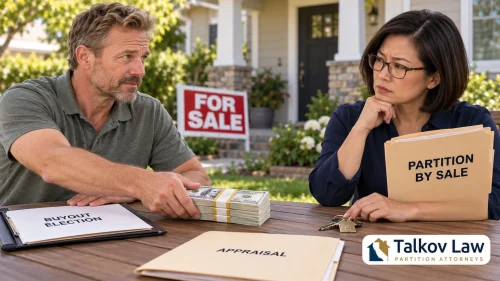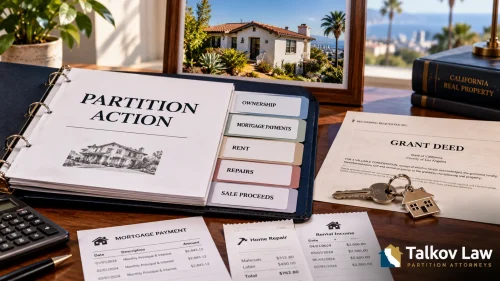

A California court cannot order a partition by appraisal unless the co-owners agree to it. In Cummings v. Dessel (2017) 13 Cal.App.5th 589, 598–599, the Court of Appeal held that a trial court erred when it let co-owners bid against each other for the property at an appraised minimum price over one side’s objection. The court still affirmed the judgment because the error made no difference to the outcome.
The case is the leading published decision on partition by appraisal in California, and it explains why most contested cases end in a partition by sale with public notice.
The Facts: A Fixer-Upper in Humboldt County
In 2009, Gayle Cummings, Jennifer Dessel, and Dessel’s daughter, Emily Seal, agreed to buy a parcel in Fieldbrook in Humboldt County, California with a small, dilapidated house and a carport. Their plan was to remodel the house into a vacation rental. The price was $200,000. Cummings made an $80,000 down payment, and the seller carried a $120,000 note.
Dessel and Seal agreed to match Cummings’s investment by making the monthly payments, paying insurance and property taxes, and contributing labor and materials. They gutted the house down to a shell, then stopped work. In late 2010, they told Cummings they could no longer make their payments, and Cummings took over the payments and property taxes to protect her investment.
The deed also caused a dispute. It listed each of the three buyers as owning one-third as joint tenants, while Cummings said the deal was half for her and half for Dessel and Seal together.
The Trial Court Ordered a Bidding Procedure
In 2011, Cummings sued to quiet title and for partition. After a five-day trial, the court ruled that Cummings owned 50 percent and Dessel and Seal each owned 25 percent as tenants in common. Finding that physically dividing the property, called partition in kind, was not feasible, it created its own two-step procedure in the interlocutory judgment:
- First, the co-owners could bid against each other to buy the property, with a minimum bid of $125,000 based on the testimony of Cummings’s appraisal expert.
- Second, if no co-owner bid, the property would be listed and sold to the public.
The court also gave Cummings an $84,765.15 credit in the bidding for the extra money she had put into the property, one of the offsets and credits in a partition action. Cummings bid the $125,000 minimum, Dessel and Seal did not bid, and Cummings became the sole owner without paying any additional money. Dessel and Seal appealed.
The Court of Appeal: Partition by Appraisal Requires Agreement
California law offers three manners of partition: partition in kind, partition by sale, and partition by appraisal. (Cummings v. Dessel (2017) 13 Cal.App.5th 589, 597.) A court may order a sale without the co-owners’ agreement when a sale “would be more equitable” than division under California Code of Civil Procedure section 872.820. Partition by appraisal is different.
The Bidding Stage Was a Partition by Appraisal
The court held that letting co-owners buy each other out at an appraised price was a partition by appraisal, and that method depends on consent. California Code of Civil Procedure section 873.910 says that once the interests are undisputed or decided, “the parties may agree upon a partition by appraisal,” and California Code of Civil Procedure section 873.920 requires that agreement to be “in writing filed with the clerk of court.”
“The unambiguous language of the partition by appraisal statutory provisions, however, requires an agreement among the parties.”
Cummings v. Dessel (2017) 13 Cal.App.5th 589, 598
Cummings conceded on appeal that there was no agreement, written or otherwise. The procedure was therefore an error of law.
It Was Not a Valid Private Sale Either
Cummings argued the bidding was really a court-ordered private sale. The court rejected that view. A partition sale requires notice like a sale on execution under California Code of Civil Procedure section 873.640, which means posting and newspaper publication, and California Code of Civil Procedure section 873.650 sets what the notice must say. Reading the statutes together, the court found “it is evident the intent was to ensure that members of the public receive notice and have an opportunity to bid on property during a partition sale, whether a sale at public auction or a private sale.” (Cummings v. Dessel (2017) 13 Cal.App.5th 589, 600–601.)
Limiting bidders to the co-owners would have made a “private sale” the same as a partition by appraisal and erased the requirement of a written agreement. Here, only the co-owners received notice of the bidding. As our article on what a notice of private sale means explains, a private sale in a partition is usually a referee marketing the property to the public.
The Result: Error, but Judgment Affirmed
The Court of Appeal found that the procedure “did not comply with the statutory requirements for partition by appraisal or for partition by sale.” Even so, it affirmed: “We shall, nonetheless, affirm the judgment because the error was not prejudicial, as it did not affect the result.” (Cummings v. Dessel (2017) 13 Cal.App.5th 589, 601–602.) The reasons the error was harmless appear in an unpublished portion of the opinion. Cummings kept the property, and each side bore its own costs on appeal.
What Cummings v. Dessel Means for California Co-Owners
- A court cannot impose a partition by appraisal. It requires a written agreement among the co-owners filed with the court.
- Without that agreement, the usual path is a court-ordered sale, typically handled by a partition referee, with notice to the public so that the property draws the best price.
- Money one co-owner put into the property can still be credited when the proceeds are divided, under California Code of Civil Procedure section 872.140.
- Co-owners who want a quick buyout at an appraised price can still agree to one, and many cases settle that way. See Buying Out a Co-Owner in California, which also covers the separate buyout process under the Partition of Real Property Act.
For plaintiffs, the lesson is to ask for the remedy the statutes allow. A sale on proper notice, followed by an accounting, ends the co-ownership and holds up on appeal.
Choose the Right Path to End Your Co-Ownership
If your co-owner will not agree on a price or a buyout, you do not need their consent to end the co-ownership. A partition by sale lets the court order the property sold and the proceeds divided. When you are ready, you can file a partition lawsuit.
Talkov Law can help. With 12 full-time partition attorneys and experience in over 650 partition actions throughout California, our team handles every step of the process, from negotiating a buyout through the referee’s sale and the final distribution of proceeds. Call (877) PARTITION (727-8484) today or contact us online to get started.