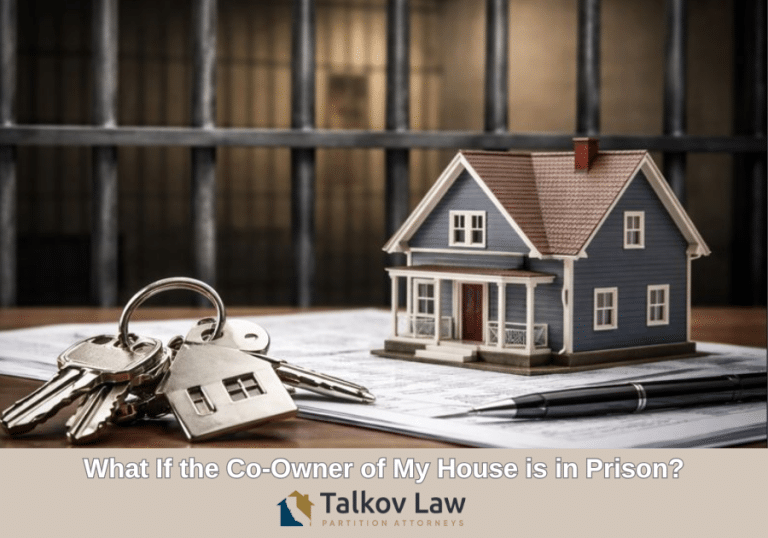
Owning a house with someone is hard enough when you can talk, negotiate, and sign paperwork together. But when the co-owner is incarcerated, normal solutions often grind to a halt—refinancing stalls, sale decisions get vetoed, and even basic issues like repairs and improvements or rental management turn into disputes.
In California, incarceration does not erase a co-owner’s property rights, but it also does not prevent you from using the court system to end co-ownership when cooperation is lacking. California’s partition laws exist for exactly this kind of deadlock. Notably, the “right to partition” is generally treated as absolute.
If your co-owner is in prison and you need to partition your property, remove the uncertainty, or stop paying everything alone, Talkov Law Partition Attorneys can help you pursue a partition action to force a sale or structured buyout. With over 650 partition actions successfully handled, we are California’s first and only partition exclusive law firm.
Call (877) PARTITION (727-8484) to speak with a partition attorney today.
What to Know When a Co-Owner Is in Prison
1) Prison does not “take them off title”
Even though incarceration does not remove someone from title, it often changes what motivates them—and what they are realistically able to do.
A co-owner who is incarcerated is still a joint owner. That means their signature is still needed when listing the property for sale, signing escrow documents, or agreeing to a buyout.
This is why incarceration commonly creates a stalemate: one person is available and motivated, and the other is unreachable, uncooperative, or practically unable to participate.
2) Why an incarcerated co-owner may be especially difficult to deal with
Incarceration often makes co-ownership disputes worse because the incarcerated co-owner may have little reason (or ability) to cooperate, especially if the co-owner suffers from a mental illness. If they owe criminal restitution, fines, or face a civil judgment tied to the underlying crime, they may assume any sale proceeds divided after a partition action will go to those obligations and stop responding.
Family dynamics can also shift while someone is in custody—like a parent’s death creating new co-owners—and third parties (such as a partner or friend) may remain in the home and resist cooperation. Often times, co-owners in prison are often subject to default partition judgments, thereby allowing the to be sold by court order without their signature.
3) When an incarcerated co-owner will not cooperate, a partition action may be the only solution
A partition action is a court-supervised process to end co-ownership, usually by ordering a sale and distributing the proceeds. In California, a partition case typically unfolds in two phases:
- Stage 1: Ownership and sale. The court determines each owner’s percentage and decides that the property will be sold.
- Stage 2: Accounting and compensatory adjustments. After sale, the court can adjust the proceeds to account for unequal payments, repairs, insurance, property taxes, or other contributions and benefits during co-ownership.
This structure matters because incarceration often creates real world imbalances, especially where one co-owner pays the mortgage and maintains the property while the incarcerated co-owner contributes little or nothing.
4) A partition referee can sign documents and manage the sale without the incarcerated co-owner’s cooperation
In many partition-by-sale cases, the court appoints a neutral partition referee. A referee can manage the entire sale process and—critically—can sign the sale documents necessary to complete the transaction when an owner is missing or uncooperative.
That is often the practical “unlock” when a co-owner is incarcerated: instead of waiting for signatures that never come, the court can authorize a partition referee to move the sale forward.
5) What happens if you have been paying everything yourself?
Partition law allows the court to order equitable adjustments between co-owners. One important statute is CCP § 872.140, which authorizes the court to order “allowance, accounting, contribution, or other compensatory adjustment among the parties according to the principles of equity”.
In real terms, the accounting phase often involves arguments like:
- One owner paid the mortgage, taxes, and insurance.
- One owner paid for repairs or improvements.
- One owner had exclusive possession or collected rent without sharing.
A common approach reflected in partition accounting is that reimbursable advances can be paid back before the remaining proceeds are divided among the owners.
6) What if someone else is living in the house while the co-owner is incarcerated?
This comes up often: a spouse, family member, or friend remains in the home and claims some right to stay—or claims reimbursement for expenses. Partition rights allow the property to be cleared of all occupants to allow for a sale.
7) Why you should not “wait it out”
Many owners try to “wait until they get out” or “work it out later.”
The risk is that the financial damage grows—missed mortgage payments, deferred maintenance, unpaid taxes, or continued disputes about who should be reimbursed. Partition exists to stop that bleed by giving you a court-controlled exit.
8) Serving a co-owner in jail is usually not the hard part
Many people worry that you cannot serve a partition complaint on someone who is incarcerated. In many cases, service can be completed at the jail or prison where the co-owner is incarcirated. Once proper service is completed, the case can move forward even if the co-owner does not respond.
Talkov Law Partition Attorneys routinely handles the logistics of serving the Summons and Complaint at the facility where the co-owner is being held, including identifying the correct location, coordinating with a process server, and documenting proper service so the case can move forward.
Talkov Law Partition Attorneys Can Help
If the co-owner of your house is in prison and you’re stuck paying bills, dealing with occupants, or unable to sell, Talkov Law Partition Attorneys can help you use a partition action to move forward, often with a court-appointed referee who can manage the sale even without the co-owner’s cooperation.
Call (877) PARTITION (727-8484) or fill out our online contact form to speak with a partition attorney today.