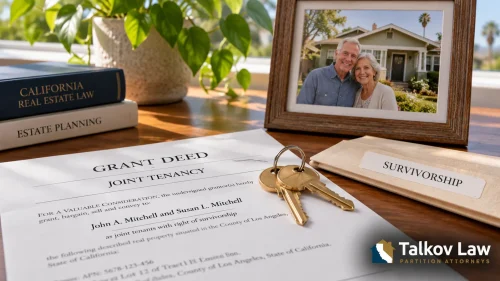
A joint tenancy deed that does not match what the co-owners agreed can be undone in the same partition action that ends the co-ownership. In Demetris v. Demetris (1954) 125 Cal.App.2d 440, 443–446, a father learned that the deed to the house he bought with his son made him a joint tenant with the son and daughter-in-law, instead of a half owner as a tenant in common. The Court of Appeal approved rewriting the deed to a tenancy in common, repaying the father the extra ,000 he put toward his son’s share, and paying the mortgage lender from all of the sale proceeds before the family members divided the rest.
Why Demetris v. Demetris Matters
When family members buy a home together, one person often handles the paperwork, and years later the deed may say something no one agreed to. Demetris answers three questions that come up in many family partition cases: Can the court fix a deed that is wrong? Does the co-owner who paid extra get it back? And who gets paid first when the house is sold with a loan still on it?
The Facts: A Burlingame Home and the Wrong Kind of Deed
The father, about 60 years old, agreed with his son to buy a home in Burlingame for $17,000. Each would pay half and own half as “partners,” which the court treated as tenants in common, meaning each owns a separate share that passes under his will rather than automatically to the other owner. The father wanted it that way because he had two daughters as well, and he had made a will leaving his share to all of his children. (Demetris, at pp. 441–442.)
The father trusted his son to get the deed done correctly. The trial court found that the father was not educated enough to fully understand the documents and that the two had a confidential relationship, meaning a relationship of trust in which one person relies on the other. But the deed that came out of escrow named the father, the son, and the son’s wife as joint tenants with right of survivorship, meaning that when one owner dies, that owner’s share passes to the survivors instead of to that owner’s heirs. (Demetris, at pp. 441–442.) Our post on joint tenancy between a parent and child explains why that difference matters so much to a parent.
The money did not line up with the deed either. In escrow, the father paid $9,500, which included $1,000 toward the son’s half that the son was supposed to repay. The father later spent $557 on improvements. The son and his wife took out a $7,500 loan from Prudential Life Insurance Company of America, secured by a deed of trust (a loan security document, like a mortgage) on the whole property, and still owed $6,929.73 on it. The son paid $427.85 in property taxes. (Demetris, at p. 442.)
Father and son both lived in the house until they had a falling out. The father learned the deed was a joint tenancy only when he consulted a lawyer about partition. He asked the son and daughter-in-law to correct the deed, and they refused. The son claimed the father’s payments were a $10,000 gift; the trial court did not believe him. Everyone agreed the house could not be divided physically and would have to be sold by a referee. (Demetris, at pp. 442–443.)
Why the Joint Tenancy Mattered
A partition would have ended the joint tenancy anyway. The problem was what the father would have walked away with. Joint tenants own equal shares; as the court later put it in Milian v. De Leon (1986) 181 Cal.App.3d 1185, 1195, “by definition joint tenancy ownership means equal ownership.” Left as written, the deed would have cost the father in three ways:
- One-third instead of half. With three joint tenants on the deed, the father held one-third of the house, even though he agreed to own half and paid more than half the price.
- His daughters could be cut out. If he died before the case ended, his share would pass to his son and daughter-in-law by right of survivorship, not to his daughters under his will.
- No repayment for the extra $1,000. Once a court finds a true joint tenancy, it generally may not order reimbursement for unequal contributions to the purchase price unless the owners agreed to it. (Milian v. De Leon (1986) 181 Cal.App.3d 1185, 1195.)
Correcting the deed to a tenancy in common instead of a joint tenancy fixed all three problems, which is why the father asked for reformation and partition in the same case.
The Trial Court Fixed the Deed and Ordered a Sale
The trial court reformed the deed, meaning it rewrote the deed to say what the parties had actually agreed. The father received an undivided one-half interest, and the son and his wife held the other half together as tenants in common. The court then ordered a partition by sale. From the sale proceeds, after the costs of sale, the father was to receive half, plus the $1,000 he advanced for his son and the full $557 he spent on improvements, minus half of the taxes the son paid. The loan was to be paid only out of the son’s side. (Demetris, at pp. 442–443.) The son and his wife appealed.
A Deed Can Be Corrected Without Proof of Fraud
The father’s complaint accused the son of fraud, but the trial court made no finding of fraud, probably because there was no evidence the son set out to have the deed drawn that way. The son and his wife argued that without fraud, the deed could not be changed. The Court of Appeal disagreed: “no fraud is essential to justify the reformation of a written instrument.” (Demetris, at p. 443.)
Relying on Civil Code section 3399, the court explained that a document that does not truly express the parties’ intent can also be corrected because of a mistake:
“If the instrument does not truly express the intention of the parties it will also be revised if the discrepancy is caused through mutual mistake of the parties, or a mistake of one party which the other at the time knew or suspected.”
Demetris v. Demetris (1954) 125 Cal.App.2d 440, 443
The court added that this remedy is not limited to the exact situations the statute lists. Because the complaint and findings showed a mistake, the unproven fraud claim could be treated as surplus, and the son and his wife were not hurt by it: their defense was that the payments were a gift and the deed reflected what everyone wanted, a defense the trial court rejected. (Demetris, at pp. 443–444.)
The court also held that the findings showed constructive fraud, which is unfair conduct the law treats like fraud even without intent to deceive. When someone in a position of trust keeps an advantage gained through the other person’s mistake after being asked to give it up, that is enough:
“There is a breach of fiduciary duty and at least constructive fraud when a person in a confidential relation to another retains, notwithstanding the other’s demand, an undue advantage which he knows he obtained over the other because of the other’s mistake….”
Demetris v. Demetris (1954) 125 Cal.App.2d 440, 444
That is true even if the trusted person did not cause the mistake. (Demetris, at p. 444.) Here, the son refused to fix the deed after his father asked.
The Spouse on the Deed Could Not Keep the Windfall
The daughter-in-law argued that no one had alleged or proved that she committed fraud. The court held that the father’s mistake justified correcting the deed as to her just as much as to her husband. It added that California does not let a spouse, even an innocent one, keep the benefits of the other spouse’s fraud. Her real interest was protected: she kept her share of the half that belonged to her and her husband, the part of the house “to which the father has no better claim.” (Demetris, at p. 444.)
Today, a deed that names the wrong owners or the wrong kind of ownership can be corrected in the partition itself. Under Code of Civil Procedure section 872.610 (CCP 872.610’s rule on trying the interests of all parties), the interests of every party may be put in issue, tried, and decided in the partition action. A separate quiet title action is usually unnecessary.
The Co-Owner Who Paid More Gets Repaid
The son and his wife next argued that the father could not recover the extra $1,000 because his complaint never specifically asked for it. The court rejected that argument. The complaint alleged that father and son agreed to each pay half and that the father actually paid $9,500, which was $1,000 more than his share. That was enough. (Demetris, at pp. 444–445.)
The court explained that a partition settles every money dispute between the co-owners that comes from owning the property together. Quoting a leading legal encyclopedia, it said: “Where one cotenant has paid more than his proportion of the purchase price of the land, he is entitled on partition to an accounting therefor.” (Demetris, at p. 445.) An accounting is the court’s tally of what each co-owner paid and received, so the sale proceeds can be adjusted to make things fair. And the father did not need to spell out his legal theory:
“As the facts with respect to the father’s excess payments were alleged in the complaint no legal conclusion as to his right need be pleaded to permit the court to take these facts into consideration in decreeing an equitable solution.”
Demetris v. Demetris (1954) 125 Cal.App.2d 440, 445
The court also refused to consider a statute of limitations argument against the $1,000 because the son and his wife never raised it in the trial court, even when the parties’ advances were discussed there. (Demetris, at p. 445.)
The same power exists under today’s statutes. Code of Civil Procedure section 872.140 (CCP 872.140, the compensatory adjustment statute) provides: “The court may, in all cases, order allowance, accounting, contribution, or other compensatory adjustment among the parties according to the principles of equity.” Our guides to unequal down payments and partition offsets, credits, and reimbursements explain how these claims are proved, and down payment gifts in partition actions covers the “it was a gift” argument the son lost here.
The Limit: True Joint Tenants
Reimbursement for an unequal down payment worked in Demetris because the deed was first corrected to a tenancy in common. In Milian v. De Leon (1986) 181 Cal.App.3d 1185, 1195, the Court of Appeal pointed this out, describing Demetris as “a case dealing with the rights of tenants in common, not joint tenants.” Once a court finds a true joint tenancy, Milian held, it generally may not order reimbursement for unequal contributions to the purchase price unless the owners agreed to it.
But Milian also explained that the difference is “more theoretical than real,” because the court can decide whether a true joint tenancy was ever intended, and unequal contributions are evidence on that question. If the court finds a tenancy in common, it can order reimbursement, as in Demetris, or set the owners’ shares in proportion to what each paid, as in Kershman v. Kershman (1961) 192 Cal.App.2d 23, 26–27. (Milian v. De Leon (1986) 181 Cal.App.3d 1185, 1195–1196.) Our summary of Milian v. De Leon and our post on the escrow vesting worksheet cover how courts decide what kind of ownership the parties really intended.
The Mortgage Is Paid From All the Sale Proceeds First
The son and his wife did win two points, both about how the sale proceeds would be divided. The first was the loan. The trial court paid the father his half and his reimbursements first and left the lender to be paid only from the son’s side. The Court of Appeal held that was wrong. Between the family members, the son and his wife were responsible for the loan. But the lender’s lien was on the whole house:
“[S]aid company has a lien on the property as such, which lien, under section 771, Code of Civil Procedure, must be satisfied out of all proceeds after deduction of costs, before division among the parties.”
Demetris v. Demetris (1954) 125 Cal.App.2d 440, 445
The court said the error in paying the father before the lender “becomes immediately clear if we consider the possibility of low proceeds of the sale.” (Demetris, at p. 445.) If the house sold for less than expected, the lender, whose lien covered the whole house, could go unpaid.
That did not mean the father had to help pay his son’s loan. The Court of Appeal rewrote the payout order itself. After costs, the lender is paid in full. The father then receives an amount equal to half of the net proceeds, calculated as if the loan had never been paid from them, plus his reimbursements. The son and his wife receive whatever is left. And if what is left after the loan is not enough to pay the father in full, the son must pay the father the difference. (Demetris, at p. 446.)
Former section 771 is now Code of Civil Procedure section 873.820 (CCP 873.820, the rule on applying sale proceeds). It pays the expenses of sale, then the other costs of partition, then “[p]ayment of any liens on the property in their order of priority except liens which under the terms of sale are to remain on the property,” and only then divides the rest among the owners. Later courts have followed Demetris on this point. In Cohen v. Karubian (1969) 276 Cal.App.2d 44, 48, the court called Demetris perhaps the clearest authority, aside from the statute, and explained that “the lien being on the entire parcel must be satisfied out of the proceeds as a whole even though the lien was obtained to finance the purchase of only one co-tenant’s interest.”
The second error was the $557 the father spent on improvements. The trial court took the full $557 out of the son’s half. But the father owned half the house, so he had to bear half of that cost himself: the trial court’s order was wrong “whereas the father clearly must himself bear half of said costs.” (Demetris, at pp. 445–446.) The same was true of the $427.85 in taxes the son paid. The Court of Appeal netted the two: half of the difference between $557 and $427.85, or $64.57, went to the father. (Demetris, at p. 446.)
That is the same principle behind Southern Adjustment Bureau, Inc. v. Nelson (1964) 230 Cal.App.2d 539, 541: each owner carries their share of the common expenses, and the owner who paid more is made whole for the other owner’s share. On improvements specifically, Ventre v. Tiscornia (1913) 23 Cal.App. 598, 605, requires the court to count the cost of necessary improvements before partition. Our summaries of Southern Adjustment and Ventre show how those credits are calculated. See also what to do when a co-owner is not paying the property taxes.
The Math: Trial Court Versus Court of Appeal
The opinion does not say what the house sold for. To see why the order of payment matters, suppose the sale left $15,000 after the costs of sale, with $6,929.73 still owed on the loan.
- The trial court’s order: The father receives $7,500 (half), plus $1,000, plus $557, minus $213.93 (half the taxes), for $8,843.07. The son’s side receives $6,156.93 and must pay the $6,929.73 loan from it. The lender comes up $772.80 short.
- The Court of Appeal’s order: The lender is paid $6,929.73 first, leaving $8,070.27. The father is owed $7,500, plus $1,000, plus $64.57, for $8,564.57. The remaining $8,070.27 goes to the father, and the son owes him the other $494.30. The son and his wife receive nothing from the sale.
Under the corrected order, the lender is paid in full and the son, who took out the loan, bears its cost.
What Demetris Means for Co-Owners Today
- A mistaken joint tenancy can be undone in the partition. If the deed does not reflect what the co-owners agreed, the court can correct it without proof of fraud, based on a mutual mistake or one owner’s mistake that the other knew or suspected.
- Trusting a family member with the paperwork matters. A family member in a position of trust who keeps an advantage from your mistake after you ask them to fix it commits at least constructive fraud.
- Extra purchase money can come back to you. A tenant in common who paid more than their share of the price is entitled to an accounting. Plead the facts of what was agreed and what you paid.
- Loans on the whole property are paid first. A lien on the whole house is paid from all the sale proceeds before the owners divide it, even if only one owner took out the loan. The owner who took it out then bears it in the final numbers.
- Common expenses are shared by ownership. Improvements and taxes are split between the owners, and the owner who paid more is credited for the other owner’s share.
Stuck in a Joint Tenancy You Never Agreed To?
The father in Demetris did not need a separate lawsuit to fix the deed, get back his extra payment, and force a sale. A single partition action did all three, and the court made sure the sale proceeds were paid out in the right order.
Talkov Law can help. With 12 full-time partition attorneys and experience in over 650 partition actions throughout California, our team handles every step of the process, from proving what the co-owners really agreed through the partition sale and the final distribution of proceeds. Call (877) PARTITION (727-8484) today or contact us online to get started.