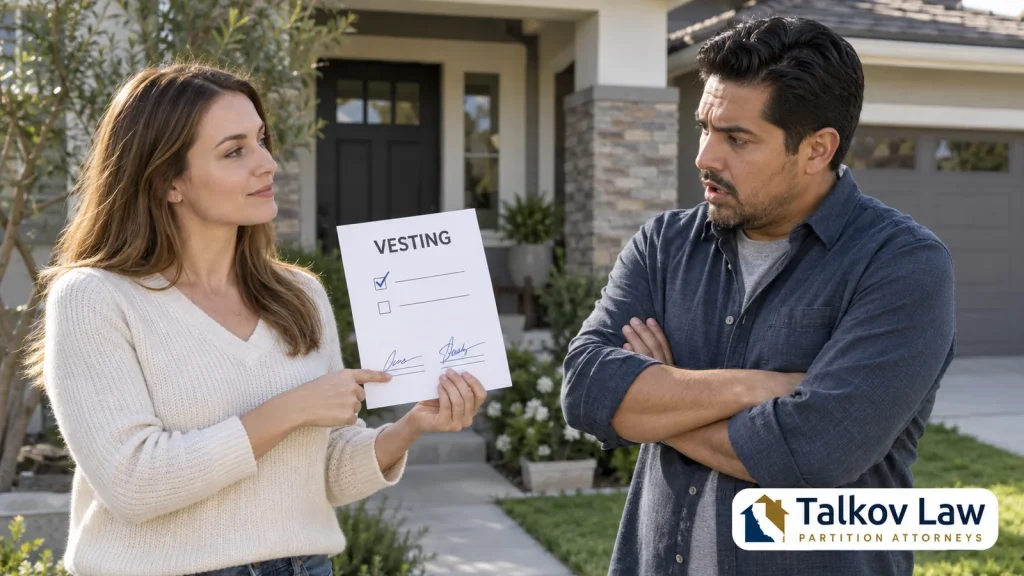
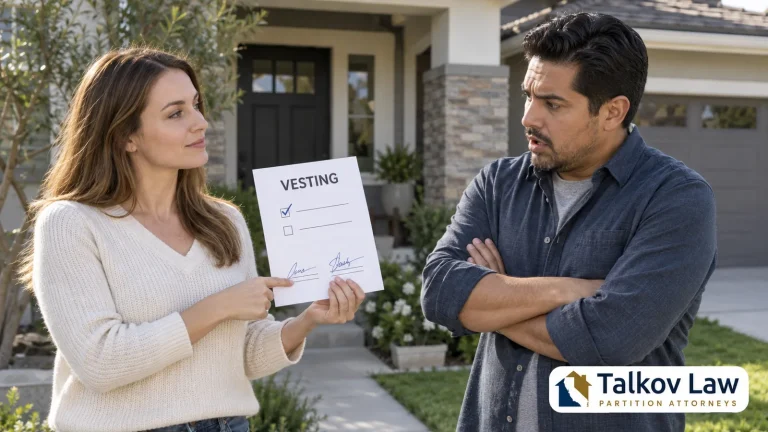
A vesting worksheet is the escrow form on which home buyers tell the escrow holder exactly how their names and their manner of holding title should appear on the deed, and it is usually the reason a deed says “as joint tenants,” “as tenants in common,” or neither. When co-owners later end up in a partition action, that signed worksheet often settles the first dispute in the case: how the property is actually owned.
Many co-owners insist they never agreed to joint tenancy or to a tenancy in common. That may be partly true, because escrow officers, real estate agents, and loan officers often fill in the form ahead of time. But each buyer still signed a written instruction telling escrow how to vest title, and escrow ordinarily will not close without every buyer’s signature.
What Is a Vesting Worksheet in a California Escrow?
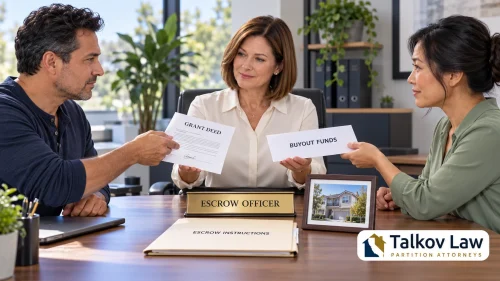
Buyers never sign the deed that puts them on title. The seller signs the grant deed, and escrow or the title company types in the buyers’ names and manner of holding title based on the buyers’ written instructions. The vesting worksheet, sometimes called vesting instructions, is where those instructions come from.
The standard California purchase agreement points buyers to this step. Versions of the California Association of Realtors residential purchase agreement provide that “Title shall vest as designated in Buyer’s supplemental escrow instructions,” followed by a capitalized warning that the manner of taking title may have significant legal and tax consequences.
A typical worksheet asks buyers to check one of the common types of co-ownership:
- As joint tenants, with equal shares and a right of survivorship
- As tenants in common, often with a blank for each buyer’s percentage or fraction
- As community property, or community property with right of survivorship, for spouses and registered domestic partners
- As a married person’s sole and separate property
- As a single, unmarried, or widowed individual
Most worksheets also warn, in bold capital letters, that how you hold title can have serious tax consequences and that buyers should get tax or legal advice before completing the form. The form then ends with a signature line for each buyer.
A Deed That Says Nothing Creates a Tenancy in Common
The manner of holding title matters because California law supplies a default. California Civil Code section 686 provides that “Every interest created in favor of several persons in their own right is an interest in common,” unless it was acquired as partnership property, declared to be a joint interest, or acquired as community property.
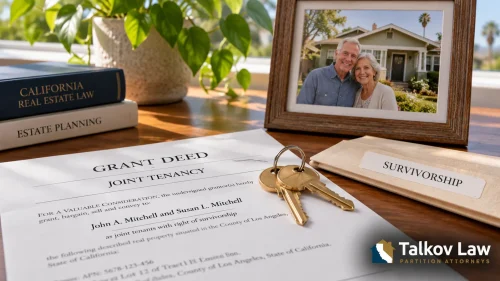
A joint tenancy, by contrast, has to be created on purpose. Under California Civil Code section 683, a joint tenancy arises from a single transfer that expressly declares it to be one, and the joint tenants own equal shares. A deed says “as joint tenants” because someone instructed escrow to write those words, and the vesting worksheet is usually that instruction. When a deed lists two buyers with nothing after their names, they hold title as tenants in common.
A deed that leaves out each owner’s percentage raises a separate question, which we cover in our post on unclear ownership interests on deeds with multiple co-owners.
“I Never Agreed to That” Rarely Undoes a Signed Vesting Worksheet
Co-owners who regret how they hold title usually say one of three things: escrow filled out the form, the other buyer filled it out, or they signed without understanding it. Any of those may be true. None of them usually changes the result.
The worksheets we review show how this happens. On one, the two buyers handwrote their names followed by “as joint tenants,” and both signed on the same day. On another, each buyer signed a separate copy two days apart, and both copies were already marked “tenants in common.” Filled in ahead of time or not, each buyer signed a written instruction to escrow.
Several rules make that signature hard to escape:
- California courts generally hold people to the documents they sign, whether or not they read them.
- Under California Evidence Code section 662, the owner of legal title is presumed to own the full beneficial title, and that presumption can be overcome only by clear and convincing proof.
- Buyers who financed the purchase usually also signed a deed of trust and loan documents naming them the same way.
- The worksheet itself told them to get tax and legal advice first.
A well-known California partition case shows how courts react. In Milian v. De Leon (1986) 181 Cal.App.3d 1185, an unmarried couple bought a house, “both parties signed escrow instructions,” and the grant deed was taken in both names as joint tenants. One co-owner testified that he did not understand the joint tenancy designation. The trial court did not credit his testimony, ordered the sale proceeds divided equally, and the Court of Appeal affirmed. We discuss the case further in our analysis of the decision.
A signed worksheet is not always the end of the matter. A quiet title action may be needed when one co-owner never signed, a signature was forged, or the recorded deed does not match the signed worksheet because of an escrow mistake. In that last situation, the escrow company may face claims of its own, as discussed in our post explaining that escrows can be negligent even while following instructions.
Joint Tenancy or Tenancy in Common Changes the Rules of a California Partition Action
Any co-owner can file for partition whether title is held in joint tenancy or tenancy in common, because the right to partition is absolute. The manner of holding title changes the rules that apply once the case is filed.
The Partition of Real Property Act Applies Only to Tenants in Common
The Partition of Real Property Act governs only some partition actions. California Code of Civil Procedure section 874.311(b) provides that the Act “applies to real property held in tenancy in common” when no agreement in a record binding all the co-owners governs partition, and section 874.311(c) limits it to actions filed on or after January 1, 2023.
Property held in joint tenancy falls outside the Act. Joint tenants do not receive the court-ordered determination of fair market value under California Code of Civil Procedure section 874.316, the cotenant buyout under California Code of Civil Procedure section 874.317, or the preference for an open-market sale under California Code of Civil Procedure section 874.320. As we explain in our post on whether a co-owner can buy you out after you file, that buyout right reaches only tenants in common.
A True Joint Tenancy Can Bar Reimbursement for an Unequal Down Payment
Tenants in common who paid unequal amounts can often prove unequal shares or recover unequal down payments through the partition offsets and accounting. Joint tenants face a harder rule.
In Milian, the court explained that “by definition joint tenancy ownership means equal ownership.” It held that once a partition court determines a true joint tenancy exists, it “may not order reimbursement or contribution on account of differences in the amounts the parties have paid toward the initial acquisition of the property,” unless the co-owners agreed to reimbursement. Whether the buyers intended a true joint tenancy is a question of fact, and the signed vesting worksheet is often the best evidence of what they intended.
Joint Tenancy Carries a Right of Survivorship Until It Is Severed
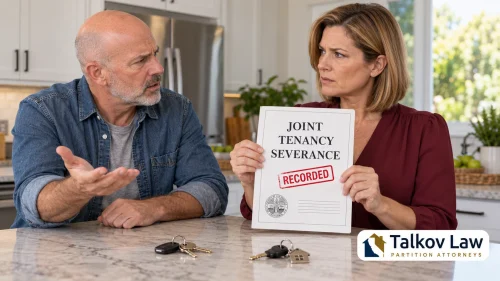
Joint tenancy includes a right of survivorship, so a joint tenant’s share passes to the surviving joint tenant at death rather than to the deceased owner’s heirs. A joint tenant can generally sever the joint tenancy without the other owner’s consent, but under California Civil Code section 683.2(c), the severing document generally must be recorded before the severing joint tenant’s death to defeat survivorship.
Other steps can sever a joint tenancy too, including putting a co-owned house into trust. Because severance turns a joint tenancy into a tenancy in common, it can also change whether the Partition of Real Property Act applies to a later partition action.
How to Find the Vesting Worksheet for Your California Property
The worksheet is rarely in the co-owner’s own files. Good places to look include:
- The escrow company’s file for the purchase, identified by the escrow number on the closing statement
- The title company’s file for the same transaction
- The lender’s loan file, which usually holds the deed of trust and vesting information
- The real estate agents’ transaction files
- The recorded grant deed, available from the county recorder, which shows the final vesting
Once a partition action is filed, these records can be obtained by subpoena if a co-owner will not cooperate. Our guide on piecing together a property’s title history explains the related recorded documents.
Let the Vesting Worksheet Frame Your Partition Action
The manner of holding title decides whether the Partition of Real Property Act applies, whether an unequal down payment can be recovered, and what happens when a co-owner dies. Co-owners who say they never agreed to joint tenancy or tenancy in common usually signed the instruction that created it. These disputes come up often among former romantic partners who bought together and among family members on title.
Talkov Law can help. With 12 full-time partition attorneys and experience in over 650 partition actions throughout California, our team handles every step of the process, from tracking down the escrow file through the referee’s sale and the final distribution of proceeds. Call (877) PARTITION (727-8484) today or contact us online to get started.