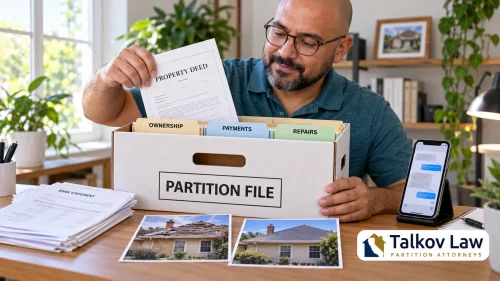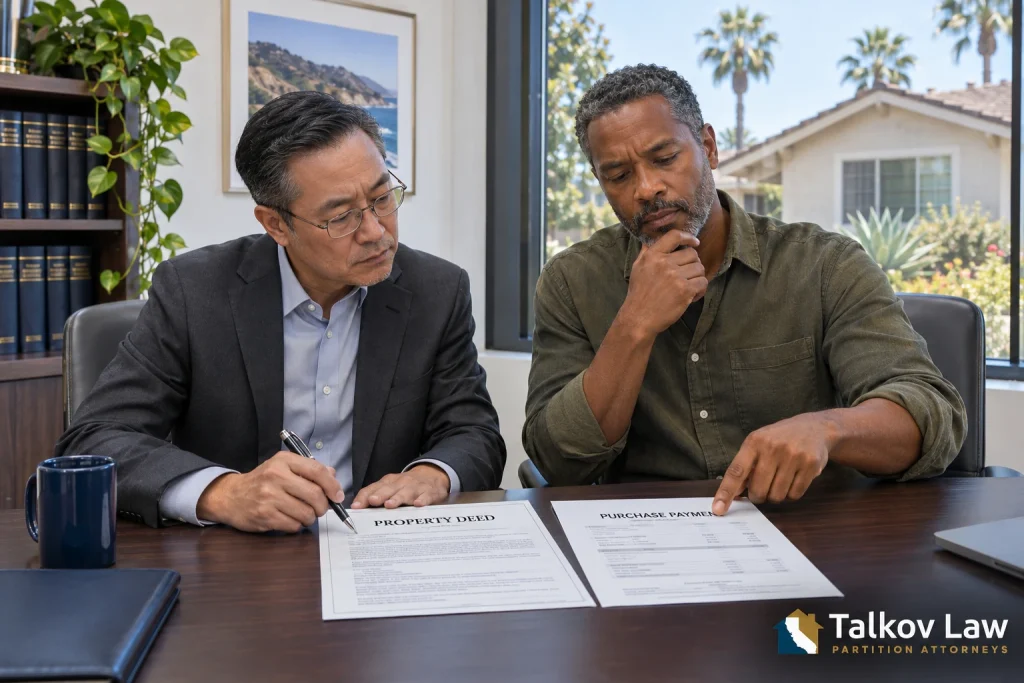
A resulting trust is how California law protects someone who paid for real estate titled in another person’s name. If you put money toward the purchase, you may own a share the deed does not show, and a partition action lets the court decide that share before the property is sold, so you receive the equity your money bought.
What Is a Resulting Trust in California?
A resulting trust is created by law, not by a written trust document. It arises when one person pays for property but title is put in someone else’s name. As the Court of Appeal put it, “Ordinarily a resulting trust arises in favor of the payor of the purchase price of the property where the purchase price, or a part thereof, is paid by one person and the title is taken in the name of another.” (Martin v. Kehl (1983) 145 Cal.App.3d 228, 238.)
The person on the deed simply holds title for the person who paid. That titleholder “has no duties to perform, no trust to administer, and no purpose to pursue except the single purpose of holding or conveying the property according to the beneficiary’s demands.” (Estate of Yool (2007) 151 Cal.App.4th 867, 874.) In other words, the deed shows legal title, but the person who paid holds the real, or beneficial, ownership.
You do not have to pay the entire price. The California Supreme Court has held that “a resulting trust may be established in a fractional interest in property where the one urging the trust pays only a portion of the purchase price.” (Watson v. Poore (1941) 18 Cal.2d 302, 317.) The rule also applies when the co-owner on title made the payment with your money and your consent. (Majewsky v. Empire Construction Co. (1970) 2 Cal.3d 478, 485.)
Resulting Trust vs. Constructive Trust
The two are often confused. A resulting trust carries out what the buyers meant to do when one paid and the other took title. A constructive trust is a remedy a court imposes to undo wrongdoing, such as fraud. The Court of Appeal summed up the difference, quoting an earlier decision: “The resulting trust carries out the inferred intent of the parties; the constructive trust defeats or prevents the wrongful act of one of them.” (Martin v. Kehl (1983) 145 Cal.App.3d 228, 238, quoting American Motorists Insurance Co. v. Cowan (1982) 127 Cal.App.3d 875, 884–885.)
That difference helps the co-owner who paid. To prove a resulting trust, you do not have to show that the person on the deed lied or cheated; you show who paid for the property.
How Do You Prove a Resulting Trust in a Partition Action?
A partition action is where co-owners’ shares get decided. Code of Civil Procedure section 872.610 provides that “The interests of the parties, plaintiff as well as defendant, may be put in issue, tried, and determined in the action.” So a co-owner can ask the court to recognize a resulting trust in the same case that ends the co-ownership, often together with a quiet title claim.
Step 1: Show That You Paid Toward the Purchase Price
The law presumes a resulting trust when “the title to the property was taken in the name of one party and the consideration for the transfer furnished by the other.” (Rowland v. Clark (1949) 91 Cal.App.2d 880, 882–883.) The trust is implied from the facts, so you need neither a written agreement with the co-owner on title nor proof of fraud. (Rowland v. Clark (1949) 91 Cal.App.2d 880, 883.)
The money must go toward the purchase itself, paid at or before the time title is taken. (Socol v. King (1950) 36 Cal.2d 342, 347–348.) Money paid later, such as mortgage payments, repairs, or property taxes, is usually handled through partition offsets instead.
Step 2: Prove the Exact Amount by Clear and Convincing Evidence
Evidence Code section 662 starts from the deed: “The owner of the legal title to property is presumed to be the owner of the full beneficial title. This presumption may be rebutted only by clear and convincing proof.” That is a higher standard than in most civil cases, as explained in our article on clear and convincing evidence.
For a resulting trust, the proof must pin down the dollars: “One who claims a resulting trust in land must establish clearly, convincingly and unambiguously, the precise amount or proportion of the consideration furnished by him.” (Laing v. Laubach (1965) 233 Cal.App.2d 511, 517.) In Lloyds Bank California v. Wells Fargo Bank (1986) 187 Cal.App.3d 1038, 1044, family members lost their claim because they could not show how much each had contributed.
Done right, the claim succeeds. In Martin v. Kehl (1983) 145 Cal.App.3d 228, 239, the plaintiff paid half the down payment while title was taken in the defendant’s name, and the court called it “a classic case of a resulting trust,” affirming the plaintiff’s one-half interest. The best evidence is usually documents, such as:
- the escrow closing statement
- bank statements, wire confirmations, and cancelled checks showing the money leaving your account
- texts or emails discussing the purchase and who would own what
Our guide on what information to gather for a partition action covers these records in more detail.
Can a Resulting Trust Be Defeated?
The presumption can be rebutted with evidence that the money was a gift or a loan. When a parent pays and title goes to a child, the law presumes a gift instead. (Lloyds Bank California v. Wells Fargo Bank (1986) 187 Cal.App.3d 1038, 1043.) Our article on down payment gifts in partition actions explains how courts sort this out. Waiting years is usually not fatal: the four-year time limit does not begin to run until the co-owner on title refuses your demand to recognize your share. (Estate of Yool (2007) 151 Cal.App.4th 867, 875.)
Example: Proving a Resulting Trust in a Partition
Maria and her brother David buy a house for $500,000 in cash. Maria pays $200,000 and David pays $300,000, but the deed names only David. If Maria proves her $200,000 payment by clear and convincing evidence, and David cannot show it was a gift or a loan, Maria owns 40% of the house ($200,000 ÷ $500,000). If the house later sells for $800,000 in the partition, her share is $320,000 (40% × $800,000), before sale costs and any offsets.
Frequently Asked Questions About Resulting Trusts
Does a resulting trust have to be in writing?
No. A resulting trust is implied from the facts, so no written agreement is required. (Rowland v. Clark (1949) 91 Cal.App.2d 880, 883.) What you need is proof of the payment itself.
Can I claim a resulting trust if my name is not on the deed?
Yes. That is the usual situation: you paid, and title was taken in someone else’s name. (Martin v. Kehl (1983) 145 Cal.App.3d 228, 238.) In a partition, Code of Civil Procedure section 872.610 lets the court decide your interest along with everyone else’s.
What if I paid the mortgage after we bought the house?
A resulting trust looks at money paid toward the purchase, at or before the time title is taken. (Socol v. King (1950) 36 Cal.2d 342, 347–348.) Later mortgage payments, repairs, and taxes are usually credited to you through partition offsets when the sale money is divided.
If you paid toward a home that is titled in someone else’s name, or in a share smaller than what you paid, a resulting trust can put your ownership on the record before the property is sold.
Talkov Law can help. With 12 full-time partition attorneys and experience in over 650 partition actions throughout California, our team proves each co-owner’s share and takes the case through the sale and the final division of proceeds. Call (877) PARTITION (727-8484) today or contact us online to get started.