Constructive Trust in California for Real Estate Co-Ownership
What is a Constructive Trust in California Real Estate?
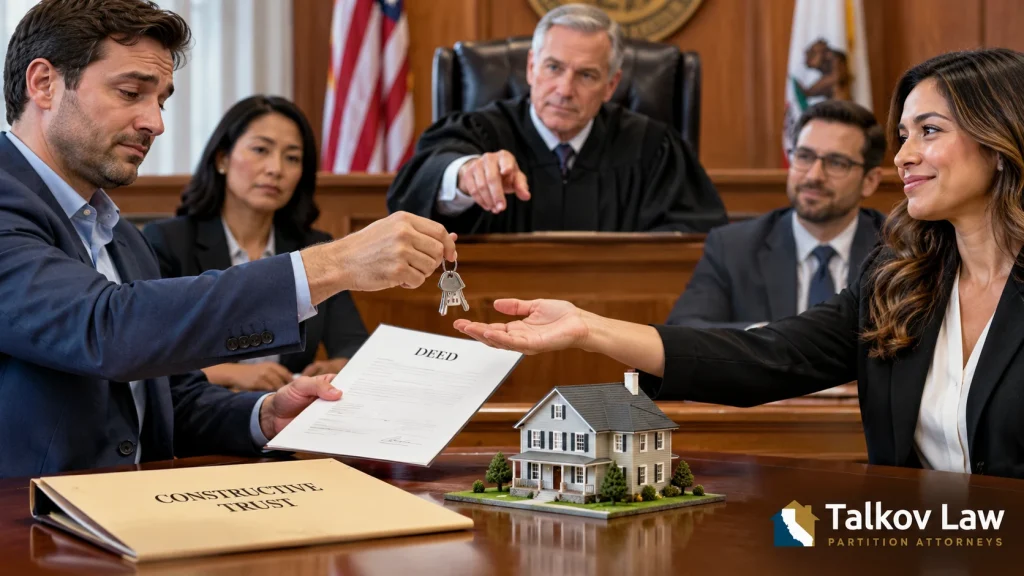
A constructive trust is a remedy used by a court to compel a person who has property they are not justly entitled to to transfer it to the intended beneficiary as determined by the court.
How can I get a Constructive Trust?
California law provides that a constructive trust is created where a defendant takes a property by fraud, accident, mistake, undue influence, the violation of a trust or other wrongful act. California Civil Code §§ 2223, 2224. By court order, a constructive trust imposes trustee status on the defendant. This means that they can hold the property but they can’t benefit from it.
A court creates a fictional or “constructive” trust by recognizing that legal title is held by one person (the wrongdoer) but demands the wrongdoer hold that title as a trustee of a trust created for the beneficiary–the rightful owner. The title-holder’s only duty is to give the property to the rightful owner. This can happen if a trustee is stealing from a family trust.
The following must be shown for the court to impose a constructive trust: “(1) the existence of a res (property or some interest in property)’ (2) the right of a complaining party to that res; and (3) some wrongful acquisition or detention of the res by another party who is not entitled to it.” Communist Party v Valencia, Inc. (1995) 35 CA4th 980, 990.
Importantly, if no res exists, then there is nothing over which the complaining party can obtain a constructive trust.
Constructive Trust Example – Real Estate Co-Ownership
Sarah withdrew $10,000 from her bank account to buy a house. Sarah put the money in an envelope in her room. Sarah’s boyfriend, Jim, finds the money and uses it to buy the house in his name with a $20,000 down payment. Jim has wrongfully taken and used money that belongs to Sarah. Jim no longer has the $10,000. However, Sarah can show the court that she withdrew the money from her account and that Jim took it and bought half of the house. Through a method called “tracing” the court can find that Jim has title to the house but must give one-half of the house to Sarah even though the $10,000 that was Sarah’s is no longer in cash form.
Contact a Real Estate Constructive Trust Attorney in California Today!
Contact our real estate co-ownership attorneys today for a free consultation at (877) PARTITION (727-8484) or contact us online.