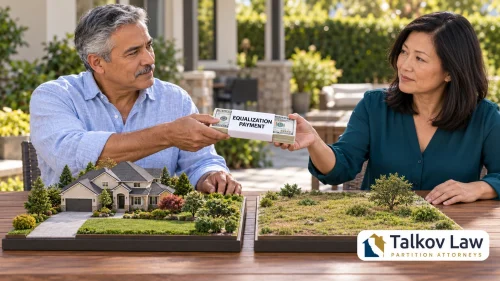
A property can be large enough to divide on a map but still be unsuitable for a fair physical division. In Sting v. Beckham (1949) 94 Cal.App.2d 823, 824–825, the Court of Appeal upheld a partition by sale of approximately 60 acres near Banning because the property’s value depended heavily on a single water well. Giving the well to one co-owner would have seriously disadvantaged the other. The decision illustrates why partition by sale versus partition in kind turns on the property’s actual use and value, not simply its acreage.
Why Sting v. Beckham Matters
A co-owner who wants to keep land may propose splitting it instead of selling it. But two parcels with the same number of acres do not necessarily represent equal shares of the property’s value. If one parcel receives the feature that makes the property valuable, a seemingly equal division can leave the other owner with much less.
Sting provides a concrete example of evidence supporting a partition by sale. The court examined how the well and the remaining land functioned together and upheld the sale despite conflicting evidence. The case did not establish that every property with a well must be sold. Its lesson is that the evidence must explain why a proposed physical division would be unfair.
The Facts: Two Co-Owners, 60 Acres, and One Well
Emily J. Sting and Mary Beckham jointly owned approximately 60 acres of largely unimproved land near Banning. Sting held an undivided one-half interest in the land and the well. A pump, shed, and roughly 1,600 feet of water pipeline connected the well to a rock plant on adjacent land owned separately by Beckham. The plant had used the well’s water for years and required all the water the well produced. (Sting, at pp. 823–824.)
Sting sued for partition, requesting physical division or, if division could not occur without material injury, a sale and division of the proceeds. She also requested an accounting for water used by Beckham. Her claim to an ownership interest in the pump, pipelines, machinery, and equipment was rejected. The trial court nevertheless found her entitled to partition of the real property and ordered a sale through a partition referee. (Sting, at p. 824.)
Beckham appealed. The question was whether sufficient evidence supported selling the property rather than dividing it physically. The published appellate decision addressed that question, rather than deciding an award for the water Beckham had used.
Why the Court Upheld a Sale Instead of Physical Division
The evidence allowed the trial court to find that the land had little value without the well and its water. The well’s value could be found to greatly exceed that of the remaining land. Allocating the well to one owner would therefore leave the other with a substantially inferior portion. (Sting, at pp. 824–825.)
The court described the well property as “so indivisibly linked with the balance of the property, both physically and with respect to value” that separating it would cause great detriment. (Sting, at p. 825.) Either owner would understandably want the parcel containing the well. Drawing a boundary through the acreage would not solve that problem.
The Court of Appeal also explained that the character and location of the property can themselves supply evidence supporting a sale. Although the evidence conflicted, it was sufficient to support the trial court’s finding. The appellate court affirmed the judgment rather than substituting its own factual assessment. (Sting, at p. 825.)
How Later California Law Uses Sting
Sting applied the partition statutes in effect in 1949, which required proof that physical division would cause great prejudice to the owners. California revised its general partition statutes in 1976. Under Code of Civil Procedure section 872.820, a sale is required when the parties agree or when the court determines that sale and division of the proceeds would be more equitable than physical division.
The Court of Appeal later cited Sting as an example of evidence justifying sale under the revised law. In Butte Creek Island Ranch v. Crim (1982) 136 Cal.App.3d 360, 366, the court explained that Sting involved land whose major value rested in the well, making an award of the well parcel to one owner unfair to the other. The continuing point is the need for evidence showing why the property cannot be divided fairly.
Cases governed by the Partition of Real Property Act require a separate statutory analysis. Following the applicable buyout process, section 874.318 generally requires physical division unless it would cause great prejudice to the co-owners as a group. Section 874.319 requires consideration of practical divisibility, value, ownership history, sentimental attachment, lawful use, contributions, and other relevant circumstances. No single factor controls without weighing the others. Sting remains a useful illustration, but it does not replace those requirements.
What Evidence Helps Show That the Property Should Be Sold?
For a co-owner seeking a sale, Sting shows why it helps to explain the property in concrete terms. A useful presentation should address where the property’s value comes from and what each owner would actually receive after division. Depending on the property, relevant materials may include:
- A map showing important features. Identify the location of wells, buildings, access roads, and other features that affect use and value.
- Valuation evidence. Compare the proposed parcels and explain whether one owner would receive materially less than their ownership share warrants.
- Evidence of how the property functions. Explain whether separating a key feature from the remaining land would impair its usefulness.
- An assessment of a workable division. Address whether access arrangements, a different boundary, or an equalizing payment could make division fair, rather than assuming that any difference in value requires a sale.
These are practical ways to develop the evidence, not a checklist imposed by Sting. The strongest argument connects the property’s actual characteristics to the governing legal standard. Acreage alone does not answer whether partition in kind is workable.
Resolve a Dispute Over Selling or Dividing Co-Owned Property
If your co-owner insists that the property can simply be split, the next step is to examine whether that proposal gives each owner a fair share of its value and complies with the applicable partition law. A partition action allows the court to resolve that dispute and determine the appropriate method of ending the co-ownership.
Talkov Law handles California partition actions. Our attorneys can evaluate a proposed physical division, develop the evidence supporting a sale, and guide you through the referee’s sale and distribution of proceeds when a sale is ordered. Call (877) PARTITION (727-8484) or contact us online to discuss your co-owned property.